
Understanding Workers' Compensation Benefits for Atlanta Airline Workers
Learn how Georgia's workers' compensation system protects Atlanta airline workers, from ramp agents to pilots, and how to navigate claims.

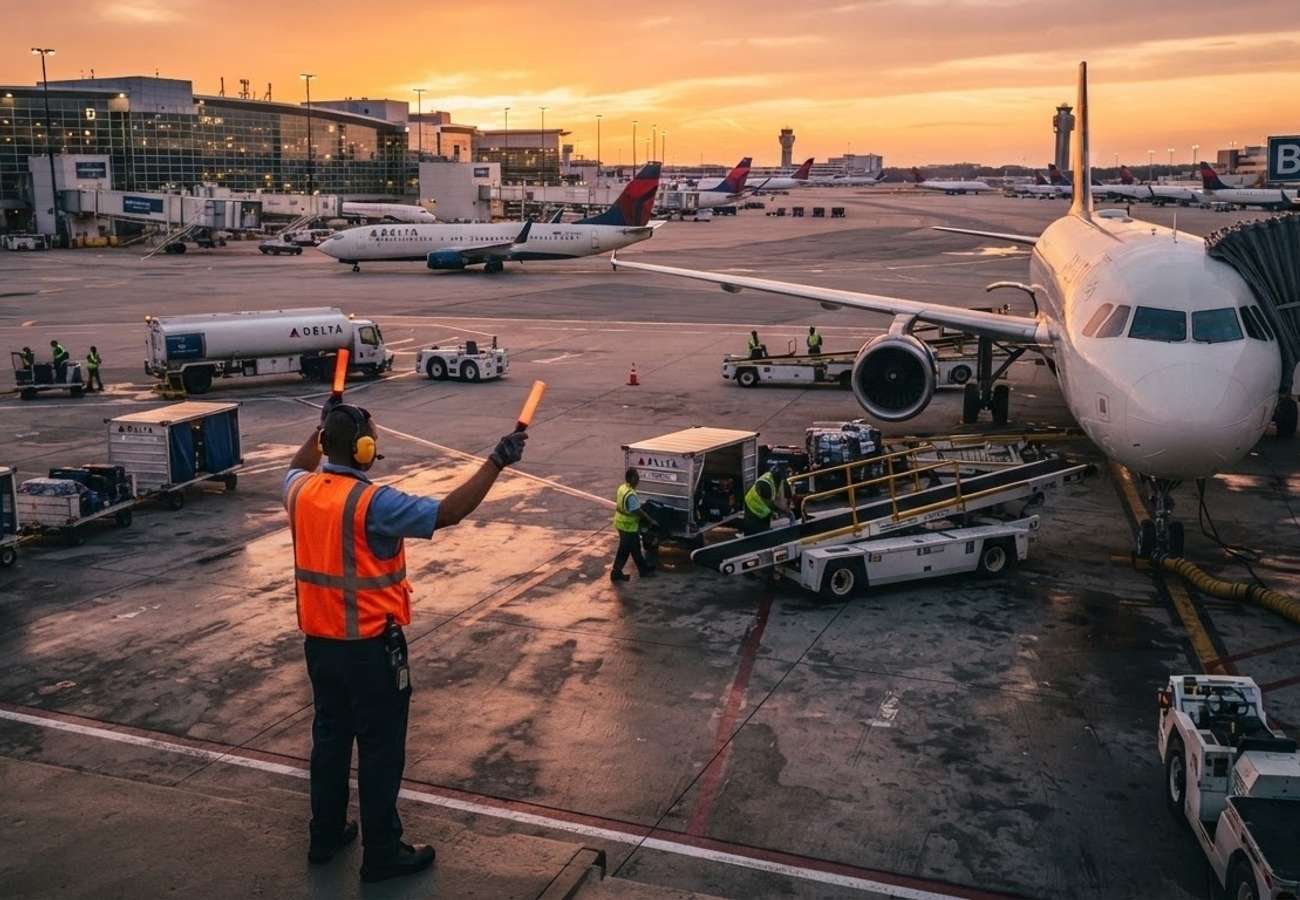
Image generated by AI
The airline industry consistently ranks among the most physically demanding work environments in the transportation sector. According to the Bureau of Labor Statistics' 2022 occupational injury data, air transportation workers experience nonfatal injury and illness rates that significantly exceed many other transportation subsectors — a reality that makes robust workers' compensation protections not just beneficial, but essential. As Atlanta's Hartsfield-Jackson continues to operate as the world's busiest passenger airport, the sheer volume of workers moving cargo, servicing aircraft, directing passengers, and maintaining flight schedules creates an environment where the stakes around workplace injury are unusually high.
For airline employees in Atlanta and across Georgia, workers' compensation isn't a background administrative detail — it's the primary financial and medical safety net when something goes wrong on the job. Yet many workers don't fully understand how the system operates for their specific roles, or why their claims can look very different from those filed by workers in other industries. That disconnect between expectation and reality can cost injured workers time, money, and access to care they legitimately need.
This piece works through the full picture: what makes airline workers' comp distinct, how claims actually move through the system, what factors shape compensation outcomes, and how legal and regulatory complexity can complicate even straightforward injuries.
Why Workers' Compensation Matters for Airline Employees
Airline work encompasses an unusually wide range of physical risk profiles under one industry umbrella. A ramp agent loading baggage in summer heat faces orthopedic and heat-related hazards. A flight attendant managing turbulence injuries at 35,000 feet faces a completely different risk environment. Airline mechanics working with hydraulic systems, fuel lines, and heavy equipment operate in a hazardous environment that has more in common with industrial manufacturing than with most service jobs. This diversity of risk is exactly why generic workers' compensation frameworks often fail to fully address what airline employees actually need.
Georgia's workers' compensation system requires most employers with three or more employees to carry coverage, and airline carriers operating in Atlanta are no exception. But coverage requirements are just the baseline. What matters practically is whether injured workers understand their rights under those policies — and whether those policies account for the specific nature of airline hazards.
Consider a ground crew member at Hartsfield-Jackson who slips while marshaling aircraft on a rain-slicked tarmac and tears a rotator cuff. The injury itself is clear-cut. But the path to compensation involves correctly identifying the employer of record (especially relevant for contracted ground handling companies), meeting Georgia's reporting deadlines, and documenting an injury that occurred in a noisy, fast-moving environment where no one may have witnessed the exact moment of the fall. Without understanding what the process requires, workers can inadvertently undermine claims they should legitimately receive.
The physical demands of airline work don't scale down with seniority or experience. A veteran baggage handler carries the same physical load as a new hire. That sustained physical exposure is part of why workers' comp for airline employees isn't just about acute accidents — it also covers cumulative trauma and occupational illness, categories that matter enormously in this industry.
How Airline Worker Injury Claims Are Processed
Filing a workers' compensation claim in the airline industry follows Georgia's general procedural framework, but with several layers of complexity that workers in other sectors don't face. The process begins at the moment of injury, and the decisions made in the first 24 to 72 hours can significantly shape the outcome of the entire claim.
Injury Reporting and Documentation Requirements
Georgia law requires injured workers to notify their employer of a workplace injury within 30 days, but in practice, reporting immediately — ideally the same day — protects the claim far more effectively. For airline workers, this means notifying a direct supervisor or the designated safety officer, even when an injury feels minor at first. Delayed-onset conditions like back injuries or repetitive strain are common in airline roles and often seem manageable in the moment.
Documentation carries particular weight in airline injury claims. Workers should record the time, location, and conditions surrounding the injury, identify any coworkers present, and seek medical evaluation promptly. For airline work accidents involving multiple parties — such as third-party ground handlers or contractors, which are common at major hub airports — the chain of employment documentation becomes especially important in determining which insurer bears responsibility. Attorneys who handle airline work accidents routinely point to inadequate initial documentation as the most common reason legitimate claims face delays or denials.
How Airline Claims Differ from Non-Airline Workers
The most significant procedural distinction involves employer structure. Many airline workers aren't employed directly by the carrier whose aircraft they service — they work for subcontractors handling ground operations, catering, fueling, or maintenance. This creates genuine ambiguity about which employer's workers' comp policy applies, and in some cases, airlines and subcontractors dispute liability between themselves while the injured worker waits.
Federal preemption adds another layer. Certain aspects of airline employment fall under federal jurisdiction through the Airline Deregulation Act and related statutes, which can affect how and where some claims are pursued. Flight crew members in particular may encounter questions about whether state workers' comp laws or federal maritime-adjacent doctrines apply. Non-airline workers filing claims in Georgia typically navigate a single employer relationship and a state system — airline workers often face a more tangled legal landscape from the outset.
Common Injuries and Factors Affecting Compensation for Airline Workers
The injury patterns across airline roles are distinct enough that compensation outcomes vary meaningfully depending on where a worker sits within the operation. Baggage handlers and ramp agents account for a disproportionate share of musculoskeletal injuries — back strains, shoulder tears, and knee damage from repeated heavy lifting and awkward movement on the tarmac. Flight attendants face a different cluster of risks: turbulence-related falls, slip-and-fall injuries in galleys, and cumulative fatigue-related conditions. Maintenance technicians carry elevated exposure to chemical hazards, noise-induced hearing loss, and injuries from working in confined spaces around heavy machinery.
Compensation in Georgia's workers' comp system covers medical treatment, temporary total disability (TTD) benefits when a worker cannot return to work, temporary partial disability when they can work in a limited capacity, and permanent disability ratings when injuries result in lasting impairment. The calculation of TTD benefits — set at two-thirds of the worker's average weekly wage under Georgia law — sounds straightforward, but for airline workers with irregular schedules, overtime-heavy pay structures, or multiple income streams, establishing an accurate baseline wage becomes genuinely contested.
The nature and permanence of the injury also influences whether a claim settles or proceeds to a hearing. Soft tissue injuries with full recovery typically resolve more quickly. Permanent conditions affecting a worker's ability to return to their specific role — a ramp agent with a permanent shoulder impairment, for instance — involve considerably more complex negotiations around future medical care, retraining, and long-term disability benefits.
Legal and Regulatory Challenges in Airline Worker Injury Compensation
Building on the jurisdictional complications introduced earlier, the legal landscape for airline workers extends well beyond standard state claims processes. Two distinct challenges consistently emerge: union involvement in shaping and enforcing compensation rights, and the regulatory complexity created by overlapping state and federal authority.
The Role of Unions and Dispute Resolution
Many airline workers — particularly those employed by major carriers — belong to unions that have negotiated collective bargaining agreements (CBAs) directly affecting injury benefits. The International Association of Machinists and Aerospace Workers and the Association of Flight Attendants, among others, have secured provisions in CBAs that can supplement or interact with state workers' comp entitlements. Understanding how CBA provisions layer onto Georgia's statutory benefits is essential, because in some cases union-negotiated benefits exceed the state baseline, while in others, accepting one form of benefit may affect eligibility for another.
Dispute resolution in unionized workplaces often involves grievance procedures that run parallel to the formal workers' comp adjudication process. An injured worker might be navigating both a union grievance over a denied claim and a Georgia State Board of Workers' Compensation hearing simultaneously — two separate processes with different standards, timelines, and outcomes.
Jurisdictional Complexities and Compliance Issues
Georgia's workers' comp system governs most claims for Atlanta-based airline employees, but the picture shifts when injuries occur outside the state. An Atlanta-based flight attendant injured during a layover in another state, or a pilot injured during an international operation, may face genuine questions about which jurisdiction's law applies. Georgia courts generally apply Georgia law when the employment relationship is centered here, but multi-state injuries create disputes that take time and legal expertise to resolve.
Federal aviation safety regulations also impose independent obligations on carriers around injury reporting and hazard remediation that operate separately from workers' comp. Airlines must comply with FAA safety directives while simultaneously managing OSHA requirements and state compensation obligations — compliance failures in any of these areas can complicate injured workers' claims or create additional avenues for recovery.
How Workers' Compensation Impacts Well-being and Airline Safety Standards
The connection between adequate compensation and worker recovery outcomes is well-documented in occupational health literature. Workers who receive timely, appropriate benefits return to work faster, experience fewer complications from delayed treatment, and report better long-term health outcomes than those whose claims are disputed or delayed. In an industry where physical capability is directly tied to job function — a baggage handler cannot perform their role with an unaddressed back injury — the stakes of getting compensation right extend beyond individual welfare.
There's also a systemic safety dimension that doesn't get enough attention. Airlines that handle injury claims poorly face an indirect incentive problem: workers who fear claim denial may underreport injuries, which removes the data that safety programs depend on to identify hazard patterns. When ramp operations at a major hub see repeated shoulder injuries among baggage handlers, that cluster is the signal that triggers ergonomic assessments, equipment upgrades, or revised loading procedures. Suppress the reporting, and the safety improvement never happens.
The mental health dimension of workplace injury is increasingly recognized in occupational health research. Injured workers who face protracted claims disputes, financial pressure during recovery, and uncertainty about their employment status show significantly higher rates of anxiety and depression — which themselves complicate physical recovery. Return-to-work programs that pair medical care with income continuity and role accommodation don't just help the individual worker; they reduce the total cost of claims and maintain workforce stability for the carrier. The quality of workers' compensation administration, in other words, is ultimately inseparable from the quality of airline operations themselves.
Related Travel Guides
Legal Translation vs Certified Translation: What's the Difference?
10 Best Travel Tips for Riyadh Airport, According to Reddit
Common Injuries for Baggage Handlers: Compensation Guide 2026
Disclaimer
This article is for informational and educational purposes only. It does not constitute legal, financial, or professional advice. While we strive to provide accurate and up-to-date information, travel policies, regulations, and conditions change rapidly. Always verify information with official sources before making travel decisions. Nomad Lawyer makes no representations about the accuracy, reliability, completeness, or suitability of the information provided. Readers should consult qualified professionals for advice specific to their circumstances. The views expressed in this article are those of the author and do not necessarily reflect the views of Nomad Lawyer.
Raushan Kumar
Founder & Lead Developer
Full-stack developer with 11+ years of experience and a passionate traveller. Raushan built Nomad Lawyer from the ground up with a vision to create the best travel and law experience on the web.
Learn more about our team →