
Aviation Updates: UK Regulators Crack Down on Lithium Batteries to Prevent Catastrophic Summer Travel Chaos
As inflight fire incidents double, the UK Civil Aviation Authority enforces strict new battery rules to prevent deadly cargo fires and massive airport disruptions.

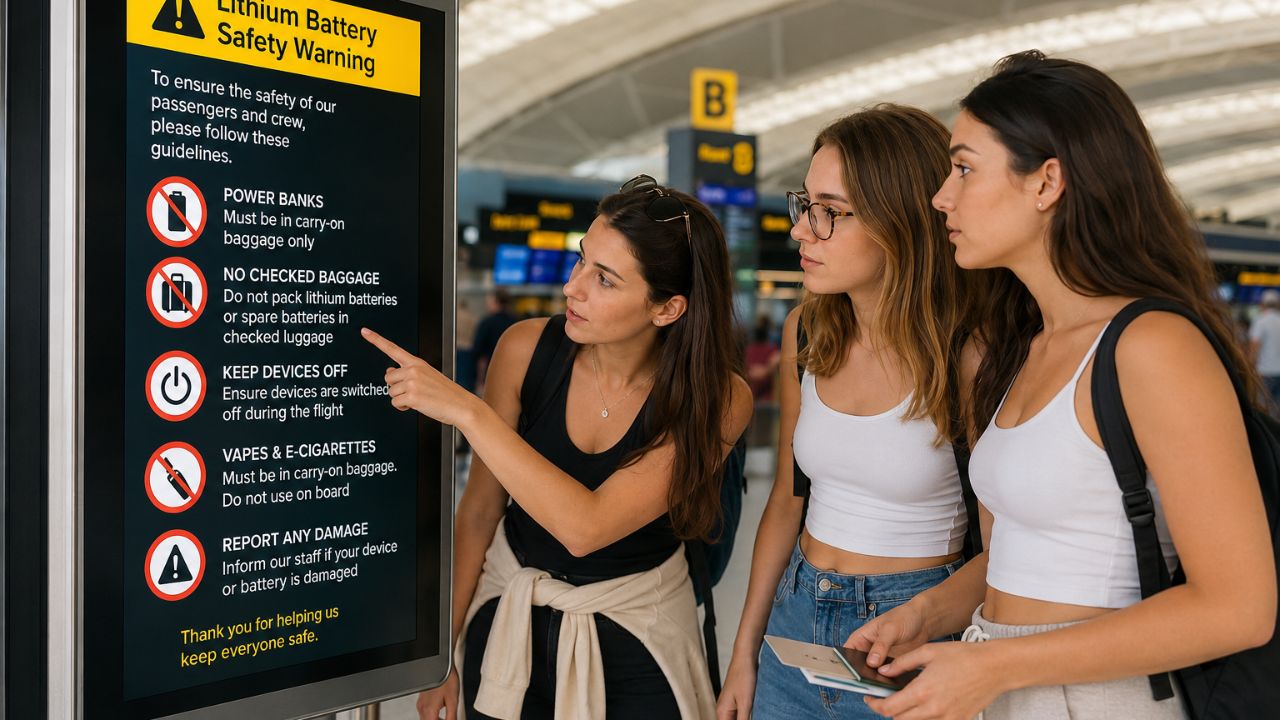
Image generated by AI
Aviation Updates: UK Regulators Crack Down on Lithium Batteries to Prevent Catastrophic Summer Travel Chaos
As a massive surge in dangerous inflight lithium battery fires threatens to trigger catastrophic emergency diversions across Europe, UK aviation regulators have launched an urgent, highly aggressive crackdown on passenger electronics to prevent massive travel chaos during the peak summer season.
Image generated by AI
As urgent airline news platforms and highly critical aviation updates continuously document the fragile nature of global aviation safety, a terrifying internal threat has forced UK regulators into immediate action. The UK Civil Aviation Authority (CAA) has issued a massive, highly aggressive safety warning regarding the exponential rise of lithium battery-related incidents across commercial flights. With modern passengers carrying multiple high-density electronic devices—including power banks, vapes, laptops, tablets, and spare batteries—the risk of sudden overheating and catastrophic inflight fires has reached a critical threshold. To prevent deadly emergencies that would instantly trigger severe airport disruptions and cascading flight cancellations, regulators are ruthlessly enforcing strict hand-luggage mandates. As the peak summer travel season pushes airline networks to their absolute operational breaking point, this crackdown on passenger packing behavior is the industry's primary defense against unmitigated travel chaos.
Expanded Overview: The Thermal Runaway Threat
When analyzing the massive operational forces driving aviation safety protocols, the sheer volatility of modern lithium-ion batteries is terrifying.
Aviation regulators explicitly report that incidents involving smoking, overheating, and completely malfunctioning lithium batteries on aircraft have nearly doubled between 2024 and 2025. Even more alarming, the incorrect packing of these highly combustible items into checked baggage has surged by more than 90 percent during the exact same period. When a damaged or short-circuited lithium battery is exposed to heat, it enters a violent chemical chain reaction known as thermal runaway. This reaction causes the device to rapidly overheat, violently vent highly flammable toxic gases, and spontaneously ignite. On a fully loaded wide-body aircraft carrying thousands of individual passenger devices, a single thermal runaway event can quickly escalate into a catastrophic inferno if not immediately contained by trained crew members.
Section-Wise Breakdown: The Cargo Hold Vulnerability
The absolute core of the CAA's aggressive crackdown is entirely focused on the terrifying vulnerability of aircraft cargo holds.
Aviation authorities mandate that highly combustible items like power banks and vapes must remain in the passenger cabin for one explicit reason: rapid detection. If a lithium battery fire ignites in the cabin, highly trained flight attendants can immediately deploy specialized fire suppression equipment to contain the blaze before it melts through the fuselage. Conversely, if a passenger illegally packs a loose power bank into their checked suitcase, a fire starting deep inside the inaccessible cargo hold becomes a catastrophic survival scenario. While modern cargo holds feature smoke detection and fire suppression systems, their containment options are severely limited against self-oxidizing lithium fires.
Section-Wise Breakdown: The Strict Packing Mandates
To neutralize this lethal threat, the UK aviation sector is ruthlessly enforcing strict new packing rules for all departing passengers.
Power banks, vapes, and loose spare batteries are now strictly prohibited in checked luggage; they must be carried exclusively in cabin baggage, with all terminals properly insulated to prevent accidental short-circuiting against metal objects. Furthermore, aviation authorities strongly warn passengers never to charge power banks during the flight, as the generated heat massively increases the risk of ignition. If passengers choose to pack large devices like laptops and tablets into their checked suitcases, those items must be completely and entirely powered off. Leaving a packed laptop in sleep or standby mode risks accidental activation, severe overheating, and subsequent thermal runaway deep inside the cargo hold.
Aviation Details: UK Lithium Battery Safety Matrix
The exact operational telemetry outlining this highly critical safety crackdown, detailing the alarming incident statistics and the strict regulatory packing mandates, has been consolidated into the mandatory matrix below.
UK Aviation Lithium Battery Safety Matrix (2026)
| Safety Metric | Regulatory Guideline |
|---|---|
| Regulatory Authority | UK Civil Aviation Authority (CAA) |
| Primary Hazard | Lithium-ion thermal runaway / Inflight fire risk |
| Incident Growth | Cases doubled (2024–2025); >90% surge in checked baggage errors |
| Power Banks & Vapes | Strictly prohibited in checked luggage; must remain in cabin |
| Laptops & Tablets (Checked) | Must be completely powered off (No sleep/standby mode) |
Passenger Impact: Confiscations and Emergency Diversions
For the international traveler, ignorance of these critical safety mandates will result in immediate logistical nightmares at the security checkpoint.
As airports prepare for massive summer passenger volumes, security screeners are aggressively hunting for illegally packed batteries. Passengers who attempt to check power banks or loose batteries will face immediate baggage confiscation, leading to severe terminal delays and massive airport disruptions. More terrifyingly, if an illegally packed battery successfully makes it onboard and triggers a thermal runaway event mid-flight, the flight crew will be forced to execute a terrifying emergency diversion. A single mid-air fire can instantly ground an aircraft, stranding hundreds of passengers, destroying carefully planned itineraries, and triggering massive financial losses across the European network.
Industry Analysis: A Unified Front for Peak Summer
Aviation economists explicitly highlight that this crackdown is not isolated to government regulators; the entire UK aviation industry is mobilizing to protect the fragile summer schedule.
Major airline stakeholders, including prominent international carriers like Virgin Atlantic and industry bodies such as Airlines UK, have aggressively thrown their support behind the CAA’s dedicated safety initiative. By flooding terminal screens and pre-flight communications with urgent battery packing instructions, airlines are desperately trying to modify passenger behavior before travelers reach the baggage drop. With global load factors surging to record highs, the industry understands that preventing a single onboard fire is significantly cheaper and infinitely safer than managing the catastrophic fallout of a downed aircraft.
Conclusion: Prevention is the Only Defense
Ultimately, the urgent lithium battery safety warning issued by the UK Civil Aviation Authority is a desperate, highly necessary maneuver to protect the integrity of the European aviation network. The staggering 90 percent surge in checked baggage packing errors proves that millions of passengers remain dangerously uneducated regarding the lethal reality of thermal runaway. By ruthlessly enforcing the cabin-only rule for power banks and vapes, airlines are actively ensuring that catastrophic fires can be suppressed before they destroy an aircraft. As record-breaking crowds descend upon UK airports this summer, strict passenger compliance is the absolute final line of defense separating a routine holiday flight from a terrifying emergency diversion and unmitigated travel chaos.
Key Takeaways
- Massive Incident Surge: The UK Civil Aviation Authority reports that dangerous lithium battery-related incidents on aircraft have nearly doubled between 2024 and 2025.
- The Checked Baggage Threat: Incorrectly packing lithium batteries into checked luggage has spiked by over 90 percent, creating a catastrophic fire risk in inaccessible cargo holds.
- Strict Cabin Mandates: Power banks, vapes, and loose spare batteries are absolutely prohibited in checked bags and must be carried exclusively in hand luggage for rapid fire detection.
- Device Power-Down Rules: Any laptops or tablets placed in checked suitcases must be completely powered off, not left in sleep or standby mode, to prevent accidental overheating.
- Industry-Wide Crackdown: Supported by major carriers like Virgin Atlantic, the safety campaign aims to prevent mid-air fires and emergency diversions that would trigger massive summer travel chaos.
FAQ: UK Lithium Battery Flight Rules 2026
Why are power banks and vapes banned from checked baggage? Lithium batteries can violently overheat and catch fire (thermal runaway). If a fire starts in a checked suitcase inside the inaccessible cargo hold, it is incredibly difficult for the crew to suppress, making it a lethal threat to the aircraft.
How much have lithium battery incidents increased on UK flights? According to the UK CAA, overall battery incidents have doubled between 2024 and 2025, with a highly alarming 90 percent surge in passengers illegally placing batteries into checked luggage.
Can I pack my laptop in my checked suitcase? Yes, but only if the laptop is completely powered off. Leaving the device in sleep or standby mode risks accidental activation, causing the device to overheat inside the suitcase and potentially trigger a fire.
Related Travel Guides
Japan Airlines JAL Sky Museum Haneda Morning Slot Travel Chaos 2026
Singapore Airlines Stock Rally World Cup Travel Chaos 2026
Europe Regional Flight Disruption Survival Guide 2026
Disclaimer: This article is strictly for informational and aviation safety purposes. The incident statistics (including the doubling of battery events between 2024 and 2025), specific safety regulations, and electronic device packing mandates are based on official advisories issued by the UK Civil Aviation Authority and supporting entities (such as Virgin Atlantic and Airlines UK) available at the time of publication. Aviation security rules regarding the transport of hazardous materials, including lithium-ion power banks, vapes, and high-capacity laptops, are highly dynamic and subject to immediate, unannounced modification. Passengers must explicitly verify exact battery capacity limits (Wh ratings), specific airline packing policies, and current airport security mandates directly with their operating carrier and relevant aviation authority prior to arriving at the airport.
Disclaimer
This article is for informational and educational purposes only. It does not constitute legal, financial, or professional advice. While we strive to provide accurate and up-to-date information, travel policies, regulations, and conditions change rapidly. Always verify information with official sources before making travel decisions. Nomad Lawyer makes no representations about the accuracy, reliability, completeness, or suitability of the information provided. Readers should consult qualified professionals for advice specific to their circumstances. The views expressed in this article are those of the author and do not necessarily reflect the views of Nomad Lawyer.
Raushan Kumar
Founder & Lead Developer
Full-stack developer with 11+ years of experience and a passionate traveller. Raushan built Nomad Lawyer from the ground up with a vision to create the best travel and law experience on the web.
Learn more about our team →