
Travel Disrupted at Vancouver International Airport as Passengers Flying to Toronto, Montréal, Castlegar, Kelowna, Calgary and Several other Destinations Face Over a Dozen Flight Cancellations and Numerous Delays, Impacting Lufthansa, Jazz, Air Canada, Pacific Coastal Airlines and others, New Update
Vancouver International Airport faces major disruption with 111 delays and 18 cancellations affecting Air Canada, Luftha

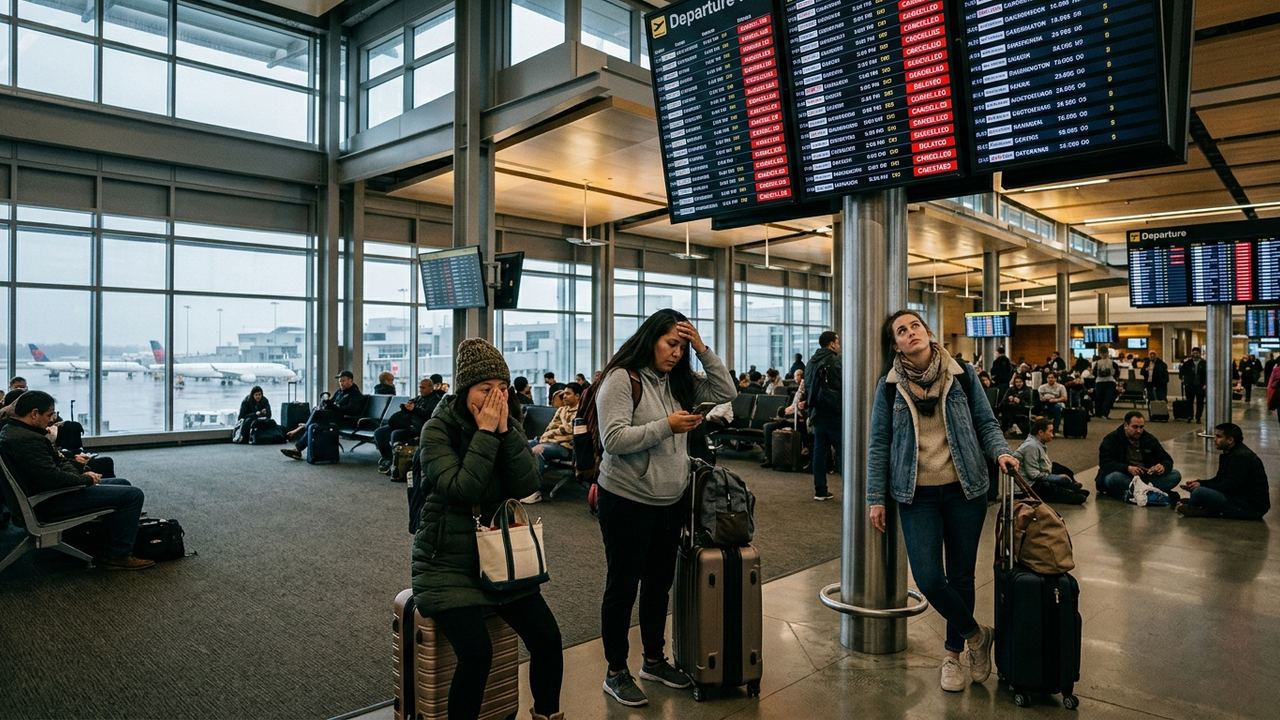
Image generated by AI
[Vancouver, June 27, 2026] — Air travel across Western Canada faced significant turbulence on June 26, 2026, as Vancouver International Airport dealt with a surge of 18 flight cancellations and 111 delays in a single 24-hour period. The operational breakdown impacted a diverse array of carriers, including Air Canada, Lufthansa, and Pacific Coastal Airlines, leaving thousands of passengers stranded or delayed on routes to major hubs like Toronto, Montréal, and Frankfurt.
The disruption event created a systemic bottleneck at one of Canada's most critical aviation gateways, affecting both domestic regional hops and long-haul international corridors. Flight tracking data indicates that the instability was not confined to a single airline but was a widespread operational failure that rippled through connecting networks.
Operational Gridlock at Vancouver International Airport
Vancouver International Airport serves as the primary link between North American domestic traffic and transpacific or transatlantic flights. On the day of the disruption, the airport experienced a severe schedule imbalance. With 111 recorded delays and 18 total cancellations, the facility struggled with gate availability and aircraft turnaround times.
The scale of the disruption suggests a broad operational failure rather than isolated mechanical issues. This congestion heavily impacted passengers attempting to reach regional destinations such as Castlegar and Kelowna, which rely on Vancouver as a feeder hub. Because these smaller airports depend on the stability of the main gateway, the delays in Vancouver triggered a domino effect across the British Columbia interior.
Analysis of Affected Flight Paths
The instability touched a wide variety of destinations, ranging from short-haul provincial routes to intercontinental journeys.
Flights specifically cancelled included services to:
- Domestic: Toronto, Montréal, Edmonton, Tofino, Trail, Castlegar, and Powell River.
- International: Frankfurt.
Meanwhile, a massive volume of delays plagued routes to:
- North American Cities: Calgary, Ottawa, Winnipeg, Saskatoon, Prince George, Fort St. John, Victoria, Penticton, Seattle, San Francisco, Denver, and Miami.
- Global Hubs: London, Amsterdam, Incheon.
- Regional Points: Kamloops, Kelowna, Masset, and Bella Bella.
Carrier Performance and Disruption Metrics
Data reveals that regional carriers bore the brunt of the cancellations, while major legacy carriers dealt with the highest volume of delays. Pacific Coastal Airlines saw the most significant hit to its schedule, while Air Canada and its subsidiaries struggled with widespread timing slips.
| Airline | Cancelled | Cancelled (%) | Delayed | Delayed (%) |
|---|---|---|---|---|
| Pacific Coastal Airlines | 7 | 11% | 16 | 25% |
| Jazz (ACA) | 5 | 3% | 26 | 20% |
| Air Canada | 4 | 3% | 14 | 11% |
| Lufthansa | 2 | 50% | 12 | 5% |
| All Nippon Airways | 0 | 0% | 1 | 25% |
| Air North Charter | 0 | 0% | 1 | 9% |
| British Airways | 0 | 0% | 2 | 50% |
| China Airlines | 0 | 0% | 1 | 50% |
| Cargojet | 0 | 0% | 1 | 9% |
| China Southern Airlines | 0 | 0% | 1 | 50% |
| XiamenAir | 0 | 0% | 1 | 100% |
| Edelweiss Air AG | 0 | 0% | 1 | 50% |
| EVA Air | 0 | 0% | 1 | 50% |
| Flair Airlines | 0 | 0% | 2 | 5% |
| Korean Air | 0 | 0% | 1 | 25% |
| KLM | 0 | 0% | 2 | 100% |
| Philippine Airlines | 0 | 0% | 1 | 50% |
| Porter Airlines | 0 | 0% | 7 | 31% |
| Horizon (ASA) | 0 | 0% | 2 | 11% |
| Air Canada Rouge (ACA) | 0 | 0% | 12 | 28% |
| SkyWest | 0 | 0% | 2 | 12% |
| United Airlines | 0 | 0% | 2 | 5% |
| WestJet Encore | 0 | 0% | 6 | 19% |
| WestJet | 0 | 0% | 5 | 5% |
| American Airlines | 0 | 0% | 2 | 12% |
Consequences for Canadian Tourism and Logistics
The disruption at Vancouver International Airport has immediate ramifications for Canada's tourism sector. As a primary entry point for travelers from Asia and Europe, any instability in Vancouver's operations threatens the viability of onward itineraries.
International tourists connecting through Vancouver to cities like Calgary or Montréal often have pre-booked hotel reservations and guided tours. When long-haul flights from Incheon or London are delayed, it creates a cascade of missed connections and logistical failures across the country. Industry observers note that maintaining operational stability at this hub is vital for Canada to remain competitive in the global travel market.
Passenger Guidance and Recovery Options
Travelers currently facing disruptions are advised to communicate directly with their operating carriers to explore rebooking options. Under Canadian aviation guidelines, airlines typically provide alternatives based on seat availability.
For those with complex itineraries involving international connections in Frankfurt or London, airlines may automatically adjust tickets based on alliance agreements. Passengers are encouraged to monitor real-time flight status via official airport channels and maintain a flexible itinerary to mitigate the impact of further delays.
Why This Matters: Industry Insight
The events of June 26 highlight the extreme fragility of the "hub-and-spoke" aviation model. When a primary node like Vancouver International Airport experiences a localized failure, the impact is not contained within the city; it effectively degrades the efficiency of the entire national network.
The data shows a stark contrast between regional and international impacts. While Pacific Coastal Airlines suffered the highest percentage of cancellations, the sheer volume of delays for Air Canada and its partners indicates a systemic capacity issue. The fact that carriers from South Korea, Germany, and the Netherlands were all impacted simultaneously suggests that the issue was likely ground-side or airspace-related rather than an airline-specific technical glitch. This underscores the necessity for airports to implement more robust contingency planning to prevent a single day of operational friction from disrupting global tourism flows.
Related Travel Guides
Disclaimer
This article is for informational and educational purposes only. It does not constitute legal, financial, or professional advice. While we strive to provide accurate and up-to-date information, travel policies, regulations, and conditions change rapidly. Always verify information with official sources before making travel decisions. Nomad Lawyer makes no representations about the accuracy, reliability, completeness, or suitability of the information provided. Readers should consult qualified professionals for advice specific to their circumstances. The views expressed in this article are those of the author and do not necessarily reflect the views of Nomad Lawyer.
Kunal K Choudhary
Co-Founder & Contributor
A passionate traveller and tech enthusiast. Kunal contributes to the vision and growth of Nomad Lawyer, bringing fresh perspectives and driving the community forward.
Learn more about our team →