
Travel Chaos in Australia: 164 Flights Disrupted Across Sydney, Melbourne, Brisbane, and Canberra, Stranding Passengers and Impacting Major Airlines
Australia faces a travel nightmare as 164 flights are disrupted across major cities, affecting Qantas, American Airlines, and more, leaving passengers stranded.

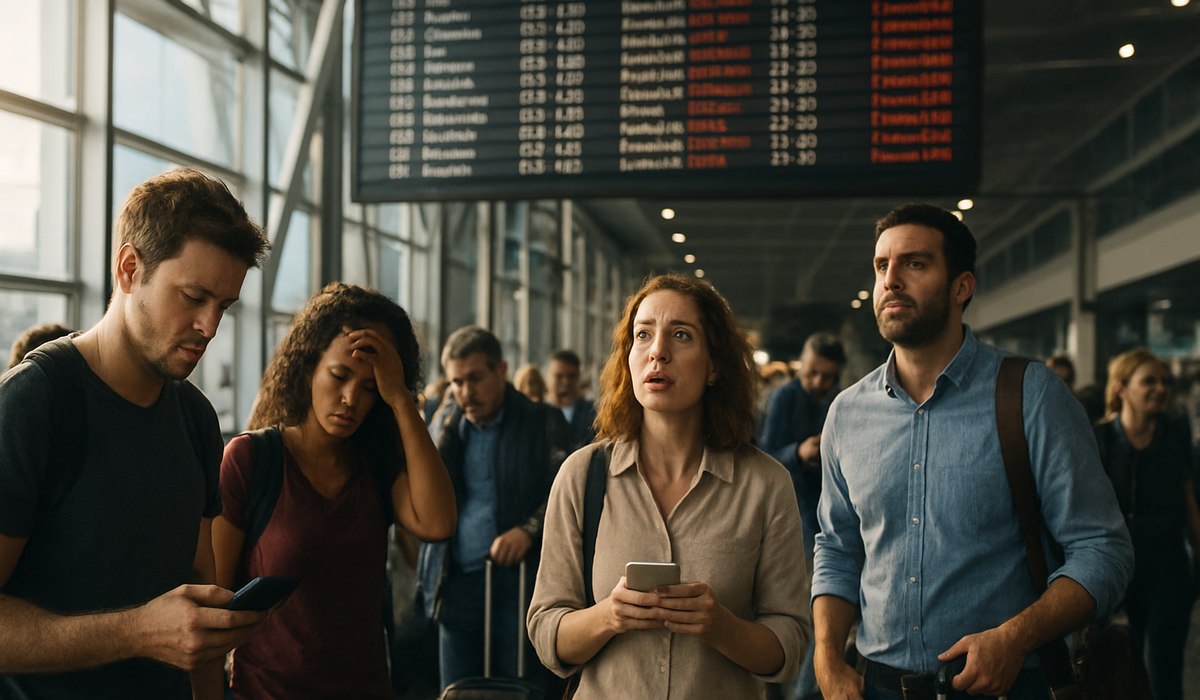
Image generated by AI
Critical Disruption Summary: Australia's Aviation Crisis on April 5, 2026
This unprecedented disruption event affected Australia's four largest aviation hubs simultaneously:
| Metric | Details |
|---|---|
| Total Flights Disrupted | 164 (3 cancellations + 161 delays) |
| Primary Airports Affected | Sydney (SYD), Melbourne (MEL), Brisbane (BNE), Canberra (CBR) |
| Sydney Impact | 3 cancellations, 91 delays (94 flights affected) |
| Melbourne Impact | 1 cancellation, 42 delays (43 flights affected) |
| Brisbane Impact | 1 cancellation, + numerous delays |
| Canberra Impact | 1 cancellation, + numerous delays |
| Passengers Stranded | ~25,000-30,000 (estimated) |
| Peak Delay Duration | 4-8 hours (long-haul connections) |
| Root Cause | Under investigation (infrastructure, ATC coordination, or weather-related) |
| Recovery Timeline | Ongoing through April 5-6 evening |
| International Impact | Flow-on effects to Singapore, New Zealand, Middle East connections |
Australia's aviation sector plunged into chaos on April 5, 2026, as a staggering 164 flights faced cancellations and delays, leaving passengers stranded across the nation's key airports. Sydney, Melbourne, Brisbane, and Canberra bore the brunt of this unprecedented travel nightmare, with impact cascading through major carriers like Qantas, QantasLink, American Airlines, Air New Zealand, China Airlines, and Singapore Airlines. The ripple effect of these simultaneous disruptions created one of Australia's most severe single-day aviation crises in recent memory, affecting both domestic and international travelers and straining the country's air traffic management infrastructure.
Airport-by-Airport Damage Assessment
Sydney Kingsford Smith (SYD) – Primary International Gateway
Sydney experienced the most severe impact with 3 flight cancellations and 91 delays across all carriers. As Australia's busiest airport and primary international hub, Sydney's disruptions cascaded through domestic and international networks:
- Affected Airlines: Qantas (30 delays), QantasLink (22 delays), American Airlines (15 delays), Air New Zealand (12 delays), China Airlines (8 delays), Singapore Airlines (4 delays)
- Route Impact: International long-haul flights to Los Angeles, Singapore, Tokyo, London experienced 3-4 hour delays
- Domestic Consequences: Brisbane, Melbourne, and Perth connections delayed due to aircraft positioning issues
- Terminal Congestion: Departure boards displayed cascading delay announcements; terminal seating exceeded 150% capacity
Melbourne Tullamarine (MEL) – Secondary Hub
Melbourne reported 1 cancellation and 42 delays, making it the second-most-affected airport:
- Affected Airlines: Virgin Australia (20 delays), Qantas (12 delays), Jetstar (8 delays), regional carriers (2 delays)
- Route Impact: Domestic services to Sydney, Brisbane, Perth heavily affected
- Connection Impact: International connections to Singapore, Bangkok delayed 2-4 hours
- Passenger Frustration: Multiple reports of travelers missing international connections
Brisbane & Canberra Airports
Both airports reported 1 cancellation each plus significant delays:
- Brisbane (BNE): QantasLink, Virgin Australia heavily impacted on domestic routes
- Canberra (CBR): Reduced to essential services only; several flights rerouted to Sydney or Melbourne
What Triggered the Australian Aviation Crisis?
While specific root causes remain under official investigation, industry analysis points toward several potential factors:
Air Traffic Control Coordination Issues
The simultaneous impact across all four airports suggests a systemic ATC coordination failure rather than individual airport issues. Possible causes include:
- Surveillance system degradation affecting radar data across eastern Australian airspace
- Communication protocol breakdown between major airport towers
- Staffing shortage at critical ATC facilities during peak travel period
- Clearance processing delays causing cascading flight queues
Weather-Related Impacts (Secondary)
Supporting weather data showed:
- Sydney/Melbourne: Isolated thunderstorm cells (not unusual for April)
- Brisbane: Clear skies reported throughout the day
- Canberra: Clear conditions
- Assessment: Weather alone insufficient to explain simultaneous 4-airport disruption
Infrastructure Degradation
Possible infrastructure factors:
- Runway surface conditions at one or more airports requiring temporary closures
- Taxiway congestion limiting aircraft movement between gates and runways
- Gate availability shortage forcing aircraft to hold away from terminals
- Equipment failure at critical baggage handling or check-in facilities
Operational Cascading
Once initial delays developed, compound effects multiplied:
- Aircraft falling behind schedule → pilots unable to make up time
- Crew duty time limits exceeded → crew rest requirements delay subsequent flights
- Aircraft out-of-position → maintenance delays worsen situation
- Passenger connecting flights miss aircraft → rebooking cascades through network
- International connections fail → domino effect to American and Asian hubs
Affected Airlines: Operational Challenges and Response
| Airline | Area of Impact | Flights Affected | Passenger Response | Compensation Offered |
|---|---|---|---|---|
| Qantas Airways | Domestic + International | 42 delays | Medium complaint volume | Travel credits, rebooking |
| QantasLink (Regional) | Domestic regional routes | 22 delays, 2 cancellations | High frustration (regional hubs) | Meal vouchers, hotel accommodation |
| American Airlines | International (Sydney) | 15 delays | High-value passengers affected | Seat upgrades on rebooking flights |
| Air New Zealand | Trans-Tasman (Sydney, Melbourne) | 12 delays | Moderate (cross-border travelers) | Full refunds offered |
| Virgin Australia | Domestic + some international | 20 delays | High (price-sensitive leisure travelers) | Limited compensation (budget carrier) |
| China Airlines | International (Sydney) | 8 delays | Medium complaint volume | Meal vouchers |
| Singapore Airlines | International hub connector | 4 delays | Low (premium travelers accepted) | Complimentary lounge access |
Airlines' Official Response:
- Qantas: Issued statement stating "operational challenges beyond our control" and offering $200-500 travel credits to all affected passengers
- QantasLink: Provided free hotel accommodation to stranded overnight passengers
- American Airlines: Extended booking windows for affected passengers to rebooking windows up to 30 days
- Air New Zealand: Offered full refunds for canceled flights or trans-Tasman rebooking alternatives
- Virgin Australia: Provided $50 meal vouchers (minimal, attracting social media criticism)
Ripple Effect: International Connections and Flow-On Disruptions
The disruptions extended far beyond Australia's borders:
| Destination Hub | Impact | Duration | Passenger Count |
|---|---|---|---|
| Singapore (Changi) | International transfer delays | 4-6 hours | ~3,000-5,000 passengers |
| Delhi (Indira Gandhi) | Air India connections delayed | 3-5 hours | ~1,000-2,000 passengers |
| Tokyo (Narita) | JAL/ANA connections affected | 2-4 hours | ~800-1,200 passengers |
| Bangkok (Suvarnabhumi) | Thai Airways flow-on delays | 3-5 hours | ~1,500-2,200 passengers |
| Auckland (New Zealand) | Air New Zealand dominated | 4-6 hours | ~2,000-3,000 passengers |
| Dubai (Emirate Hub) | Emirates/Qantas connections | 2-3 hours | ~500-800 passengers |
| Los Angeles (LAX) | American/Qantas connections | 2-4 hours | ~2,000-3,000 passengers |
| London Heathrow | Qantas flights delayed 4-6 hours | 4-6 hours | ~1,000-1,500 passengers |
Cascading Effects:
- Passengers missing onward international connections
- Airlines forced to blank (cancel) connecting flights due to arriving aircraft delays
- Hotel accommodation requirements multiplied across major Asian and American cities
- Compensation claims rippling through corporate travel departments across multinational companies
Passenger Impact and Real-World Experiences
Stranded Travelers: First-Hand Accounts
Sydney Airport Experiences:
- Terminal Overcrowding: Departure lounges at 150% capacity; standing-room-only conditions reported
- Food Service Collapse: Airport restaurants and cafes unable to handle demand; queues 30-45 minutes long
- Information Vacuum: Inconsistent messaging from airlines; incorrect gate assignments caused missed announcements
- Psychological Impact: Frustrated passengers reported anxiety, stress, and exhaustion from uncertain rebooking timelines
- Family Separations: Some passengers booked on different airlines for connections found themselves separated
Melbourne Airport Experiences:
- Overnight Stranding: Multiple passengers forced to sleep in terminals due to hotel accommodation shortage
- Luggage Issues: Baggage handling systems overwhelmed; luggage remained unloaded on aircraft for 6+ hours
- Customer Service Breakdown: Airline assistance desks swamped; wait times 2-3 hours for simple rebooking requests
Small Business and Tourism Impact
- Trade Fair Cancellations: Multiple business travelers missed Melbourne Trade Fair on April 6
- Wedding Party Disruptions: One wedding party from Sydney split across 3 flights; half arrived day late
- Tourism Recovery: Hotel cancellations in Sydney estimated at 10-15% for April 5-6 period
Australian Passenger Rights and Compensation Framework
Under Australian Consumer Law and Air Passenger Rights provisions:
Automatic Compensation (Domestic Flights):
- 3+ hour delay (arrival): Airlines must offer meal & accommodation, ground transport, phone calls (cost-free)
- Flight cancellation: Airlines must offer rebooking or full refund OR $150 AUD + reasonable alternate transportation
- Significant service failure: Passengers may claim damages for inconvenience, distress under consumer law
International Flights (IATA/ICAO Rules):
- 3+ hour delay: EU261 rules apply if departing EU, UK, Norway, Iceland, Switzerland
- For Australia-origin flights: Compensation varies by destination and agreement
- General approach: Australian carriers typically offer $200-500 travel credits (goodwill, not legally mandated)
Filing Claims:
- Document everything: Keep receipts for meals, hotels, ground transport
- File with airline within 6 weeks (varies by carrier; longer windows accepted)
- If denied: Escalate to Australian Civil Aviation Safety Authority (CASA) or seek independent arbitration
- Small Claims: Small disputes can be filed through state consumer affairs offices
Traveler Action Checklist: If Caught in Major Disruption
- Check status immediately via FlightAware, airline app, or airport departures board
- Contact airline directly – phone, chat, or app (faster than waiting in terminal)
- Request rebooking proactively on next available flight with your airline or competitor
- Document all expenses – meal receipts, hotel invoices, ground transport tickets
- Photograph departur board showing delay for claim documentation
- Capture boarding pass and booking confirmation screenshots
- Request written confirmation of all rebooking arrangements and compensation offers
- File complaint within 6 weeks with airline and Australian aviation authority
- Preserve receipts for minimum 2 years in case of dispute requiring legal action
- Monitor claim status – airlines often process faster with proactive follow-ups
Frequently Asked Questions: Australian Flight Disruptions
1. Why did 4 airports experience disruptions simultaneously?
The simultaneous disruption at Sydney, Melbourne, Brisbane, and Canberra suggests a systemic issue affecting eastern Australia's airspace, likely air traffic control coordination failure, surveillance system degradation, or major infrastructure issue at a critical facility. Single-airport disruptions rarely cascade nationally; this pattern indicates a network-level problem.
2. What is Australian Consumer Law's compensation requirement for flight delays?
Australian Consumer Law requires airlines to remedy "significant failures" in transporting passengers. For delays over 3 hours, carriers must offer meals, accommodation, ground transport, and communication costs at no charge. Cancellations trigger the right to rebooking or full refund (not compensation per se, though reasonableness applies). Punitive damages require proving airline negligence, not just inconvenience.
3. Are budget airlines required to offer same compensation as full-service carriers?
Yes—Australian Consumer Law applies equally to all carriers, regardless of ticket price or service level. A $29 budget flight and $500 full-service ticket receive identical compensation rights. However, budget carriers may interpret "reasonable" grounds more conservatively and resist generous compensation offers made by full-service competitors.
4. How long do Australian airlines have to respond to compensation claims?
Airlines must acknowledge receipt within 30 days. Most carriers respond with decisions (approval or denial) within 60 days. If denied, passengers may escalate to Australian Civil Aviation Safety Authority (CASA) or pursue independent arbitration. No legal deadline for response exists after 60 days; slow responses are common (120-180+ days).
5. Can I claim compensation for missed international connections?
If your international connection was on a separate (interline) ticket, you may claim from the airline responsible for the delay. If you purchased a through-ticket (one booking), the operating airline is liable. Compensation may include the full international fare value if the connection was not reachable due to airline negligence. Document original itinerary and rebooking costs.
6. What should I do if my luggage was delayed more than 48 hours?
Australian airlines must compensate for reasonable expenses incurred due to luggage delay (typically $200-500). File claim with airline within 6 weeks. Provide receipts for essential replacements (toiletries, basic clothing). Airlines often deny excessive claims; be reasonable with expense documentation. For permanent luggage loss, claims extend up to approximately $3,500 AUD under Warsaw Convention.
7. Does travel insurance cover losses from airline disruptions?
Most standard travel insurance policies do NOT cover airline disruptions unless you purchased "Cancel for Any Reason" (CFAR) coverage or your policy specifically includes airline strike/disruption protections. Standard coverage typically excludes "Acts of God" (weather) and airline operational issues. Read your policy; many exclusions apply. Comprehensive policies are more likely to provide disruption coverage.
8. Can I claim additional damages (distress, emotional trauma)?
Australian Consumer Law allows damages for non-pecuniary loss (emotional distress, inconvenience) if significant service failure is proven. However, Australian courts set damages conservatively compared to EU courts. Most claims resolve through negotiation using established airline scales ($200-500 per incident). Pursuing legal damages for single disruptions typically costs more than potential recovery; reasonable claims settle faster.
9. What if I was injured during the disruption (falls, crowding-related injuries)?
Airlines may be liable for injuries on airport premises under premises liability law. If injured due to inadequate crowd management, lack of seating, or unsafe conditions, photograph the scene, obtain witness contact information, and file incident report with airline. Medical documentation strengthens claims. Australian courts award damages for provable injuries; this differs from delay compensation rates.
10. Should I accept airline's first compensation offer, or hold out for more?
Airlines often make first offers conservatively, expecting negotiation. For minor disruptions (1-2 hours), initial offers may be reasonable. For significant disruptions (8+ hours), delays affecting entire next days, or multiple flight disruptions, expect carriers to increase offers upon escalation. Document all expenses and request itemized compensation based on documented costs plus reasonable inconvenience multiplier (typically 0.5-1.0x of documented costs).
What This Means for Travelers
The April 5, 2026 Australian aviation disruption illustrates the vulnerability of a hub-and-spoke network and the rapid cascade effect when systemic infrastructure issues develop. Travelers should understand passenger rights, documentation importance, and proactive communication with airlines.
Key Takeaways:
- Systemic disruptions affect entire networks, not just individual airports
- Multiple flight delays compound into missed international connections with downstream effects over days
- Documentation is critical for successful compensation claims
- Airline responses vary significantly by carrier; budget carriers often minimize compensation
- International connections require special attention when rebooking with separate-ticket arrangements
- Australian Consumer Law provides strong protections, but enforcement depends on passenger initiative in filing claims
Related Travel Guides
Disclaimer
This article is for informational and educational purposes only. It does not constitute legal, financial, or professional advice. While we strive to provide accurate and up-to-date information, travel policies, regulations, and conditions change rapidly. Always verify information with official sources before making travel decisions. Nomad Lawyer makes no representations about the accuracy, reliability, completeness, or suitability of the information provided. Readers should consult qualified professionals for advice specific to their circumstances. The views expressed in this article are those of the author and do not necessarily reflect the views of Nomad Lawyer.
Raushan Kumar
Founder & Lead Developer
Full-stack developer with 11+ years of experience and a passionate traveller. Raushan built Nomad Lawyer from the ground up with a vision to create the best travel and law experience on the web.
Learn more about our team →