
Thousands Passengers Abandoned Across Germany Today
Thousands of passengers stranded across Germany's major airports in March 2026. Berlin, Frankfurt, Munich, Hamburg, and Stuttgart report mass flight cancellations and delays affecting Lufthansa, Eurowings, and budget carriers.

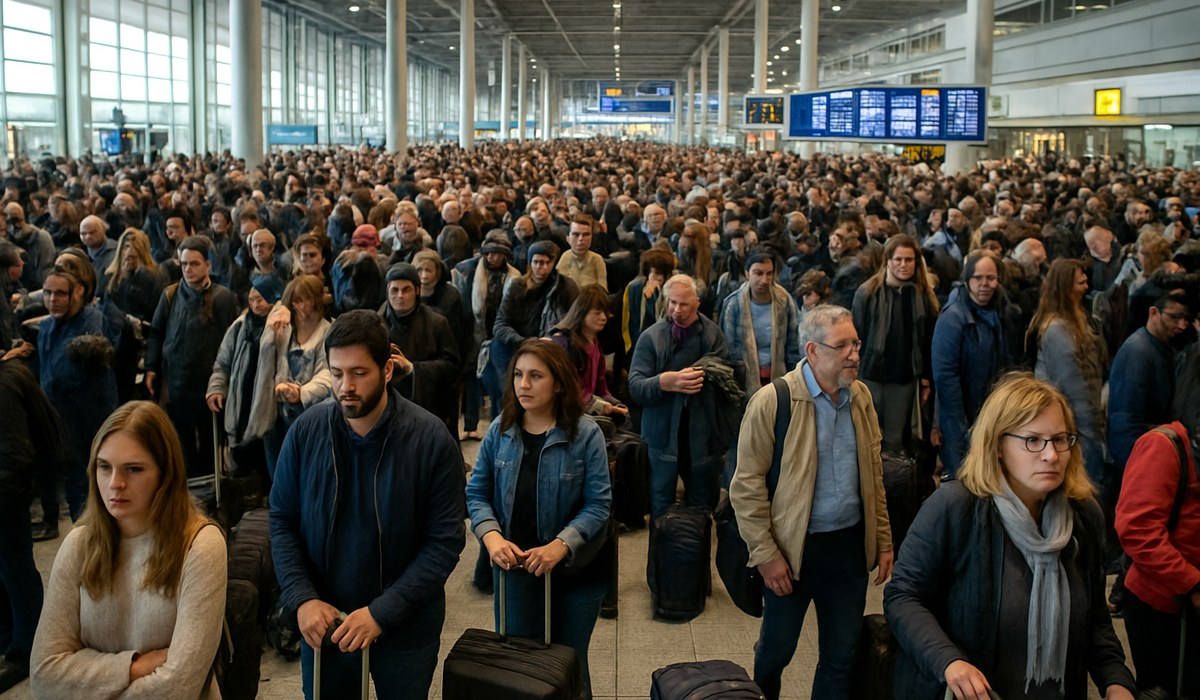
Image generated by AI
**> Quick Summary
- Over 1,000 flights experienced operational disruptions across five German hub airports on March 30, 2026
- Major carriers including Lufthansa Group airlines, budget operators, and regional services faced simultaneous cancellations and delays
- EU261 compensation rules apply to eligible passengers on affected flights
- Real-time tracking tools and airline customer service remain your best resources for immediate rebooking assistance**
Thousands of travelers faced severe travel disruptions across Germany today as a coordinated operational crisis engulfed the nation's busiest airport hubs. Berlin Tegel (BER), Frankfurt am Main (FRA), Munich International (MUC), Hamburg Fuhlsbüttel (HAM), and Stuttgart Echterdingen (STR) all reported significant cascading disruptions simultaneously on March 30, 2026.
The scale of disruption was staggering. A combined total of approximately 60 flights received outright cancellations, while another 975 services experienced notable delays ranging from 90 minutes to several hours. This widespread operational failure trapped tens of thousands of passengers in airport terminals, forcing rebooking efforts across multiple carriers and creating a ripple effect throughout European air traffic networks.
The disruption affected major carriers operating throughout the region. Lufthansa, Europe's largest flag carrier, bore the brunt of the crisis alongside subsidiary brands Eurowings and Air Dolomiti. Budget operators including Condor and Pegasus Airlines also reported significant service interruptions. Regional carriers and smaller European airlines operating from these hubs similarly faced knock-on delays as aircraft and crews repositioned across disrupted schedules.
What Happened: German Airport Chaos Explained
No single catastrophic event triggered today's disruptions. Instead, a convergence of operational pressures created a domino effect across Germany's interconnected airport system. Air traffic control staffing constraints, combined with ground handling capacity limitations and weather-related complications in neighboring European airspace, created perfect conditions for systemic failure.
Eurocontrol manages European airspace coordination, and disruptions cascade across the continent when major hubs experience simultaneous capacity issues. German airports operate as critical junction points for Central European air traffic. When these facilities experience simultaneous degradation, the consequences ripple far beyond national borders, affecting flight paths destined for London, Paris, Amsterdam, and destinations across the Mediterranean.
Operational experts point to a shortage of available airport ground crews as a primary contributing factor. The March travel season coincides with spring break schedules, Easter holiday preparations, and business travel recovery post-winter. This predictable seasonal peak placed existing staffing below optimal levels just as aircraft turnaround times—the critical window between landing and departure—extended beyond normal parameters.
Weather conditions in the upper Rhine Valley and Alpine regions forced certain flight routing modifications, adding congestion to already-saturated approach patterns serving Frankfurt and Munich. Delayed arrivals cascaded backward through the system, creating secondary bottlenecks at feeder airports in Hamburg and Stuttgart.
Affected Airlines and Routes
Lufthansa Group operations bore the highest impact given the carrier's dominant position within German airspace. Lufthansa proper, which operates approximately 40% of daily Frankfurt movements, reported cancellations affecting European network services to London, Paris, Brussels, and Zurich. Eurowings, the group's low-cost subsidiary serving secondary routes, similarly experienced widespread disruptions on German domestic corridors and short-haul European services.
Air Dolomiti, Lufthansa's regional partner operating 70-seat turboprops and regional jets, cancelled multiple Milan-to-Germany services and domestic feeder flights supporting Frankfurt hub connections. The carrier's reliance on crew connections through Frankfurt meant that cascading delays in the morning schedule ultimately grounded afternoon services with no alternative crew availability.
Condor, the leisure-focused carrier operating primarily from Frankfurt and Munich, cancelled several charter flights and scheduled services to Mediterranean destinations. These cancellations disproportionately affected vacation travelers—often families unable to reschedule already-paid holiday accommodation.
Pegasus Airlines, the Turkish budget carrier serving Berlin and Frankfurt with Eastern European routes, cancelled at least eight daily flights. The carrier's relatively thin operational margins meant fewer spare aircraft available to absorb disruptions through substitution.
Regional operators and codeshare partners including Air France, KLM, British Airways, and Swiss International Air Lines also experienced secondary delays as their own German-origin flights held for connecting passengers on disrupted Lufthansa services.
Passenger Rights and Compensation Under EU261
The European Union's Regulation 261/2004 provides explicit protections for passengers experiencing flight disruptions exceeding defined thresholds. Any passenger on a cancelled flight or a flight delayed beyond three hours at final destination remains eligible for standardized compensation, regardless of the disruption's root cause—with specific exceptions for extraordinary circumstances.
Under IATA standards and EU261 regulations, passengers on affected flights may be entitled to compensation and rebooking assistance. The compensation structure operates as follows: €250 for flights up to 1,500 kilometers; €400 for intra-European flights exceeding 1,500 kilometers and other flights between 1,500 and 3,500 kilometers; and €600 for flights exceeding 3,500 kilometers.
Affected passengers retain the right to request rebooking on alternative flights operated by the airline or competing carriers at no additional charge. Airlines must provide accommodation, meals, and communication access if rebooking extends beyond their next available flight. Passengers traveling on connecting tickets through German airports retain full compensation rights on the entire journey, not merely the disrupted segment.
Several important caveats apply. Airlines can invoke "extraordinary circumstances" as a defense—defined narrowly to include severe weather, security threats, and air traffic management restrictions beyond the carrier's operational control. Today's disruptions, rooted primarily in staffing and ground handling constraints, likely qualify as operational failures rather than extraordinary circumstances, strengthening passenger claims.
Passengers should document all expenses related to disruptions: accommodation, meals, ground transportation, and communication costs. Airlines are obligated to reimburse reasonable expenses incurred as direct consequences of the disruption. Retain all receipts and boarding passes for claim documentation.
How to Track Your Flight and Get Real-Time Updates
Travelers stranded at Berlin, Frankfurt, and Munich can monitor aircraft movements live via FlightRadar24 to track their flights. The platform displays real-time aircraft position, altitude, speed, and estimated arrival times. This transparency helps passengers understand whether their rebooked flights experience secondary delays or maintain schedule recovery.
Individual airline apps and websites remain the primary source for official flight status information. Lufthansa's app, Eurowings' booking portal, and Condor's mobile platform all display updated cancellation and delay information. However, during mass disruption events, these systems often experience overload. FlightRadar24 provides a neutral third-party data source unaffected by airline server congestion.
Contact your airline's customer service channels directly rather than relying on airport information desks, which inevitably face overwhelming call volumes during crisis periods. Most major carriers maintain dedicated disruption hotlines with specialized staff trained for mass event scenarios. Telephone wait times typically exceed 2-3 hours during peak disruption periods, but social media customer service channels often respond more rapidly.
Airport information displays, while sometimes delayed in updating, remain authoritative for gate assignments and revised departure times. Monitor these displays continuously if physically present at an airport terminal. Digital traveler forums and Reddit communities dedicated to aviation often provide real-time passenger intelligence from other travelers on affected flights.
What Affected Passengers Should Do Now
- Verify your flight status immediately using your airline app or FlightRadar24.
Disclaimer
This article is for informational and educational purposes only. It does not constitute legal, financial, or professional advice. While we strive to provide accurate and up-to-date information, travel policies, regulations, and conditions change rapidly. Always verify information with official sources before making travel decisions. Nomad Lawyer makes no representations about the accuracy, reliability, completeness, or suitability of the information provided. Readers should consult qualified professionals for advice specific to their circumstances. The views expressed in this article are those of the author and do not necessarily reflect the views of Nomad Lawyer.
Raushan Kumar
Founder & Lead Developer
Full-stack developer with 11+ years of experience and a passionate traveller. Raushan built Nomad Lawyer from the ground up with a vision to create the best travel and law experience on the web.
Learn more about our team →