
Thailand Approves Massive Double-Track Railway Network to Boost Tourism and Cross-Border Connectivity
Thailand Approves Massive Double-Track Railway Network to Boost Tourism and Cross-Border Connectivity

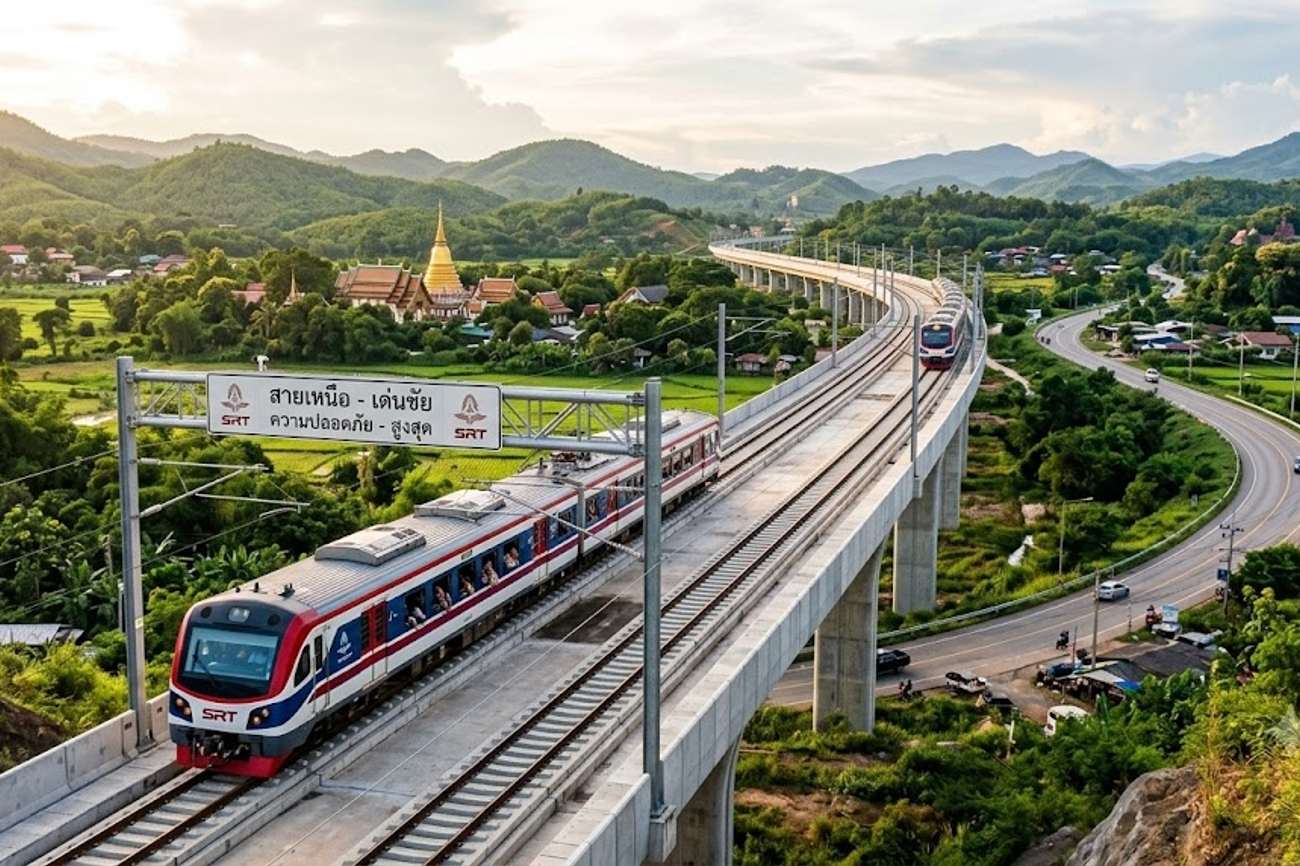
Image generated by AI
106.8 billion baht is the total capital commitment Thailand has authorized to overhaul its southern rail infrastructure, marking a decisive shift toward a high-capacity, double-track corridor designed to eliminate the systemic bottlenecks of the current single-track regime. This investment targets the critical artery between Chumphon and the Malaysian border at Padang Besar, fundamentally altering how passengers and freight move through the southern peninsula.
The Single-Track Bottleneck and the Southern Mandate
For decades, the southern rail corridor has operated on a restrictive single-track system. In such a configuration, trains traveling in opposite directions must share the same set of rails, necessitating one train to pull into a siding or station to wait for the other to pass. This operational constraint creates a "domino effect" of delays; a single late arrival can cascade through the entire schedule, compromising reliability for both commuters and international tourists.
By transitioning to a double-track network, Thailand is removing these structural pauses. The new infrastructure allows simultaneous bidirectional travel, which effectively doubles the line's capacity and slashes transit times. This is not merely a convenience upgrade but a strategic move to integrate the southern provinces more tightly with the national economy and the broader ASEAN region. The project aligns with the goals of the International Union of Railways (UIC), which emphasizes the role of modernized rail in reducing carbon footprints and enhancing regional mobility.
Financial Breakdown and Project Timelines
The 106.8 billion baht investment is distributed across three distinct phases, each targeting a specific geographic and economic node. The variance in funding reflects the complexity of the terrain and the strategic importance of the specific route.
| Project Segment | Investment Amount | Construction Duration | Strategic Focus |
|---|---|---|---|
| Chumphon–Surat Thani | 36.9 billion baht | 7 Years (from FY 2026) | Gateway to Gulf Islands |
| Surat Thani–Hat Yai Junction | 61.5 billion baht | 8 Years | Urban/Commercial Core |
| Hat Yai Junction–Padang Besar | 8.37 billion baht | 6 Years | Cross-Border Connectivity |
The budget for these works has seen upward revisions from original estimates. These increases are attributed to a combination of macroeconomic pressures—specifically the rising cost of diesel and construction materials—and necessary engineering upgrades. To ensure the longevity of the network, the government has integrated advanced flood prevention systems and upgraded level crossings. Additionally, the supervision fee for these projects has been adjusted upward from 2.25% to 2.75% of total construction costs to ensure stricter adherence to modern safety and engineering standards.
Expert Analysis: The Geopolitical and Logistical Ripple Effect
From a senior editorial perspective, this investment is less about "trains" and more about "corridors." By securing the link to Padang Besar, Thailand is positioning itself as the primary transit hub for land-based travel between mainland Southeast Asia and the Malay Peninsula.
For travelers booking routes in this region, the direct consequence is a transition from "scheduled" travel to "reliable" travel. Currently, the unpredictability of single-track delays often pushes high-value tourists toward domestic flights or private car rentals. By stabilizing the rail schedule, the State Railway of Thailand can recapture this market share.
The pricing pressure created by this efficiency will likely be felt in the regional aviation sector. As rail becomes a viable, time-competitive alternative for the Chumphon–Surat Thani–Hat Yai corridor, short-haul flight demand may soften, potentially lowering fares or forcing airlines to pivot their strategies. Furthermore, the connection to Malaysia transforms the Padang Besar crossing from a mere border checkpoint into a logistics engine. This supports the broader ASEAN objective of seamless connectivity, making multi-country "slow travel" itineraries—which are currently logistically taxing—far more attractive to the digital nomad and luxury backpacker demographics.
The integration of Surat Thani is particularly pivotal. As the primary rail-to-ferry conduit for Koh Samui, Koh Phangan, and Koh Tao, any increase in rail efficiency directly impacts the "last mile" of the journey to Thailand's most famous islands. When the rail link is unreliable, the entire tourism value chain—from hotels to tour operators—suffers from inconsistent arrival windows.
Key Takeaways
- Total Investment: 106.8 billion baht dedicated to converting the Chumphon–Padang Besar corridor to double-track.
- Timeline: Construction will span between 6 and 8 years, with the Chumphon–Surat Thani segment beginning in fiscal year 2026.
- Cross-Border Impact: The Hat Yai–Padang Besar link specifically targets enhanced connectivity with Malaysia, facilitating easier international land transit.
- Operational Shift: The removal of single-track "passing points" will result in higher frequency, increased safety, and significantly reduced travel times.
- Cost Drivers: Budget increases were necessitated by land acquisition, compensation, and the integration of modern flood prevention infrastructure.
FAQ: Thailand Rail Expansion 2026
How will the double-track system affect travel times to southern islands? Travelers heading to Koh Samui or Koh Tao via Surat Thani will experience fewer delays and more frequent departures. By eliminating the need for trains to wait for oncoming traffic, the journey from Bangkok or Chumphon becomes more predictable and faster.
Will this project make traveling from Thailand to Malaysia easier? Yes. The Hat Yai Junction–Padang Besar project specifically streamlines the connection to the Malaysian rail network. This reduces transit friction at the border and supports more efficient cross-border passenger and freight movement.
Why did the cost of the railway project increase? The budget rose due to higher costs for construction materials and diesel, as well as the inclusion of critical engineering upgrades like flood prevention and improved level crossings to meet modern safety standards.
When will the new railway lines be fully operational? The projects have staggered timelines. The shortest segment (Hat Yai–Padang Besar) takes 6 years, while the largest section (Surat Thani–Hat Yai) will take 8 years to complete.
The era of the "waiting train" in Southern Thailand is ending, replaced by a high-velocity corridor that treats the Malaysian border not as a terminus, but as a gateway.
Tags: State Railway of Thailand, Padang Besar Border, ASEAN Connectivity 2026, Southern Thailand Infrastructure, Thailand-Malaysia Rail Link
Related Travel Guides
Disclaimer
This article is for informational and educational purposes only. It does not constitute legal, financial, or professional advice. While we strive to provide accurate and up-to-date information, travel policies, regulations, and conditions change rapidly. Always verify information with official sources before making travel decisions. Nomad Lawyer makes no representations about the accuracy, reliability, completeness, or suitability of the information provided. Readers should consult qualified professionals for advice specific to their circumstances. The views expressed in this article are those of the author and do not necessarily reflect the views of Nomad Lawyer.
Raushan Kumar
Founder & Lead Developer
Full-stack developer with 11+ years of experience and a passionate traveller. Raushan built Nomad Lawyer from the ground up with a vision to create the best travel and law experience on the web.
Learn more about our team →