
Thailand Tightens Aviation Hub Security Following Australian Heroin Smuggling Arrest of Airline Employee on International Flight
Thailand has launched a sweeping airport security crackdown after a Thai airline employee was arrested in Melbourne for importing over 1 kg of heroin.

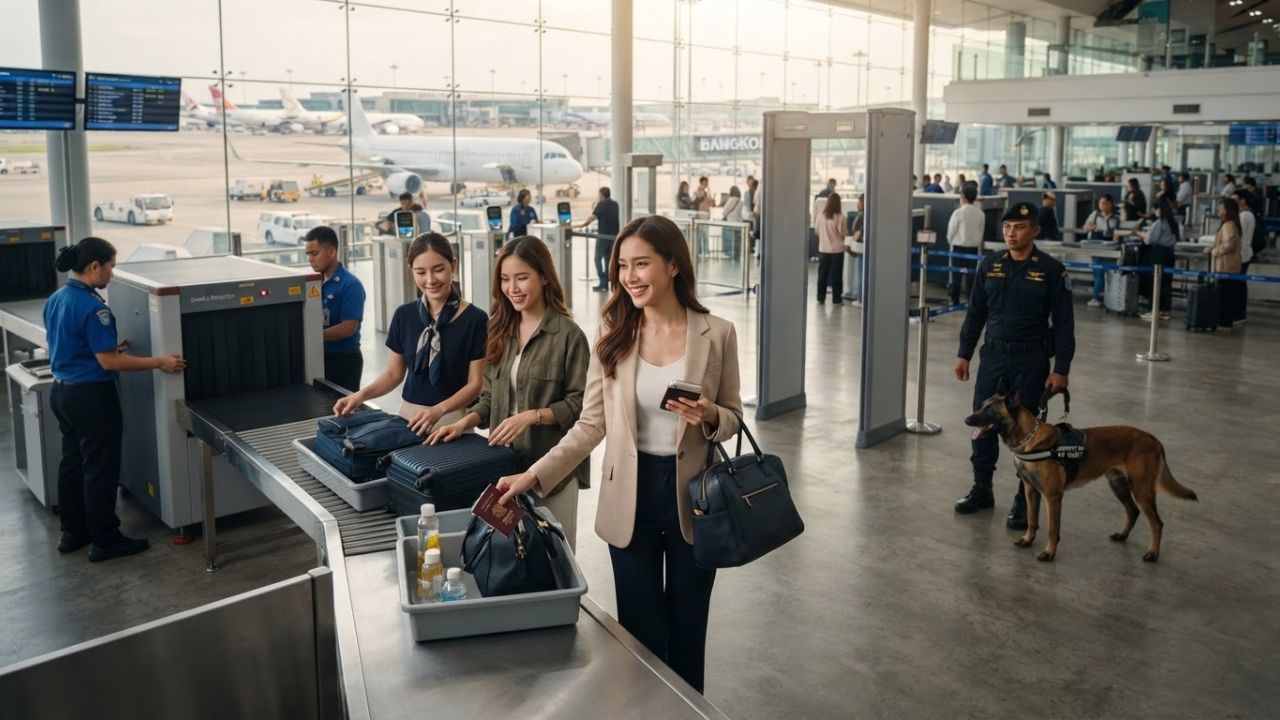
Image generated by AI
[Bangkok, July 5, 2026] — A major Thailand aviation hub security crackdown has been launched following the arrest of a Thai airline employee in Australia for allegedly smuggling heroin. Initiated on July 5, 2026, the sweeping coordination response spans Airports of Thailand, the Civil Aviation Authority of Thailand (CAAT), and anti-narcotics agencies to implement tighter crew inspections, advanced data sharing, and enhanced K9 cargo screening.
Timeline of the Bangkok to Melbourne Security Incident
According to reports from border security agencies, the international enforcement case began in late June when a 26-year-old Thai national working on a commercial flight arrived at Melbourne Airport. The timeline below tracks how a single contraband seizure triggered a comprehensive review of airport security and crew screening standards across Thailand.
| Date | Official Source Base | Event | Operational Meaning for Travel |
|---|---|---|---|
| 25 June 2026 | Joint ABF & AFP operational records | A Thai airline crew member arrived at Melbourne Airport (MEL); baggage was screened by officers. | Focus shifted to crew baggage inspection protocols and trusted-insider risks. |
| 26 June 2026 | Australian Border Force (ABF) legal logs | The employee was officially charged and remanded in custody by Australian judicial authorities. | Formal charges were filed, initiating the legal process in Australia. |
| 29 June 2026 | Public media release from Australian Border Force (ABF) | Details of the alleged importation of over 1 kg of heroin (street value AUD 500,000) were released. | The incident was publicised, highlighting the vulnerability of crew baggage channels. |
| 2 July 2026 | Thailand Public Relations Department release | Royal Thai Government ordered cross-agency coordination to review airport exit controls. | Policy response was initiated to prevent regional reputation damage. |
| 3 July 2026 | National Anti-Drug Committee official minutes | Six core security and interdiction measures were approved to halt drug outbound flows. | Policy transitioned from incident review to systemic risk management. |
Six Control Measures Approved by Thai Anti-Drug Agencies
The National Anti-Drug Committee has established six specific security directives to control outbound logistics and prevent smuggling activity. These measures directly impact airlines, airport operators, ground handlers, and corporate travel managers operating within Thai airports.
| Measure | Agencies Involved | Operational Changes | Travel Industry Impact |
|---|---|---|---|
| Outbound Baggage Cargo Screening | AOT, Customs, Royal Thai Police | More intensive X-ray scans and K9 deployment for departing passenger bags. | Potential departure queues during peak travel windows. |
| Stricter Crew Baggage Inspections | Airports of Thailand (AOT) | Separated crew clearance gates undergo mandatory, documented physical checks. | Longer pre-flight crew prep times and tighter compliance. |
| Entrusted Items Disciplinary Rules | Civil Aviation Training Institute, Airlines | Strictly banning flight crews from carrying third-party packages or parcels. | Airlines updating internal employment terms and training. |
| Passenger Information Unit (PIU) | Customs Department, Central Government | Drafting a prime-ministerial decree to establish a specialized PIU database. | Enhanced passenger-profile scanning and intelligence sharing. |
| Staff Training Upgrades | Civil Aviation Training Institute | Enhanced cargo and baggage handler instruction on identifying concealment. | Improved screening precision and gate-area monitoring. |
| Cross-Agency Linked Databases | Customs, AOT, Immigration | Connecting passenger manifests and flight records in a centralized network. | Faster background screening and inter-agency coordination. |
Airports of Thailand Capacity Constraints and 2026 Targets
Airports of Thailand (AOT) is the key agency tasked with deploying these physical and technical security updates. The scale of the passenger throughput across AOT's primary gateways shows why implementing additional screening layers must be balanced carefully against operational efficiency to prevent gate congestion.
| AOT Airport | Design Capacity (Pax/Year) | 2026 Passenger Target | Strategic Role in New Security Operations |
|---|---|---|---|
| Suvarnabhumi Airport (BKK) | 60 Million | 69.11 Million | Main long-haul hub; primary screening focus for high-risk routes. |
| Don Mueang Airport (DMK) | 30 Million | 36.03 Million | Regional and low-cost carrier gateway; focus on domestic feeders. |
| Phuket Airport (HKT) | 12.5 Million | 17.39 Million | Primary southern leisure airport; high volume of long-haul charter flights. |
| Chiang Mai Airport (CNX) | 8 Million | 10.76 Million | Northern tourist gateway; secondary transit hub for regional departures. |
| Hat Yai Airport (HDY) | 2.5 Million | 3.93 Million | Southern border airport; focus on regional security and flight paths. |
| Chiang Rai Airport (CEI) | 3 Million | 2.73 Million | Northern border gateway; specialized regional customs screening. |
Insider Risk Management Controls in Airline Crew Screening
Thai government records clarify a key operational difference in the new security environment. While airline crews have always passed through security checkpoints, these gates were traditionally designed to detect immediate safety threats, such as weapons, explosives, and dangerous items.
Under the new directives, crew members will undergo Customs and narcotics screening similar to standard passenger controls. Ground handlers and airline partners must prepare for stricter compliance requirements. Crews will face restrictions on carrying items from third parties, and companies will monitor employee travel histories to detect unusual patterns.
Passenger Information Unit and Database Sharing Upgrades
The establishment of the Passenger Information Unit (PIU) represents a major structural change in Thailand's border control strategy. Rather than relying solely on physical check-point inspections, the PIU will analyze Passenger Name Record (PNR) data.
Linking Customs and AOT databases allows authorities to identify suspicious travel histories and route variations before passengers reach the gate. This targeted risk-analysis system helps ensure that low-risk leisure travelers face minimal disruption, while cargo shipments and crew logistics corridors receive appropriate monitoring.
Economic Impact on Thailand Tourism and Outbound Travel Flows
Thailand's tourism sector is a major driver of the national economy. In the first quarter of 2026, the Ministry of Tourism and Sports recorded 9,316,909 international arrivals, which was down 2.43% year-on-year. Q1 foreign tourism revenue reached THB 461,510.57 million (down 1.24%), while domestic tourism saw 71,407,657 trips generating THB 284,841.11 million. These figures indicate that maintaining international confidence in airport security is necessary to protect tourism-driven revenue streams.
Why This Matters: Addressing Trusted-Insider Threats in Global Hubs
Our analysis of the flight data indicates that the Melbourne incident exposes the vulnerability of regional aviation networks to trusted-insider threats. When flight crews use specialized airport channels to bypass standard customs gates, they can be targeted by international smuggling syndicates. A single cargo or crew security breach can lead to increased customs scrutiny at foreign destination airports, causing flight delays and damaging the hub's reputation. This security crackdown demonstrates that regional hub integrity is dependent on integrating aviation safety gates with active narcotics database tracking.
Future Border Management and Data Fusion Standards
Market trends suggest that Southeast Asian nations will increasingly adopt biometrics and automated baggage tracking to secure crew and cargo logistics corridors by 2028. Long-term projections indicate that international customs agencies will mandate real-time Passenger Name Record (PNR) sharing for all regional routes. Expect Thai airlines to implement automated baggage reconciliation systems to verify the chain of custody for all crew luggage before takeoff.
Frequently Asked Questions: Thailand Airport Security Crackdown
Why did Thailand upgrade its airport security in July 2026?
Thailand upgraded security following the arrest of a Thai airline employee at Melbourne Airport on June 25, 2026, for allegedly importing over 1 kg of heroin.
Will the new security measures delay departing passengers?
While crew and cargo screening will be significantly tighter, data sharing and targeted risk-analysis aim to minimize delays for standard leisure travelers.
What is the role of the Passenger Information Unit (PIU)?
The PIU will analyze passenger and flight records to identify risk indicators and coordinate with customs officials before departure.
Related Travel Guides
- Hawaiian Airlines Unveils Custom oneworld Alliance Airbus A330 Livery to Showcase Island Identity in Global Route Network Expansion
- Fuji Dream Airlines Disrupts Japan Charter Market by Introducing Direct Individual Booking Fares on Kitakyushu to Sapporo Flights
- United Airlines Pilot Sues Sheraton Denver Hotel Over Bat Intrusion Biting Incident That Prompted One Hundred Thousand Dollar Rabies Treatment
Disclaimer
This article is for informational and educational purposes only. It does not constitute legal, financial, or professional advice. While we strive to provide accurate and up-to-date information, travel policies, regulations, and conditions change rapidly. Always verify information with official sources before making travel decisions. Nomad Lawyer makes no representations about the accuracy, reliability, completeness, or suitability of the information provided. Readers should consult qualified professionals for advice specific to their circumstances. The views expressed in this article are those of the author and do not necessarily reflect the views of Nomad Lawyer.
Kunal K Choudhary
Co-Founder & Contributor
A passionate traveller and tech enthusiast. Kunal contributes to the vision and growth of Nomad Lawyer, bringing fresh perspectives and driving the community forward.
Learn more about our team →