
Swiss Airports Warn of Extreme Wait Times and Flight Disruptions Under New EU Entry/Exit System
Zurich and Geneva airports warn of passenger queues up to five hours as thunderstorms and the new EU biometric Entry/Exit System disrupt flight operations.

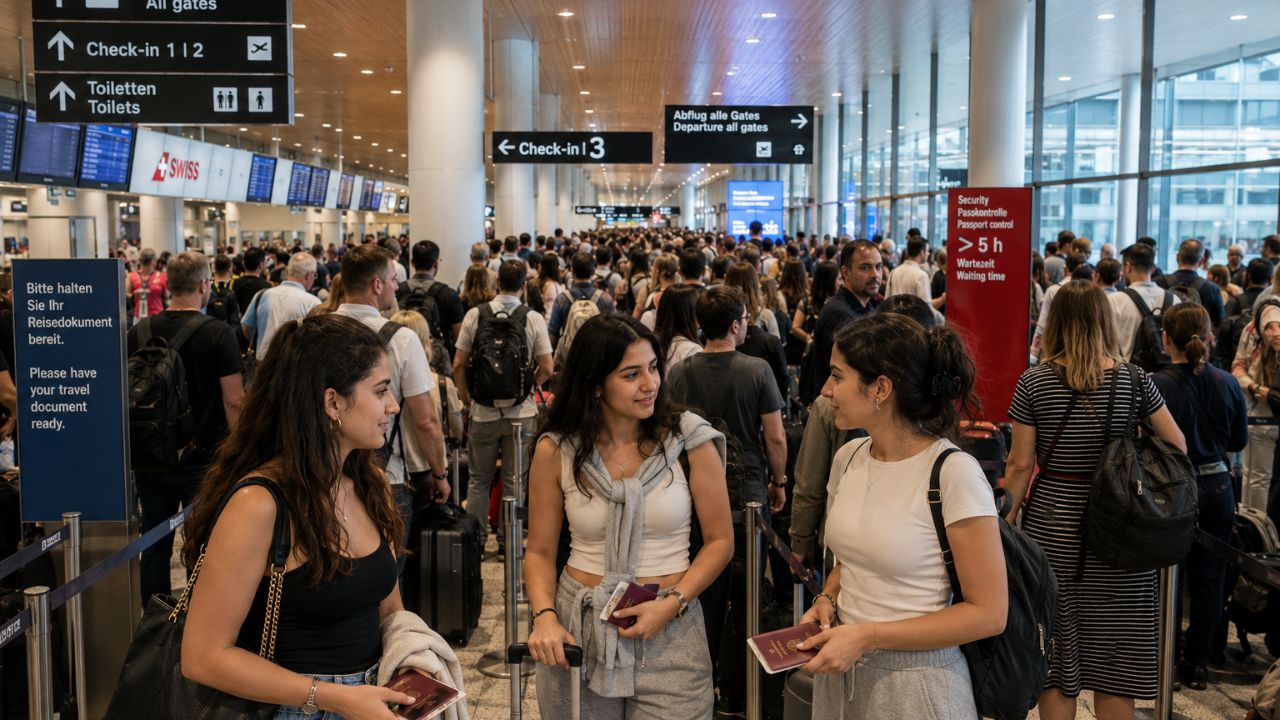
Image generated by AI
Swiss airport passenger queues have reached up to five hours at major hubs including Zurich and Geneva. Authorities attribute the terminal bottlenecks to regional thunderstorms and the implementation of the European Union's biometric Entry/Exit System.
Swiss Gateways Experience Severe Weather and Holiday Congestion
On July 4, 2026, aviation officials across Switzerland reported extreme delays affecting departure and arrival banks at key terminals. The official portal of Zurich Airport confirms that seasonal passenger volumes have peaked as summer school holidays begin.
Adding to the congestion, a wave of severe regional thunderstorms forced the cancellation of over 70 scheduled flights at Zurich. The weather disruptions left thousands of travelers stranded overnight, creating a massive backlog for ground handling networks.
Concurrently, traffic jams along the Gotthard Tunnel highway corridor forced road travelers to seek last-minute flight tickets, putting additional strain on airport check-in zones.
Biometric EU Entry/Exit System Extends Border Processing Times
The primary cause of the five-hour terminal queues is the rollout of the European Union's new Entry/Exit System (EES). This digital database replaces physical passport stamps with biometric registration for third-country nationals entering the Schengen zone.
Under the new security rules, non-EU travelers—including British and American tourists—must submit fingerprints and facial scans at border checkpoints. Because these biometric checks take several minutes per passenger, wait times have escalated.
Aviation trade organizations, including ACI Europe and the International Air Transport Association (IATA), have appealed to the European Commission for immediate system adjustments to prevent terminal gridlock.
Packing Optimization and Tarmac Baggage Regulations
To minimize security checkpoint delays, airport operations data managed by Geneva Airport indicates that passenger packing strategies are essential. Oversized carry-on bags cause friction at baggage check scanners, slowing down the boarding queue.
Airlines advise passengers to move non-essential items into checked luggage to accelerate screening.
Travelers must also adhere to strict rules regarding spare lithium batteries and power banks, which are prohibited in checked baggage.
Passenger Travel and Safety Guidelines
The tables below display the airport capacity statistics and carry-on regulations.
Swiss Airport Operations and Disruption Profile
| Airport Hub Name | Average Daily Passenger Count | Scheduled Daily Flight Operations | Severe Weather Impact | Peak Border Queue Time |
|---|---|---|---|---|
| Zurich Airport (ZRH) | 60,000 Passengers | 450 Flights | 70+ Flight Cancellations | Up to 5 Hours |
| Geneva Airport (GVA) | 45,000 Passengers | 320 Flights | Minor Departure Delays | Up to 4 Hours |
Passenger Packing and Baggage Guidelines
| Baggage Item Category | Maximum Allowance | Location Restrictions | Safety Handling Rules |
|---|---|---|---|
| Standard Cabin Baggage | Must meet airline dimensions | Stored in overhead locker | Excess weight moved to cargo hold |
| Lithium Power Banks | Max 2 devices (under 100Wh) | Cabin baggage only (Banned in checked bags) | Cannot be charged on the aircraft |
Recommended Pre-Flight Arrival Windows
Aviation authorities recommend that passengers departing to non-Schengen destinations arrive at least three hours before their scheduled flight. This buffer helps protect travelers from missing flights due to biometric registration delays.
Passengers should use airline mobile applications to receive real-time gate and flight status notifications.
For connecting flights, travelers should book itineraries with a minimum 90-minute layover window to account for airport delays.
Why This Matters
Our analysis of the flight data indicates that the implementation of the EES biometric framework has created a systemic bottleneck at European external borders. Traditional border check stations were built for manual passport verification, which takes less than 30 seconds per passenger. Introducing fingerprint scanning and facial capture at these same counters increases processing times by up to 300 percent.
This processing delay creates a dangerous compounding effect during peak travel hours. When passengers are held in border queues, flights are forced to depart with empty seats because boarding gates lock automatically. The resulting backlog of missed connections strains airline reservation systems and reduces the operational reliability of regional networks.
Industry Outlook
Market trends suggest that European airports will need to invest in automated self-service biometric kiosks to offload processing from border control desks. Airlines may also need to adjust schedules to separate non-Schengen departure banks, reducing the peak passenger load on border control staff.
Expect civil aviation authorities to negotiate temporary grace periods for EES registration during severe weather disruptions. The current terminal delays are projected to continue throughout the peak July and August travel season.
Key Takeaways
- Extreme Queues: Zurich and Geneva airports reported passenger wait times of up to five hours due to EES biometric border checks.
- Weather Disruptions: Severe thunderstorms forced the cancellation of over 70 flights at Zurich, stranding thousands.
- Biometric Delay: The new EU Entry/Exit System (EES) requires fingerprint and facial scans for non-EU travelers, slowing processing.
- Safety Rules: Power banks are strictly banned from checked luggage and must be stored in cabin baggage (maximum of two under 100Wh).
- Early Arrival: Travelers are advised to arrive three hours before departure, with a minimum 90-minute connection buffer.
FAQ
Why are the queue times at Swiss airports so long?
The delays are caused by a combination of summer holiday travel, recent thunderstorm flight cancellations, and the rollout of the EU's biometric Entry/Exit System.
Do I need to scan my fingerprints at Swiss border control?
Yes, all non-EU citizens (including UK and US passport holders) must register fingerprints and facial images under the new EES rules.
How early should I arrive for my flight from Zurich or Geneva?
Authorities recommend arriving at least three hours before departure for flights outside the Schengen zone.
Can I pack a power bank in my checked suitcase?
No, power banks are strictly banned in checked luggage. You may carry a maximum of two power banks (under 100Wh) in your cabin baggage.
Related Travel Guides
Disclaimer
This article is for informational and educational purposes only. It does not constitute legal, financial, or professional advice. While we strive to provide accurate and up-to-date information, travel policies, regulations, and conditions change rapidly. Always verify information with official sources before making travel decisions. Nomad Lawyer makes no representations about the accuracy, reliability, completeness, or suitability of the information provided. Readers should consult qualified professionals for advice specific to their circumstances. The views expressed in this article are those of the author and do not necessarily reflect the views of Nomad Lawyer.
Kunal K Choudhary
Co-Founder & Contributor
A passionate traveller and tech enthusiast. Kunal contributes to the vision and growth of Nomad Lawyer, bringing fresh perspectives and driving the community forward.
Learn more about our team →