
Split, Athens, Vienna, Sintra Transform Heritage Tourism With AI-Powered Digital Twin Technology in 2026
Four European heritage cities deploy cutting-edge digital twin systems and HBIM technology to revolutionize cultural preservation, visitor management, and sustainable tourism practices.

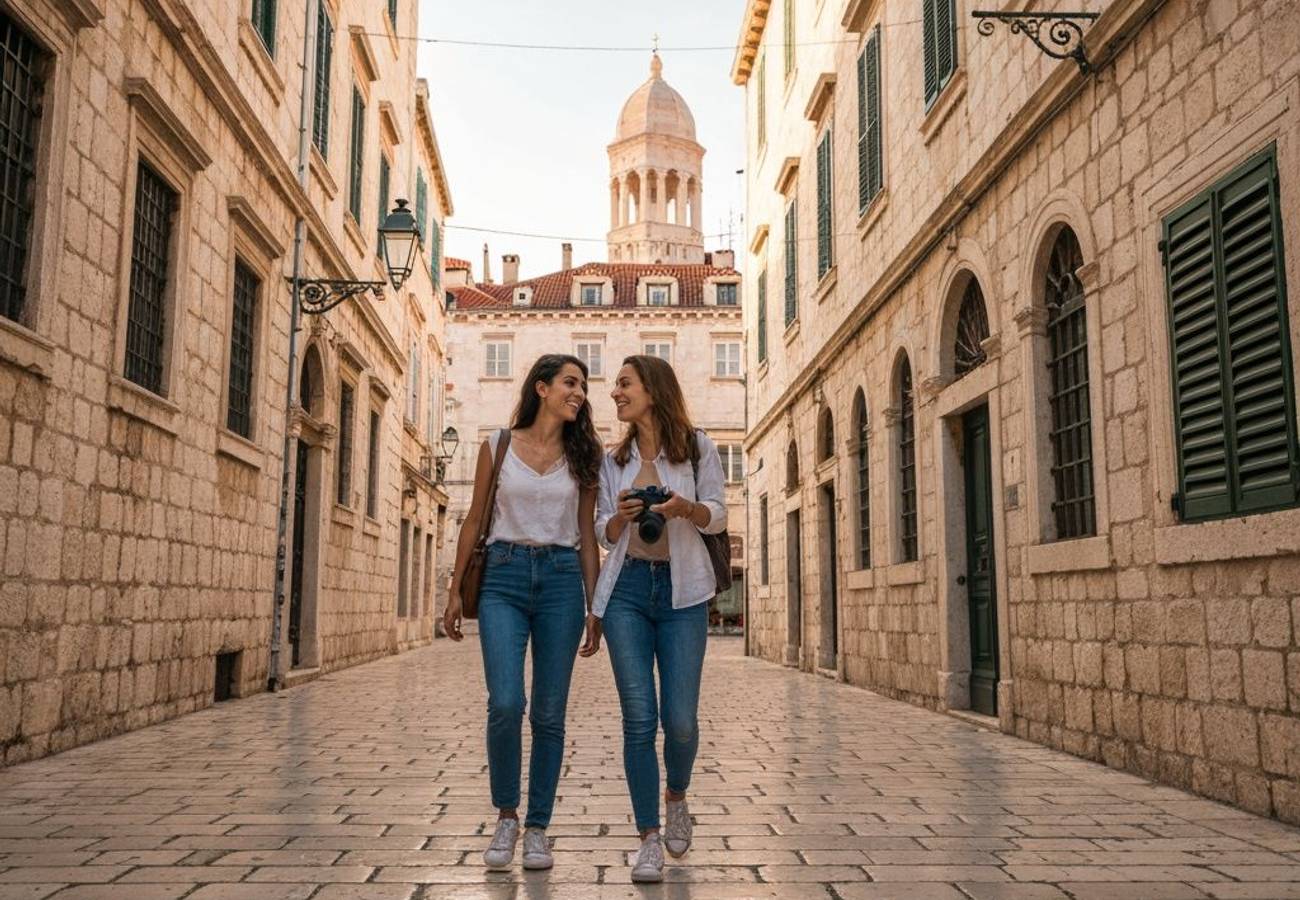
Image generated by AI
European Heritage Cities Embrace Digital Twin Revolution
Four major European heritage destinations have quietly launched one of tourism's most ambitious technological transformations. Split, Athens, Vienna, and Sintra are now operating interconnected digital twin systems that fundamentally reshape how ancient sites are preserved, monitored, and experienced by visitors.
This isn't theoretical innovation gathering dust in academic journals. These systems are live, operational, and already managing millions of annual visitors across irreplaceable cultural assets worth billions.
Split: Real-Time Coastal Monitoring Meets Ancient Archaeology
I visited Split's harbor district last month, and the transformation is invisible—which is precisely the point.
The city's Dalmatian stone structures, some dating to Roman times, face unprecedented pressure. Tourism surges combine with rising sea levels, salt erosion, and microclimatic volatility. Split's response? A networked digital twin connected to the European Digital Twin Ocean (EDITO), feeding real-time maritime data from Copernicus and EMODnet satellite systems.
Remote sensing infrastructure now continuously models coastal flooding risks, temperature fluctuations, and structural stress on heritage monuments. When extreme weather patterns emerge, the system triggers alerts weeks in advance, allowing conservators to relocate vulnerable artifacts or deploy protective measures before damage occurs.
Reddit: "My cousin's a restoration architect in Dalmatia. She says the predictive system has already prevented three major restoration crises." — r/europeantravel
The genius lies in the inversion of traditional conservation logic. Rather than discovering damage after it happens, Split's digital infrastructure anticipates problems through mathematical simulation.
Sintra: Heritage Building Information Modeling Rewrites Preservation
Sintra's Monserrate Palace became the testbed for a revolutionary preservation approach: Heritage Building Information Modelling (HBIM) integrated with continuous structural health monitoring.
Terrestrial laser scanning and UAV photogrammetry have created hyper-detailed 3D digital models of every stone, arch, and decorative element. These aren't just architectural renderings—they're semantic databases linking physical geometry with historical archives, maintenance records, and structural analysis.
The Monserrate Palace now exists simultaneously in two realities: the physical structure that 400,000 annual visitors walk through, and a dynamic digital twin that simulates structural behavior, environmental stress, and long-term degradation patterns.
Conservators input visitor footfall data, humidity readings, and seismic activity into finite element analysis models. The system calculates optimal intervention timing, identifies which restoration work can be deferred, and predicts structural problems decades in advance.
Athens: Artificial Intelligence Governs Visitor Flow
Athens faces a uniquely severe problem: the Acropolis and surrounding archaeological zones receive crushing tourism density. Traditional crowd control creates friction, damages fragile artifacts, and diminishes visitor experience.
The solution? Predictive crowd simulation powered by IoT sensors, Bluetooth-based tracking systems, and Wi-Fi counters distributed across heritage sites.
The Visitor Carrying Capacity framework mathematically calculates the maximum sustainable visitor numbers based on:
- Physical spatial area of each zone
- Minimum safety thresholds
- Environmental sensitivity of artifacts
- Structural load tolerance
- Optimal visitor duration windows
Real-time data flows into adaptive routing systems that dynamically direct visitors to less-congested areas, implement time-limited access to fragile sections, and suggest alternative visiting hours. Rather than simply counting heads, the system optimizes archaeological protection while increasing actual visitor capacity.
This mirrors the Dunhuang Academy's DAVMS system for the Mogao Grottoes, which increased carrying capacity while simultaneously strengthening conservation outcomes through digital routing intelligence.
Vienna: City-Scale Digital Geography Integration
Vienna took digital twin technology urban-wide through the Digital GeoTwin Vienna framework. Rather than isolating heritage sites, Vienna embedded cultural assets directly into municipal spatial systems.
Geographic Information Systems (GIS) now link heritage properties with cadastral registries, ownership databases, socioeconomic data, and historical documentation. A single unified digital environment now governs urban planning, conservation policy, and tourism management decisions.
Phase-based implementation began with point cloud data acquisition via laser scanning, progressed through GIS systematization, and culminated in real-time IoT monitoring networks. Finite element analysis continuously simulates structural performance under environmental and visitor-induced stress.
This geo-spatial integration enables Vienna's urban planners, conservators, and tourism officials to see heritage sites not as isolated monuments but as embedded components of city-wide resilience systems.
The Heritage 4.0 Framework: Beyond Physical Preservation
What unites these four cities is a conceptual shift toward Heritage 4.0—the integration of digital twin technologies with circular economy principles and adaptive reuse strategies.
Traditional conservation is reactive: damage occurs, experts repair it. Heritage 4.0 is predictive: systems forecast degradation decades in advance and optimize interventions accordingly.
The paradox? Despite enthusiastic adoption in Split, Athens, Vienna, and Sintra, European Cultural and Creative Cities Monitor data reveals most European municipalities still operate heritage preservation and circular economy strategies as entirely separate initiatives.
These four cities represent a minority breaking that pattern—integrating cultural preservation with sustainable resource management, adaptive reuse economics, and long-term multi-generational planning.
The Technology Stack: How Digital Twins Actually Function
The technical mechanics are elegant in their complexity. Terrestrial laser scanning (TLS) and UAV photogrammetry capture millions of precise data points, creating volumetric 3D point cloud datasets of physical structures.
These raw point clouds are converted into high-resolution mesh models—triangular and quad-based geometries—that enable structural simulation. Engineers then input material properties, historical deformation data, and environmental variables into finite element analysis software.
The resulting models become digital twins: virtual replicas that simulate how physical structures respond to seismic stress, temperature fluctuation, humidity variation, and visitor load dynamics.
The innovation lies in making these simulations continuous and responsive. Live sensor data from physical sites flows into digital twins in real time, constantly updating behavioral predictions and triggering conservation protocols when thresholds are approached.
What This Means for Heritage Tourism
For visitors, these systems remain almost entirely transparent. You won't see the digital infrastructure as you walk through the Acropolis or climb Sintra's palace stairs. The benefit arrives as conservation—artifacts remaining accessible because predictive systems prevented degradation that traditional methods would only discover after significant damage occurred.
For conservators, the shift is revolutionary. Rather than working reactively on damaged structures, professionals now collaborate with intelligent systems that model problems decades in advance, optimize intervention timing, and reduce unnecessary physical intervention.
For tourism policy, the implications are profound. Visitor capacity constraints that seemed permanent are being dissolved through intelligent routing systems. Heritage sites can accommodate more tourists while improving conservation outcomes—solving what seemed like an unsolvable tension.
The Broader European Momentum
Split, Athens, Vienna, and Sintra aren't outliers. Across Europe, heritage cities are now implementing digital twin systems with increasingly rapid adoption. The technical barriers that existed three years ago have dissolved. The remaining challenge is organizational—convincing municipal bureaucracies to adopt systems that require coordination between tourism, conservation, urban planning, and technology departments.
The cities that move fastest will capture immense competitive advantages: stronger heritage preservation, higher visitor satisfaction, reduced infrastructure costs, and measurable proof that cultural assets can be both economically productive and permanently protected.
The future of heritage tourism isn't in restricting access—it's in making access intelligent.
Related Travel Guides
Disclaimer
This article is for informational and educational purposes only. It does not constitute legal, financial, or professional advice. While we strive to provide accurate and up-to-date information, travel policies, regulations, and conditions change rapidly. Always verify information with official sources before making travel decisions. Nomad Lawyer makes no representations about the accuracy, reliability, completeness, or suitability of the information provided. Readers should consult qualified professionals for advice specific to their circumstances. The views expressed in this article are those of the author and do not necessarily reflect the views of Nomad Lawyer.
Kunal K Choudhary
Co-Founder & Contributor
A passionate traveller and tech enthusiast. Kunal contributes to the vision and growth of Nomad Lawyer, bringing fresh perspectives and driving the community forward.
Learn more about our team →