
Aviation Updates: Massive European Airspace Gridlock Drives UK-Spain Flight Prices to Record Highs Amid Severe Travel Chaos
As incredibly severe terminal gridlock completely suffocates European airspace, massive capacity constraints ensure UK-Spain flight prices remain devastatingly high during peak travel chaos.
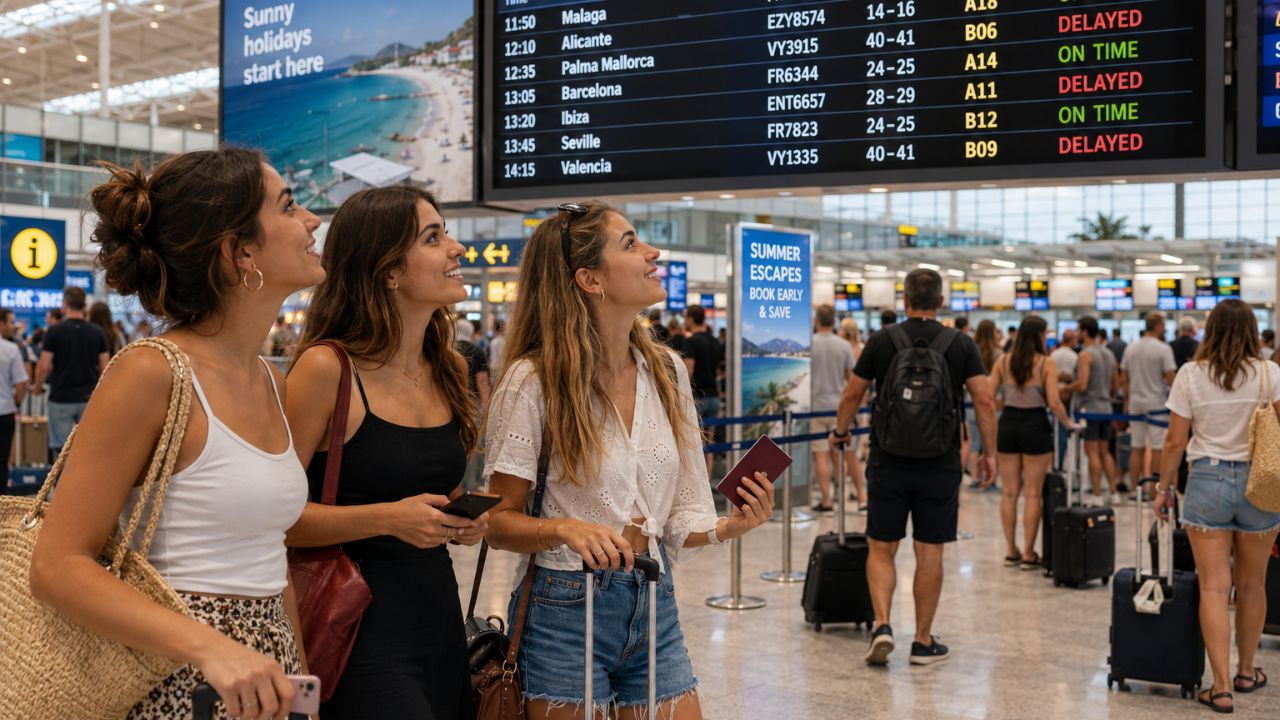
Image generated by AI
Aviation Updates: Massive European Airspace Gridlock Drives UK-Spain Flight Prices to Record Highs Amid Severe Travel Chaos
As incredibly severe terminal gridlock and massive legacy airline network failures completely suffocate primary aviation gateways across the continent, an absolute airspace meltdown is driving United Kingdom to Spain flight prices to devastating highs, forcing passengers to battle unprecedented financial and operational travel chaos.
While incredibly exhausted domestic and international passengers desperately navigate an incredibly brutal peak travel season defined by rolling flight cancellations and severe, localized airport disruptions, a massive, highly destructive capacity crisis is actively paralyzing the absolute highest levels of the European commercial aviation network. According to the absolute latest breaking airline news and official operational warnings from EUROCONTROL, the heavily saturated airspace corridor connecting the United Kingdom to Spain has completely collapsed under surging demand. Desperate to ensure that severe, localized regional air gridlock does not completely destroy their profit margins after years of hyper-inflationary pressures, airlines are aggressively maintaining hyper-inflated ticket prices. At the time of reporting, real-time aviation analysts confirm that despite a massive dip in global jet fuel prices following an interim US-Iran peace deal, carriers are absolutely refusing to pass savings onto consumers. By exploiting massive capacity constraints and airspace closures, airlines are heavily capitalizing on the terrifying unpredictability of the network, ensuring that passengers waiting for speculative last-minute flight bargains will face devastating financial consequences and complete itinerary collapse.
This highly critical capacity crisis explicitly exposes the international aviation network not just as a vital transit feed, but as a heavily congested, deeply fragile financial trap prone to sudden, catastrophic failure during peak transcontinental traffic waves. By violently overwhelming ground handling crews and massive regional aircraft rotation schedules at hubs like Málaga and Alicante, systemic demand directly drives massive global travel chaos. Because traditional transit nodes frequently suffer from severe tarmac congestion leading to massive, unannounced communication breakdowns, the total number of round-trips an aircraft can perform daily is artificially capped. This sudden, structural constraint forces airlines into a brutal pricing strategy that punishes procrastination. The UK-Spain corridor is aggressively emerging as the ultimate proving ground for modern aviation economics, demonstrating that when a network approaches terminal saturation, operational gridlock directly translates into terrifyingly expensive fares that completely shatter holiday budgets.
Aviation Updates: The Strategic Financial Exploitation of Gridlock
This massive, highly structural shift in regional network pricing perfectly illustrates the intense, incredibly fragile nature of modern European mobility.
According to highly detailed, official aviation updates, holidaymakers expecting a sudden wave of cheap flights to the Mediterranean are facing a deeply brutal reality check. While global oil markets have recently stabilized, Reuters tracking data confirms that commercial carriers are aggressively prioritizing the rebuilding of profit margins. Furthermore, basic aviation economics dictate that flight pricing is heavily dictated by sheer seat availability rather than underlying commodity costs. When passenger demand actively matches or wildly exceeds the number of available planes, airlines have zero financial incentive to discount tickets. Short-haul European routes are experiencing unprecedented booking volumes, meaning carriers can effortlessly fill seats at extreme premium rates. Travelers hoping for a late-season miracle on search engines will only find that waiting leads directly to cascading airport disruptions, fewer flight choices, and radically higher final bills.
Section-Wise Breakdown: Navigating the Spanish Capacity Crisis
The sudden, massive evolution of these critical transit expansion models actively impacts several incredibly distinct, highly sensitive operational dynamics spanning multiple massive regional tourism sectors.
The Aena Passenger Surge
At the absolute core of this massive operational pivot is the severe congestion strangling Spanish transit hubs. Spain is experiencing a historic, terrifying surge in international arrivals. Official data released by Aena, the national airport operator, confirms that Spanish hubs processed a staggering 30.69 million passengers in May alone—a massive five percent increase compared to the previous year. Popular coastal entry points like Málaga-Costa del Sol and Alicante-Elche have recorded brutal double-digit growth in British arrivals. Because planes are consistently flying at maximum physical capacity, algorithms automatically enforce massive price hikes. If an airline knows a flight will sell out regardless of cost, the immense passenger traffic ensures that any passenger holding out for a price drop will be heavily punished by the system.
The EUROCONTROL Airspace Bottlenecks
Simultaneously protecting airline pricing models are the physical constraints of European skies. EUROCONTROL has issued a stern, terrifying warning stating that the continent’s aviation network is completely saturated. Peak summer days are projected to handle close to 37,000 individual flights, violently pushing air traffic controllers to their absolute breaking point. Compounding this operational gridlock is the devastating ongoing closure of 80 percent of the airspace over Ukraine and Russia. This geopolitical restriction forces thousands of daily commercial flights into incredibly narrow, heavily congested corridors over Central Europe and the Mediterranean. The resulting bottlenecks cause frequent air traffic control delays, artificially capping seat capacity across Europe and guaranteeing that short-haul ticket prices stay fiercely expensive as flight cancellations loom.
Secondary Hubs and Hidden Fee Traps
The ultimate execution of this massive transit shift heavily relies on unbundling services to mask the true cost of flying. Securing what looks like a bargain headline fare is now a logistical nightmare. Once passengers add cabin bags, checked luggage, mandatory seat selection, and credit card fees, the price violently doubles. To bypass these inflated costs and the severe travel chaos at mega-hubs, savvy jetsetters are aggressively looking at secondary arrival airports like Murcia, Sevilla, or Valencia. However, travelers must meticulously calculate the secondary costs of cross-country trains or car rentals to avoid false economy traps, ensuring that their alternative routing does not end in localized transport gridlock.
Flight Details and Verified Expansion Impact Matrix
To fully understand the exact structural parameters of this massive performance upgrade and how airlines are desperately attempting to navigate complex capacity constraints, the following matrix explicitly details the operational metrics directly recorded by industry trackers.
Confirmed Spain/Europe Aviation Data Matrix
| Operational Metric | Confirmed Spain / Europe Aviation Data |
|---|---|
| Spanish Passenger Volume | 30.69 Million in May (Aena Data) |
| Year-on-Year Growth | 5% Increase in Spanish Arrivals |
| Peak European Flight Volume | ~37,000 Daily Flights (EUROCONTROL) |
| Airspace Restriction | 80% Closure over Ukraine and Russia |
| Primary Hubs Impacted | Málaga-Costa del Sol, Alicante-Elche |
| Secondary Bypass Hubs | Murcia, Sevilla, Valencia |
Data explicitly reflects the massive, highly structural capacity deployment currently defining the congested, hyper-expensive UK-Spain aviation corridor.
Passenger Impact: The Financial and Logistical Reality
For the highly demanding passengers actively engaged in this massive European mobility crisis, traditional, highly anticipated Mediterranean travel is currently viewed as a high-stakes battle against infrastructure limits.
The immediate consequence of this massive tactical pricing shift is measured in the profound financial shock experienced by incredibly exhausted families. Passengers originally holding out for a late-season fare drop are now trapped. By waiting, they face the severe reality of either paying triple the standard fare or entirely abandoning their itineraries due to full capacity. The massive surge in traffic at Málaga and Alicante guarantees that families will face massive queues and potential airport disruptions upon arrival. The artificial cap on seat capacity created by airspace congestion means that securing a flight is no longer just about budget; it is a desperate scramble to secure any available seat before rolling delays and algorithmic price hikes completely neutralize a traveler's ability to fly.
Industry Analysis: The Economics of Tactical Scarcity
Aviation structural analysts strictly point out that this massive, multi-national operational shift perfectly illustrates the extreme, highly vital importance of early booking strategies in a capacity-constrained market.
Economic data explicitly indicates that massive carrier networks are absolutely desperate to leverage operational scarcity to rebuild their margins. The brutal combination of 37,000 daily flights and massive Eastern European airspace closures proves that modern aviation fundamentally lacks the physical capacity to offer discount fares during peak demand. As travelers aggressively prioritize escaping flight cancellations, airlines will continue to unbundle services and rely on algorithms to maximize yield on every single seat. This sensational trend beautifully proves that the era of last-minute cheap flights is completely dead; passengers must aggressively lock in their itineraries early to successfully survive in a highly volatile, capacity-capped operational market.
Conclusion: A Highly Expensive Mediterranean Future
The massively evolving infrastructure dynamics directly defining the integration of high-volume demand into the UK-Spain aviation network violently reflect a much broader, highly critical structural transformation currently dominating how commercial aviation is physically managed in 2026.
Rather than violently forcing massive international traffic to wait for speculative discounts that will never arrive, the industry is explicitly demanding upfront commitment. As airspace over Europe reaches absolute saturation, travelers actively navigating the incredibly busy sector must absolutely remain highly vigilant. To actively survive potential travel chaos this season, passengers must aggressively monitor all breaking aviation updates, lock in their bookings instantly, and perfectly understand that escaping modern airport disruptions and devastating financial traps fundamentally requires utilizing European Commission air passenger rights to guarantee their upfront investment against future operational meltdowns.
Key Takeaways
- Massive Airspace Saturation: EUROCONTROL projects nearly 37,000 daily flights will push European airspace to its absolute limit, heavily restricting airline capacity.
- Record Passenger Surges: Aena reports a staggering 30.69 million passengers processed in May alone, guaranteeing massive travel chaos at Málaga and Alicante.
- The Myth of Last-Minute Fares: Jet fuel price drops will not lower ticket costs; airlines are utilizing algorithms and maximum capacity to keep UK-Spain fares brutally high.
- Geopolitical Bottlenecks: The closure of 80 percent of airspace over Ukraine and Russia forces massive traffic into narrow corridors, driving up the risk of flight cancellations.
- Passenger Survival Strategy: Travelers are aggressively urged to book immediately and heavily rely on European Commission passenger rights to protect against retroactive fee hikes and airport disruptions.
Related Travel Guides
Massive UAE Visa Bombshell: Strict New 30-Day Escape Window Announced
Travel Chaos Cripples Spain as Iberia and Ryanair Suffer 1,079 Delays
Global Flight Cancellation and Compensation Guide 2026
Disclaimer: This article is strictly for informational purposes only. Massive airline pricing algorithms, highly localized airspace congestion, and complex capacity constraints change rapidly based on operational demand and real-time geopolitical events. Always carefully verify your specific itinerary and aggressively monitor real-time fare metrics directly via your respective operator's platform before attempting to secure travel.
Disclaimer
This article is for informational and educational purposes only. It does not constitute legal, financial, or professional advice. While we strive to provide accurate and up-to-date information, travel policies, regulations, and conditions change rapidly. Always verify information with official sources before making travel decisions. Nomad Lawyer makes no representations about the accuracy, reliability, completeness, or suitability of the information provided. Readers should consult qualified professionals for advice specific to their circumstances. The views expressed in this article are those of the author and do not necessarily reflect the views of Nomad Lawyer.