
The Great Eastern Weather Divide: How Gulf Storms and Northeast Sunshine Are Splitting US Autumn Weekend Travel
A sharp weather divide splits US weekend travel as deep Gulf moisture triggers thunderstorm risks across Atlanta and the Southeast, while Boston and New York enjoy dry autumn skies.

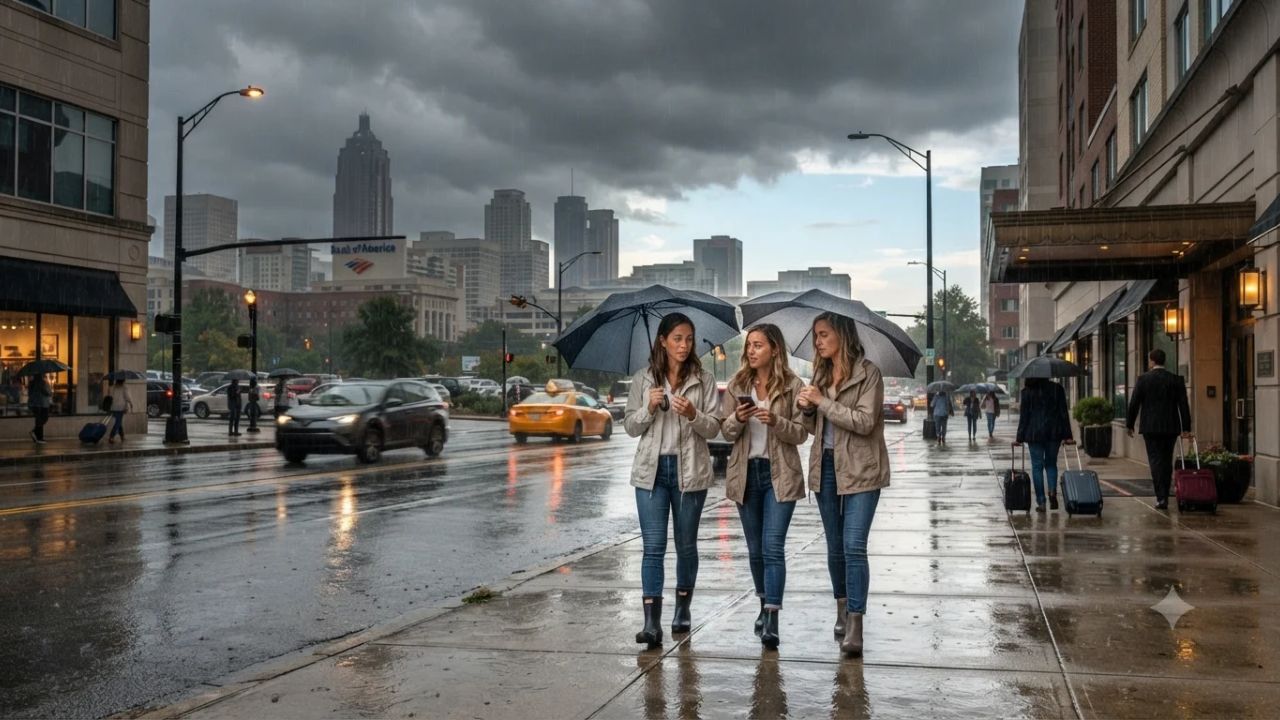
Atmospheric moisture levels surging from the Gulf of Mexico have climbed between two and two-and-a-half standard deviations above normal, creating a pronounced meteorological boundary that completely bisects travel conditions across the eastern United States this weekend. While vacationers in New York City and Boston can look forward to predominantly sunny, crisp autumn conditions on Saturday, travelers moving across Georgia, Alabama, the Carolinas, and the Florida Panhandle must contend with repeated thunderstorm tracks, severe highway ponding, and dangerous coastal surf.
The National Weather Service and NOAA’s Weather Prediction Center have designated a Level 2 of 4 Slight Risk for excessive rainfall across northern Alabama, northern Georgia, Mississippi, and the Tennessee Valley. Because airline connecting banks and interstate routes operate with narrow margins, understanding this geographic divide allows travelers to adapt road trips, flight routings, and sightseeing itineraries.
City-by-City Travel Weather Forecast & Activity Index
| City & State | Saturday Forecast & Rain Probability | Sunday Forecast & Rain Probability | Aviation & Highway Impact | Optimal Weekend Strategy |
|---|---|---|---|---|
| Atlanta, Georgia | 80% showers & thunderstorms | 90% heavy rain & lightning | High delay potential at ATL hub; low clouds | Prioritize indoor cultural venues like High Museum |
| Birmingham, Alabama | 80% heavy precipitation | 80% continued squalls | Highway hydroplaning risk on I-65 and I-20 | Postpone rural hiking; check local drainage updates |
| Montgomery, Alabama | 70% showers & storms | 90% persistent rain | Wet road conditions; reduced visibility | Indoor historic trail visits and culinary exploration |
| Panama City Beach, FL | High rain risk & squalls | Persistent storms; rough surf | High rip-current hazard; double red flags | Avoid swimming; focus on bayfront dining |
| Nashville, Tennessee | 40% isolated showers | 30% clearing conditions | Returning to full sunshine by Monday | Ideal window for lower Broadway and music venues |
| Charleston, SC | 70% rain (0.10–0.25 in) | 80% coastal showers | Downtown historic peninsula tidal pooling | Morning historic architectural strolls before rain |
| Savannah, Georgia | 80% precipitation | 80% showers & storms | Wet cobblestones along River Street | Enclosed trolley tours and covered City Market |
| Washington DC | 20% isolated showers | 60% rain developing afternoon | Sunday evening delays at DCA and IAD | Schedule National Mall monuments on Saturday |
| New York City, NY | Mostly sunny; high 21°C | 40% light showers after 14:00 | Normal operations at JFK, LGA, and EWR | Exceptional Saturday for Central Park foliage walks |
| Boston, Massachusetts | Sunny; crisp autumn air | Mostly sunny; 30% night shower | Clear flight corridors at Logan (BOS) | Prime weekend for Freedom Trail and waterfront walks |
Meteorology Behind the Regional Split
The stark contrast across the eastern seaboard is generated by a slow-moving, moisture-rich frontal boundary interacting with subtropical Gulf air. As tropical moisture feeds into the southern flank of the system, developing thunderstorm clusters repeatedly traverse the same geographic corridors—a process meteorologists term "training." Over saturated soils in northern Georgia, Alabama, and the southern Appalachians, high precipitation rates can quickly exceed municipal storm drain capacities.
Conversely, the northern periphery of this weather system remains separated from the deep tropical moisture plume. High-pressure air over northern New England creates a stable, dry airmass across Massachusetts, Connecticut, and southeastern New York on Saturday, delivering the classic blue-sky autumn conditions that leaf-peepers seek.
Aviation Navigation: Managing the Atlanta Hub
The meteorological instability across the South carries significant implications for air travel. As the world's busiest passenger airport, Hartsfield-Jackson Atlanta International Airport (ATL) serves as a primary domestic connector for Delta Air Lines and international carriers. The Federal Aviation Administration warned on October 1 that convective storm cells and low cloud ceilings in Georgia and Florida would necessitate ground delay programs and route diversions.
To protect your itinerary:
- Connection Buffers: Avoid 40-minute domestic transfers through Atlanta or Charlotte during Saturday afternoon and Sunday morning. Opt for connecting itineraries through northern hubs such as Philadelphia (PHL), Detroit (DTW), or Chicago (ORD) when flying north-south.
- Flight Status Alerts: Enable push notifications directly through your airline app rather than third-party aggregators. Flight schedules adjust dynamically as air traffic controllers reroute aircraft around active squall lines across the Florida Panhandle.
- Carry-On Essentials: Pack essential medications, electronics chargers, and a change of clothing in your hand luggage in case weather-related ramp holds delay checked baggage offloading.
Visitor Insider Tips for Weekend Exploration
Adapting your weekend travel across the eastern corridor requires tactical flexibility:
- Gulf Coast Surf Caution: Along the Florida Panhandle from Pensacola to South Walton, beach safety patrols enforce strict double-red flag warnings. Even during brief dry spells between rain bands, dangerous longshore currents and rip currents persist. Never enter the water under double-red conditions.
- Highway Driving Tactics: If driving along Interstate 85 between Montgomery and Atlanta or Interstate 75 through northern Georgia, reduce cruising speeds by 15 mph during heavy downpours. Fresh rainfall mixes with roadway oil residue to create slick driving surfaces before water drains off the asphalt.
- Capital District Scheduling: In Washington DC, schedule outdoor excursions across the National Mall and tidal basin for Saturday morning when precipitation chances remain below 20 percent. Reserve Sunday for the Smithsonian National Air and Space Museum or the National Gallery of Art as rainfall chances rise to 60 percent.
- Northeast Foliage Window: Take full advantage of Saturday’s sunny forecast in New York and Boston. Morning walking routes along the High Line in Manhattan or the Emerald Necklace in Boston will experience unobstructed autumn sunshine before cloud cover thickens Sunday evening.
Cultural and Environmental Context
While intense rainfall introduces temporary travel friction, autumn precipitation plays an indispensable ecological role across the American South. Following hot, dry summer months, Gulf moisture systems replenish critical reservoir levels in Lake Lanier and the Chattahoochee River basin, supporting municipal drinking water supplies and maintaining water flow through sensitive riverine ecosystems.
In historic coastal cities like Charleston and Savannah, managing sudden deluge events intersects directly with architectural conservation. High-volume rain events coinciding with full-moon tides put pressure on 18th-century drainage vaults. Sustainable urban management initiatives in both cities are deploying modern pump stations and permeable paving to protect historic brick foundations against water damage while preserving the historic character of the Lowcountry.
FAQ: Navigating the Eastern US Weather Divide in Autumn 2026
Which regions face the greatest risk of travel disruptions this weekend?
Northern Alabama, northern Georgia, Mississippi, the Tennessee Valley, and the Florida Panhandle face the highest likelihood of flash flooding, flight delays, and hazardous driving conditions.
Is New York City and Boston weather suitable for outdoor sightseeing?
Yes. Saturday will be mostly sunny and dry in New York City and completely sunny in Boston, offering ideal conditions for walking tours, outdoor dining, and park visits.
How are flights through Atlanta (ATL) being affected?
Convective thunderstorms and low cloud decks can prompt FAA ground stops and pacing programs, making it advisable to allow longer connection times when transiting Atlanta.
What precautions should coastal travelers in Florida take?
Avoid swimming in the Gulf of Mexico along the Florida Panhandle due to extreme rip currents, and monitor local National Weather Service beach safety bulletins.
Whether navigating the sudden downpours of the South or walking under the crisp northern sun, travelers who track the skies uncover the true rhythm of an autumn journey.
Related Travel Guides
Disclaimer
This article is for informational and educational purposes only. It does not constitute legal, financial, or professional advice. While we strive to provide accurate and up-to-date information, travel policies, regulations, and conditions change rapidly. Always verify information with official sources before making travel decisions. Nomad Lawyer makes no representations about the accuracy, reliability, completeness, or suitability of the information provided. Readers should consult qualified professionals for advice specific to their circumstances. The views expressed in this article are those of the author and do not necessarily reflect the views of Nomad Lawyer.
Preeti Gunjan
Contributor & Community Manager
A passionate traveller and community builder. Preeti helps grow the Nomad Lawyer community, fostering engagement and bringing the reader experience to life.
Learn more about our team →