
Singapore Capsule Hotels Expand Micro-Space Hospitality Supported by Record S$32.8 Billion Tourism Spending
Capsule hotel developments in Singapore expand as 2025 tourism receipts reach S$32.8B across 16.9 million international arrivals.

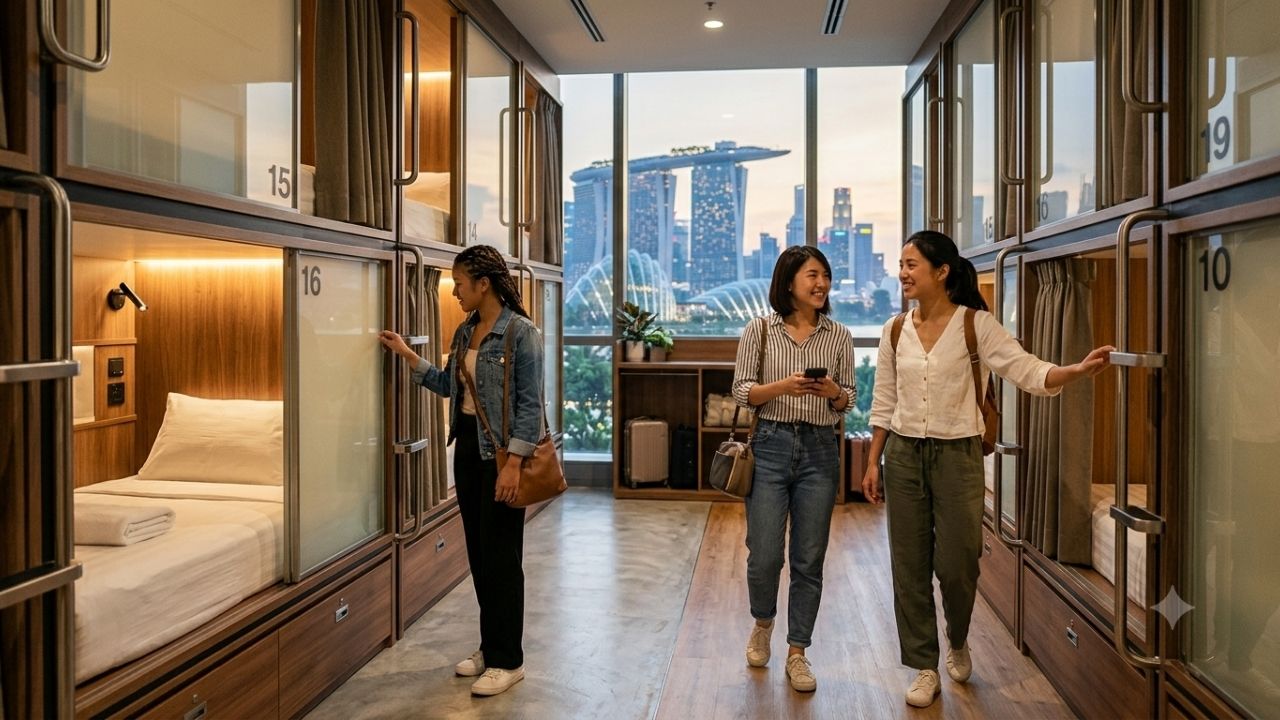
Image generated by AI
Capsule hotels in Singapore are expanding within the city-state's hospitality sector as international visitor arrivals reached 16.9 million in 2025.
[SINGAPORE] — Official statistics from the Singapore Tourism Board (STB) show that Singapore welcomed 16.9 million international visitors in 2025, generating a record S$32.8 billion in tourism receipts. Operating within a national hotel network of over 450 properties and 73,000 rooms, capsule hotels have developed into a regulated micro-space hospitality format. Subject to strict fire-safety regulations—including individual pod sprinklers and occupant movement sensors—capsule properties provide high-density, centrally located lodging for solo budget travelers across historic districts like Chinatown and Kampong Glam.
Macro Economic Context: STB Tourism Indicators and Arrival Metrics
Singapore’s hospitality sector relies on diverse accommodation formats to manage high visitor volume within a limited urban land mass.
Between 2024 and 2025, international visitor arrivals increased from 16.5 million to 16.9 million (up 2.3%), while total tourism receipts grew from S$29.8 billion to a record S$32.8 billion.
For 2026, STB projects between 17 million and 18 million international arrivals, with tourism receipts expected to reach S$31 billion to S$32.5 billion, moving toward a long-term target of S$47 billion to S$50 billion by 2040 under the Tourism 2040 blueprint.
Singapore Tourism Board (STB) Macro Baseline:
├── 2024 Performance: 16.5 Million international arrivals | S$29.8 Billion tourism receipts
├── 2025 Performance: 16.9 Million international arrivals (+2.3%) | S$32.8 Billion record receipts
├── 2026 Projections: 17.0M–18.0M arrivals | S$31.0B–S$32.5B projected receipts
└── 2040 Vision Target: S$47.0B–S$50.0B long-term annual tourism receipt target
| Tourism Indicator | Latest Official Figure | Operational Context |
|---|---|---|
| International Visitors (2025) | 16.9 Million | 2.3% YoY growth over 2024 (16.5M) |
| Tourism Receipts (2025) | S$32.8 Billion | Record high (up from S$29.8B in 2024) |
| Hotel Property Inventory | 450+ Properties | Spans luxury, boutique & capsule hostels |
| Total Room Inventory | 73,000+ Rooms | Hotel sector generates ~20% of tourism spend |
| Hospitality Workforce | ~30,000 Workers | Supports operations across all lodging tiers |
Evolution of Singapore’s Capsule Industry: Chinatown Origins to Heritage Pods
Adapted from Japanese urban sleeping pods, Singapore’s capsule lodging sector began with the opening of Wink Hostel in Chinatown in 2011.
Its sleeping pods measured approximately 1.2 meters in height and width by 2.0 meters in length, introducing individual privacy screens, power points, and reading lights within shared dormitories.
Subsequent developments by operators such as CUBE integrated boutique design elements into restored heritage shophouses across Chinatown and Kampong Glam, moving the model toward high-end micro-hospitality.
Singapore Capsule Timeline & Dimensions:
├── 2011 Benchmark: Wink Hostel opens in Chinatown (Pods: 1.2m H x 1.2m W x 2.0m L)
├── Heritage Expansion: CUBE introduces boutique shophouse pods in Kampong Glam & Chinatown
└── Consumer Model: Private sleeping pod + shared bathrooms, lounges & luggage storage
| Accommodation Format | Private Sleeping Space | Shared Facilities | Primary Space Priority |
|---|---|---|---|
| Conventional Hotel | Full private room | Limited (Lobby/Pool) | Room volume & ensuite bathroom |
| Hostel Dormitory | Bunk bed (Open dorm) | Extensive | Social interaction & lowest cost |
| Capsule Hotel | Enclosed private pod | Significant | Privacy, location & sleep utility |
| Serviced Apartment | Full private apartment | Limited | Extended multi-week stays |
Strict Fire-Safety Mandates: Sprinklers, Stacking Limits, and Motion Sensors
Singapore’s Fire Safety Bureau enforces strict regulatory standards specifically defining capsule hotel operations:
- Access Dimensions: Each capsule must provide a clear access opening measuring at least 800 mm by 600 mm (or a minimum area of 0.5 square meters).
- Vertical Stacking: Stacking is strictly limited to a maximum of two tiers per unit.
- Fire Protection: Buildings require full sprinkler systems, and each individual capsule must contain at least one dedicated fire sprinkler and a smoke or heat detector tied to the central alarm.
- Occupant Sensors: Every capsule must feature an internal presence and movement sensor to assist emergency search-and-rescue teams during building evacuations.
Singapore Fire-Safety Mandates for Capsule Hotels:
├── Pod Entry Clearance: Minimum 800mm x 600mm (0.5 sq meter clear opening area)
├── Vertical Stacking Cap: Maximum 2 tiers per capsule pod unit
├── In-Pod Fire Protection: Mandatory individual fire sprinkler & smoke detector per capsule
└── Rescue Technology: Internal occupant presence & motion detection sensor per pod
Hotels Licensing Board Oversight: Annual Renewals and Inspections
All capsule properties operate under the Hotels Licensing Board, requiring a Certificate of Registration and a Hotel-Keeper’s Licence prior to opening.
Regulatory guidelines mandate annual license renewals, pre-opening physical inspections of sleeping pods, surveillance systems, and ventilation units.
Properties with total occupant loads exceeding 200 persons must obtain secondary annual fire safety certifications, ensuring micro-stay properties maintain standards equivalent to conventional hotels.
Hotels Licensing Board Compliance Rules:
├── Operating License: Certificate of Registration & Hotel-Keeper's Licence required
├── Inspection Audit: Annual renewal inspections covering pods, surveillance & fire exits
└── High-Occupancy Threshold: Facilities with >200 occupant load require extra fire certificates
| Traveler Profile / Category | Capsule Format Suitability | Key Operational Reason |
|---|---|---|
| Solo City Break Traveler | High | Private, quiet sleeping space in central districts |
| Short-Stay Transit Guest | High | Central location outweighs private room size |
| Backpacker / Budget Traveler | High | Lower cost per night with enhanced privacy |
| Heavy Luggage Traveler | Moderate | Shared luggage lockers require advance planning |
| Family Travelers | Low | Pods designed primarily for single occupancy |
Frequently Asked Questions (FAQ)
Q1: What are the minimum fire-safety entry dimensions for capsule pods in Singapore?
A: Singapore fire-safety rules mandate a minimum pod access opening of 800 mm by 600 mm, or an equivalent area of at least 0.5 square meters.
Q2: How many capsule pods can be stacked vertically under Singapore regulations?
A: Singapore building regulations restrict vertical pod stacking to a maximum of two tiers.
Q3: What safety features are required inside every individual capsule?
A: Each capsule must contain a dedicated fire sprinkler, smoke or heat detector, and an internal occupant motion detection sensor.
Why This Matters for Solo Travelers, Hospitality Engineers, and Urban Planners
Analyzing Singapore's capsule hotel sector provides key industry insights:
- For Solo Travelers: Booking licensed capsule hotels ensures individual privacy and central location at a fraction of full-room hotel rates.
- For Hospitality Engineers: Designing capsules to meet 800mm x 600mm access and in-pod sprinkler rules guarantees regulatory compliance.
- For Urban Planners: Micro-space hospitality offers a high-density solution for housing short-stay visitors in space-constrained cities.
Related Travel Guides
Disclaimer
This article is for informational and educational purposes only. It does not constitute legal, financial, or professional advice. While we strive to provide accurate and up-to-date information, travel policies, regulations, and conditions change rapidly. Always verify information with official sources before making travel decisions. Nomad Lawyer makes no representations about the accuracy, reliability, completeness, or suitability of the information provided. Readers should consult qualified professionals for advice specific to their circumstances. The views expressed in this article are those of the author and do not necessarily reflect the views of Nomad Lawyer.
Raushan Kumar
Founder & Lead Developer
Full-stack developer with 11+ years of experience and a passionate traveller. Raushan built Nomad Lawyer from the ground up with a vision to create the best travel and law experience on the web.
Learn more about our team →