
Seattle Unveils First-Ever Drone Scoreboard for FIFA World Cup 26, Turning Sky Above Space Needle Into Live Match Display
Seattle launches a 400-drone real-time scoreboard above the Space Needle for FIFA World Cup 26, debuting the first same-

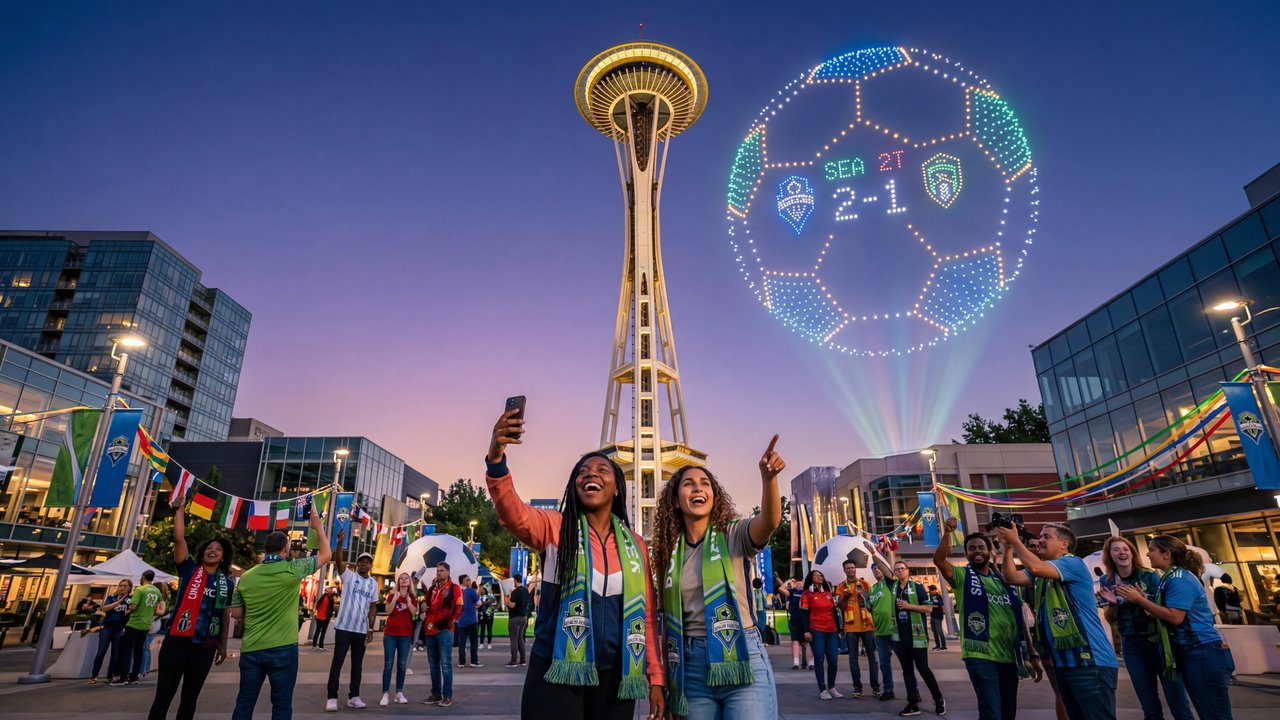
Image generated by AI
[Seattle, June 23, 2026] — Seattle has launched an unprecedented nighttime aerial display featuring a real-time drone scoreboard during its FIFA World Cup 26™ hosting period, deploying 400 coordinated drones above Seattle Center and the Space Needle to broadcast live match scores and national flags to thousands of spectators. The activation, which premiered on June 15 and June 19, represents the first known integration of same-day sports scoring into a drone show format, transforming the city's skyline into a dynamic public information display.
Visit Seattle Champions Aerial Innovation Above Space Needle
The initiative positions Seattle's most recognizable landmark—the Space Needle, originally constructed for the 1962 World's Fair—as the visual anchor for a technology-driven spectacle tied to global football's biggest tournament. Stephanie Byington, chief marketing officer for Visit Seattle, described the concept as a reflection of the city's dual identity as both a hub of technological innovation and a community with deeply rooted sports fandom.
Byington noted that the drone scoreboard was conceived to leave a memorable impression on international visitors attending World Cup matches, as well as remote audiences following the tournament from abroad. The display leverages Seattle's natural scenic backdrop and its reputation for cutting-edge engineering to create a distinctive hosting experience that extends beyond stadium boundaries.
400-Drone Fleet Delivers Real-Time Match Scores in Night Sky
At the technical core of the program, a fleet of 400 drones executes synchronized formations that function as a functioning scoreboard suspended above the city. The system is engineered to project final match scores alongside corresponding national flags, a capability that industry observers describe as the first documented use of same-day competitive results embedded into a live aerial drone performance.
Each presentation lasts approximately 12 minutes and incorporates motion graphics, illumination sequences, and visual themes connected to the host city's identity. Beyond score updates, the drone choreography includes stylized depictions of the Seattle skyline and a whale-tail motif drawn from regional World Cup design language. The combination of live sports data, aerial robotics, and creative animation positions the installation among the most technically complex fan engagement projects associated with the tournament.
Seattle Center International Fountain Serves as Primary Viewing Location
Public access to the drone shows is structured around free, open-air viewing opportunities. The designated primary observation point is the International Fountain Plaza at Seattle Center, located at 305 Harrison St, Seattle, WA 98109. This site offers spectators an unobstructed sightline toward the aerial formations as they animate the airspace above the surrounding campus.
Presentations are scheduled within late-evening windows, typically falling between 10 p.m. and 11:30 p.m. Pacific Time, though organizers caution that weather conditions and operational requirements may prompt adjustments. Confirmed upcoming display dates include:
| Date | Scheduled Time (PT) | Notes |
|---|---|---|
| June 24 | 10:00 p.m. | International match pairing event |
| June 26 | After 11:00 p.m. | Time subject to adjustment |
| July 1 | 11:30 p.m. | Late-evening window |
| July 6 | To be determined | Final scheduling pending |
Floating Soccer Pitch at Pier 62 Expands World Cup Footprint to Waterfront
Seattle's broader World Cup hosting strategy extends well beyond the drone scoreboard, incorporating a network of citywide activations designed to distribute fan activity across downtown and waterfront corridors. A standout feature is a temporary floating soccer pitch installed at Pier 62, situated at 1951 Alaskan Way, Seattle, WA. This installation pushes the tournament's physical presence into public recreational space along the Elliott Bay waterfront, offering visitors an interactive experience removed from the stadium environment.
The floating pitch concept reflects an effort to reimagine how host cities can use existing public infrastructure to amplify the cultural reach of a sporting event. By activating waterfront real estate that normally serves as general recreational space, Seattle creates an environment where football engagement becomes embedded in the daily rhythm of the city.
Seattle Soccer House at 600 Pine Street Offers Multi-Level Immersive Viewing
In the downtown retail corridor, a multi-level commercial building at 600 Pine St, Seattle, WA has been converted into Seattle Soccer House, an immersive viewing destination featuring large-format broadcast screens distributed across multiple floors. The venue is designed to accommodate concentrated fan gatherings in a structured indoor setting, providing an alternative to open-air viewing for spectators seeking a more controlled environment.
The transformation of a conventional retail space into a dedicated football viewing hub illustrates how host cities are repurposing existing commercial infrastructure to meet surge demand during tournament periods. Seattle Soccer House functions as both a social gathering point and an economic driver, channeling visitor traffic into the downtown retail district.
Victory Hall in SODO District Combines Broadcasts With Hospitality Programming
Seattle's SODO district hosts another major fan activation at 1201 1st Avenue South, Seattle, WA, where Victory Hall operates as a combined viewing and hospitality venue. The facility features a large-scale broadcast screen measuring approximately 23 feet, paired with food and beverage service designed to sustain extended match-day attendance.
Victory Hall's location in the SODO neighborhood places it in proximity to Seattle's stadium cluster, creating a natural flow between formal match venues and auxiliary fan zones. The integration of dining and viewing functions within a single space reflects a broader trend in sports hospitality, where host cities seek to maximize dwell time and per-visitor spending during high-profile events.
Unity Loop Links Cultural Spaces and Entertainment Zones Across Seattle
The various installations are interconnected through a citywide experience framework designated as the Unity Loop, a planned pathway designed to stitch together cultural institutions, small businesses, public parks, and entertainment districts into a continuous visitor route. The system aims to distribute pedestrian traffic across multiple neighborhoods while preserving a coherent narrative for fans navigating the city during the tournament.
By linking dispersed activations through a unified circulation strategy, Seattle reduces pressure on any single venue while broadening the economic footprint of World Cup-related tourism. The Unity Loop concept also encourages visitors to explore districts beyond the immediate stadium vicinity, supporting smaller commercial operators who might otherwise remain outside the tournament's economic radius.
Walkable Downtown Infrastructure Strengthens Seattle's Host City Positioning
Seattle's suitability as a World Cup host is reinforced by its compact, walkable downtown configuration, which allows visitors to move among hotels, stadium facilities, and fan zones on foot. This urban structure reduces reliance on motorized transit during peak periods and creates a more seamless experience for international visitors unfamiliar with local transportation systems.
The region's proximity to natural landscapes—including mountain and waterway vistas visible from multiple points within the city—adds a scenic dimension that distinguishes Seattle from flatter or more densely built host environments. Additionally, the Pacific Northwest's high baseline rate of youth and adult soccer participation contributes to a local audience that is both knowledgeable and enthusiastic, generating organic atmosphere across the city's public spaces during match days.
Drone Scoreboard Reflects Convergence of Aerial Robotics and Live Sports Broadcasting
The drone scoreboard program is the product of collaboration among a specialist aerial display provider, municipal venue operators, tournament organizers, and creative agencies. The system merges several previously distinct technical domains—autonomous drone choreography, real-time sports data integration, and large-scale public entertainment programming—into a single coordinated output.
Industry observers note that the installation represents one of the most ambitious fan engagement deployments associated with the tournament, both in terms of technical complexity and public accessibility. Unlike stadium-based digital displays, the drone scoreboard operates in open airspace, making it visible to anyone within line of sight of Seattle Center at no cost. This accessibility model aligns with broader efforts by host cities to democratize the World Cup experience beyond ticketed venues.
Impact on Tourism and Urban Branding Extends Beyond Tournament Window
The drone scoreboard and its associated citywide activations carry implications that extend past the final whistle of FIFA World Cup 26™. By investing in large-scale, publicly accessible programming that merges technology, sport, and urban identity, Seattle signals a hosting philosophy that prioritizes both immediate fan engagement and long-term destination branding.
The visibility of the Space Needle and Seattle Center as backdrops for globally broadcast imagery reinforces the city's international profile as both a tourism destination and a center for innovation. For the tourism sector, the drone scoreboard functions as a marketing asset that will continue to generate visual content and media references well after the tournament concludes, potentially influencing visitor decision-making in subsequent travel cycles.
Seattle's Drone Scoreboard Sets New Benchmark for Future Mega-Event Hosting
The deployment of a 400-drone real-time scoreboard above Seattle Center establishes a new technical and creative benchmark for how cities can stage public-facing spectacles during mega-events. As future host cities evaluate their own fan engagement strategies, Seattle's model—combining open-access viewing, live data integration, multi-district activation networks, and walkable urban infrastructure—offers a replicable framework that extends the cultural and economic impact of global sporting tournaments far beyond the stadium gates.
Related Travel Guides
Disclaimer
This article is for informational and educational purposes only. It does not constitute legal, financial, or professional advice. While we strive to provide accurate and up-to-date information, travel policies, regulations, and conditions change rapidly. Always verify information with official sources before making travel decisions. Nomad Lawyer makes no representations about the accuracy, reliability, completeness, or suitability of the information provided. Readers should consult qualified professionals for advice specific to their circumstances. The views expressed in this article are those of the author and do not necessarily reflect the views of Nomad Lawyer.
Kunal K Choudhary
Co-Founder & Contributor
A passionate traveller and tech enthusiast. Kunal contributes to the vision and growth of Nomad Lawyer, bringing fresh perspectives and driving the community forward.
Learn more about our team →