
Seattle and New York Power US GDP Surge: Record Foreign Overnight Stays and 2026 Travel Guide

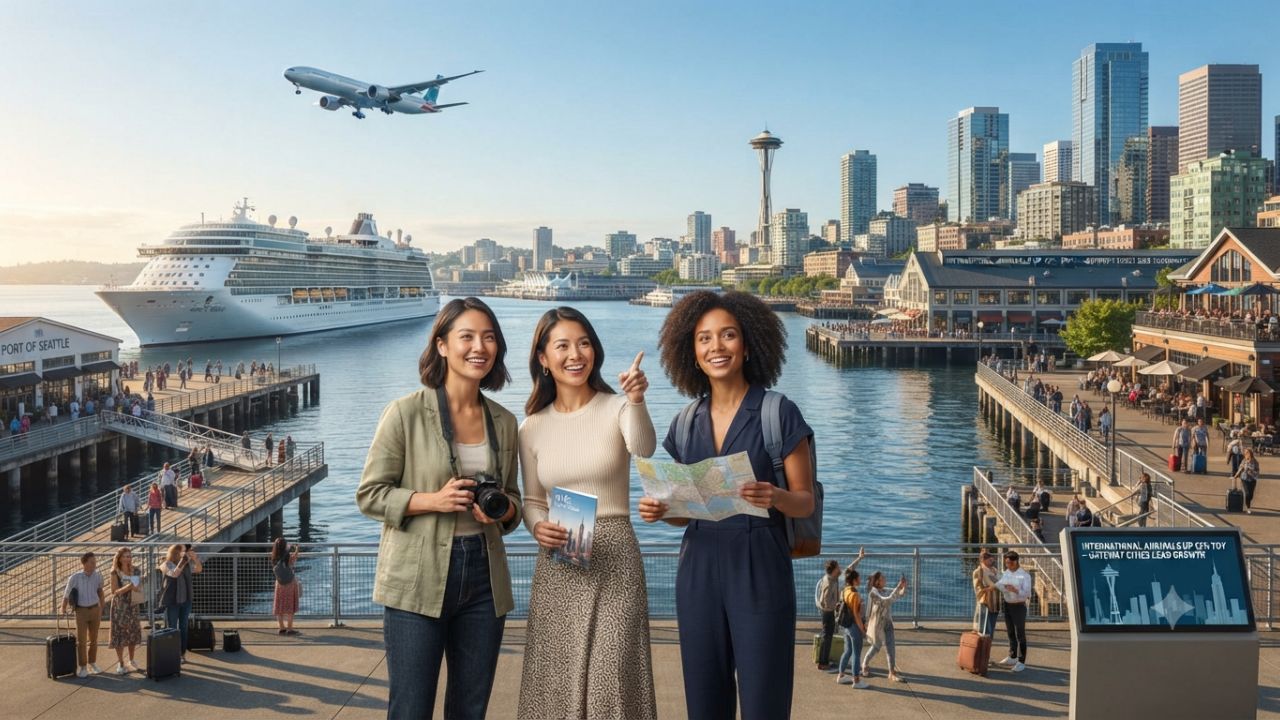
Image generated by AI
International overnight stays across the United States expanded at a record 9.0 percent year-on-year pace in 2026, growing nearly three times faster than domestic leisure volume and generating 33 percent of all US service exports. According to verified national accounts from the Bureau of Economic Analysis (BEA) and the National Travel and Tourism Office (NTTO), travel and tourism exports now account for 11 percent of total US exports, helping propel annualized real Gross Domestic Product (GDP) growth to 2.1 percent.
While New York City maintains its historic primacy as the nation's premier transatlantic gateway, the Pacific Northwest has emerged as America’s fastest-growing foreign trade corridor. Driven by widebody transpacific routes at Seattle-Tacoma International Airport (SEA) and a record-breaking Alaska cruise season at the Port of Seattle, global visitors from East Asia, Western Europe, and Latin America are transforming the Puget Sound region into a major international economic engine.
The Macroeconomic Surge: Transpacific Inflows and Urban Gateways
Monthly non-resident arrivals entering the United States stabilized between 5.4 million and 5.7 million during peak summer periods, on track to surpass 70 million international visitors nationwide in 2026 and projecting toward 75 million to 85 million in upcoming cycles.
In Seattle, the convergence of aerospace, enterprise technology, and maritime cruising has created a high-yield corporate and leisure ecosystem. Direct widebody flights connecting SEA with Tokyo, Seoul, Taipei, London, Paris, and Frankfurt on Boeing 787 Dreamliners and Airbus A350 aircraft operate at elevated international load factors, while the Port of Seattle’s cruise terminals—including Bell Street Pier at Pier 66—recorded their highest passenger volume in history.
| Macroeconomic & Gateway Metric | 2026 Recorded Baseline | Comparative Growth Rate | Strategic National Impact |
|---|---|---|---|
| US Travel Service Export Share | 33% of Total US Service Exports | #1 Single US Service Export Category | Narrows current account trade deficit |
| Total US Export Share | 11% of All US Exports | Multi-Billion Monthly Inflow | Funds high-wage domestic hospitality jobs |
| Foreign Overnight Stay Growth | +9.0% Year-on-Year | 3x Faster than Domestic Travel Growth | High daily per-capita visitor spend |
| Monthly Non-Resident Arrivals | 5.4M to 5.7M Visitors / Month | 70M+ Projected Annual Volume | Forecast to reach 75M–85M in late 2020s |
| US Real Annualized GDP Growth | 2.1% Annualized Growth | Beats Early Consensus Forecasts | Service exports drive positive net output |
Source: U.S. Bureau of Economic Analysis (BEA) & National Travel and Tourism Office (NTTO).
Seattle's Structural Shift as a Premier Transpacific Hub
Seattle’s emergence as a top-tier international arrival port relies on three structural economic pillars:
- Transpacific Route Expansion: Increased flight frequencies on non-stop widebody routes connecting Seattle-Tacoma International Airport (SEA) with major financial centers in East Asia, Southeast Asia, and Western Europe.
- Maritime Cruise Volume: The Port of Seattle’s record cruise season positioning the city as the primary Pacific hub for long-haul international travelers bound for Alaska and northern coastal itineraries.
- Corporate "Bleisure" Mobility: High foreign direct investment (FDI) and corporate travel generated by regional tech giants—including Amazon, Microsoft, Boeing, and Nordstrom—where international business executives extend corporate trips into high-spending personal vacations.
These dynamics mean foreign travelers in Seattle average longer stays and significantly higher daily expenditures than domestic day-trippers, creating a strong economic multiplier for local hotel, dining, and transit networks.
Federal and State Policy Frameworks Accelerating Visitor Access
Public agencies have implemented targeted infrastructure and policy initiatives to support international arrival growth:
- Airport Facility Modernization: Multi-billion-dollar investments funded through the Bipartisan Infrastructure Law have expanded international processing halls at SEA airport. U.S. Customs and Border Protection (CBP) deployed Simplified Arrival biometric systems, cutting passenger processing times and expanding hourly terminal throughput.
- Public-Private Marketing Alignment: The Washington State Department of Commerce and Visit Seattle aligned marketing campaigns alongside public port authorities, utilizing regional tourism improvement districts to recruit international flight routes.
- Intermodal Transit Integration: Sound Transit’s Link Light Rail directly connects SEA airport to downtown commercial centers, Bellevue technology corridors, and maritime cruise piers, enabling international visitors to travel seamlessly across the metropolitan area without adding to highway congestion.
Multiplier Effects on Hospitality, Retail, and Municipal Revenues
The influx of foreign visitors has delivered gains across commercial hospitality and public tax treasuries:
- Hotel Occupancy & RevPAR: Revenue Per Available Room (RevPAR) and Average Daily Rate (ADR) across downtown Seattle reached record summer benchmarks. Hoteliers report that foreign travelers book further in advance, exhibit lower cancellation rates, and utilize premium property amenities at elevated rates.
- Retail & Cultural Activation: High-end retail sales in downtown commercial districts, Pike Place Market, and regional cultural venues have surged, supporting urban commercial real estate values.
- Municipal Tax Collections: Transient occupancy taxes and local sales tax collections from foreign visitors provide dedicated funding for municipal services, convention center operations, and public transit without increasing tax burdens on local residents.
US International Travel & Macroeconomic FAQ: October 2026
What percentage of US service exports does travel and tourism represent? Travel and tourism exports account for 33 percent of all US service exports and 11 percent of total US exports, making it the single largest service export category in the national balance of payments.
How fast are foreign overnight stays growing compared to domestic travel? Foreign overnight stays grew at a 9.0 percent year-on-year rate in 2026, expanding nearly three times faster than domestic leisure travel volume.
What non-stop international flight routes connect Seattle-Tacoma International Airport (SEA)? SEA features direct widebody service to major global hubs including Tokyo, Seoul, Taipei, London, Paris, and Frankfurt on Boeing 787 and Airbus A350 aircraft.
What is the annual projection for international visitors to the United States in 2026? Monthly arrivals averaging 5.4 million to 5.7 million put the United States on track to surpass 70 million international visitors in 2026, with long-term forecasts reaching 75 million to 85 million.
Why This Matters for Travel Operators and Policy Makers in 2026
For commercial travel operators and economic policy makers, 2026 benchmarks confirm that international tourism functions as a vital national service export. High-spending foreign visitors directly reduce the trade deficit while funding domestic transportation and hospitality infrastructure.
By aligning widebody aviation routes, biometric port processing, and light rail transit integration, gateway cities like Seattle and New York demonstrate how modern urban centers can convert global travel demand into long-term national GDP growth.
Related Travel Guides
Disclaimer
This article is for informational and educational purposes only. It does not constitute legal, financial, or professional advice. While we strive to provide accurate and up-to-date information, travel policies, regulations, and conditions change rapidly. Always verify information with official sources before making travel decisions. Nomad Lawyer makes no representations about the accuracy, reliability, completeness, or suitability of the information provided. Readers should consult qualified professionals for advice specific to their circumstances. The views expressed in this article are those of the author and do not necessarily reflect the views of Nomad Lawyer.
Kunal K Choudhary
Co-Founder & Contributor
A passionate traveller and tech enthusiast. Kunal contributes to the vision and growth of Nomad Lawyer, bringing fresh perspectives and driving the community forward.
Learn more about our team →