
Kazakhstan's SCAT Airlines Executes Massive Fleet Expansion with Dual Boeing 737 MAX 8 Deliveries
Violently modernizing Central Asian aviation capacity, SCAT Airlines has deployed two brand-new Boeing 737 MAX 8 aircraft, solidifying the Shymkent hub as a premier corridor.

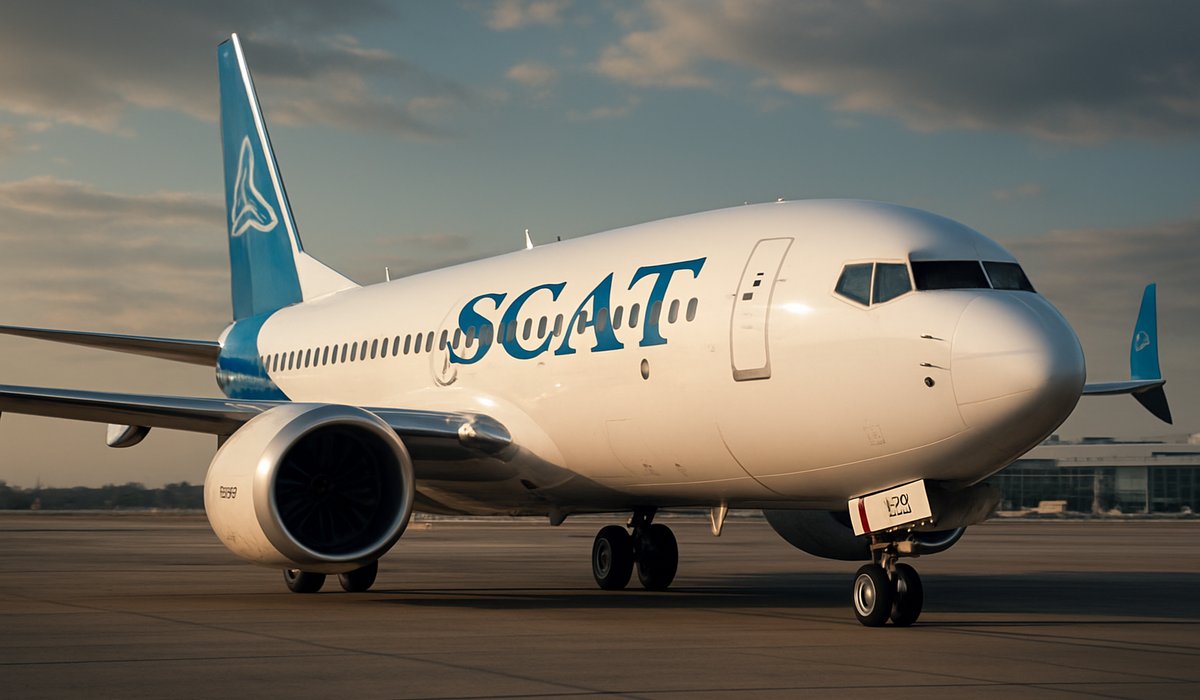
Image generated by AI
Re-Engineering the Central Asian Air Corridor
Fundamentally redefining the power dynamics of Eurasian logistics, SCAT Airlines—one of Kazakhstan’s absolute premier carriers—has officially executed a massive fleet modernization strategy by successfully delivering two brand-new Boeing 737 MAX 8 aircraft directly from Seattle. This multi-million dollar acquisition in April 2026 is an incredibly aggressive statement of intent. The airline is actively dismantling the outdated, legacy flight infrastructure of Central Asia and violently replacing it with highly advanced, hyper-efficient modern fleets capable of executing highly profitable long-range missions without refueling.
This specific expansion completely anchors SCAT’s overarching strategy: to mathematically establish Shymkent International Airport—their corporate home—as the absolute primary transfer hub connecting the deep reaches of Asia with Europe. The deployment of the 737 MAX 8 is vital to this mission. These jets provide an enormous range advantage and burn mathematically 20% less fuel than previous generations. SCAT is utilizing this extreme efficiency to rapidly carpet-bomb its route network, opening massive direct flight pipelines connecting Astana to crucial outposts like Ulaanbaatar, and directly assaulting the massive Russian and regional markets (Novosibirsk, St. Petersburg, Bishkek) with unprecedented flight frequencies.
The Strategy of the Shymkent Hub
The geography of this expansion is brilliant.
By actively funneling these new Boeing assets into Shymkent Airport rather than strictly relying on the massive capital hub of Astana or Almaty, SCAT is generating a deeply strategic, secondary megahub in the southern tier of the country. This significantly eases regional friction. Travelers moving from deeply rural Kazakh zones or neighboring Uzbekistan no longer have to endure grueling routing north to Almaty; they can execute a massive, seamless European transfer directly through Shymkent, riding in the ultra-quiet, intensely comfortable cabin space unique to the new MAX jet architecture.
The Central Asian Aviation Matrix (SCAT Focus)
| Core Aviation Component | The Obsolete Paradigm | The Modern SCAT Reality |
|---|---|---|
| Aircraft Tech (The Boeing MAX) | Antiquated Soviet-era or legacy western jets. | Hyper-fuel efficient, massive range capability. |
| Route Architecture | Forced massive backtracking through Almaty. | Point-to-point regional dominance via Shymkent hub. |
| The Primary Vectors | Strictly localized internal hops. | Massive international jumps (e.g., Astana to Ulaanbaatar/St. Petersburg). |
What Guests Get
- Complete acoustic comfort — realizing that the Boeing 737 MAX 8 mathematically features a massively quieter cabin footprint, deeply reducing travel fatigue on harsh regional flights.
- The destruction of 'Range Limits' — grasping that SCAT can now execute much longer direct flights without annoying, complex fuel stops, saving travelers hours of connection time.
- Micro-economic aviation shifts — understanding that an airline executing massive fleet upgrades forces competitors to drastically improve their own hard-product to retain demanding Central Asian business travelers.
What This Means for Travelers
If you are mapping an itinerary crossing Central Asia or Eurasia in 2026: You must consciously audit the specific aircraft type when booking your flights. The legacy airlines of the region frequently utilize a mix of aging equipment. By actively targeting SCAT flights explicitly operated by the massive new 737 MAX 8s, you mathematically guarantee a significantly safer, vastly more comfortable European-standard passenger experience. Look for the distinct split-scimitar winglets on the aircraft when configuring your booking; this physical detail guarantees you are flying the new jet.
Navigating the Shymkent Hub: As SCAT aggressively builds Shymkent into a massive international transfer point, travelers should absolutely expect ongoing, heavy construction and rapid expansion at the actual physical airport facility. To mitigate massive crowding during this growth phase, ensure you arrive a full 180 minutes prior to international departures. You must possess the exact required visas for transit, as the complex, rapidly expanding web of destinations involves several nations (like Russia and Mongolia) that mandate strict, uncompromising border documentation.
FAQ: Flying the New Kazakh Network
Is SCAT Airlines safe? Yes. SCAT Airlines operates under incredibly strict international aviation protocols. The integration of brand-new, direct-from-factory Boeing aircraft further solidifies their commitment to absolute operational safety and modern fleet mechanics.
Why is the Boeing 737 MAX 8 important? It is the absolute workhorse of modern aviation. Beyond safety upgrades, its modern engine design allows airlines to fly significantly farther using far less fuel, which mathematically allows them to launch long, thin routes (like Astana to Ulaanbaatar) profitably.
Where exactly is Shymkent? It is a massive, incredibly vital economic city located deep in southern Kazakhstan, situated perfectly near the borders of Uzbekistan and Kyrgyzstan, making it a brilliant geographic nexus for regional air logistics.
External Resources
Related Travel Guides
- Airlines Deploy Lie-Flat Beds on Narrowbody Jets: A Game-Changing Strategy to Combat Rising Operating Costs
- Air Canada Pilot Faces Fraud Charges After Operating Aircraft for 17 Years Without Valid Credentials
- Major US Carriers Retire Regional Jets, Deploy Larger Airbus Aircraft on Secondary Airport Routes
Disclaimer
This article is for informational and educational purposes only. It does not constitute legal, financial, or professional advice. While we strive to provide accurate and up-to-date information, travel policies, regulations, and conditions change rapidly. Always verify information with official sources before making travel decisions. Nomad Lawyer makes no representations about the accuracy, reliability, completeness, or suitability of the information provided. Readers should consult qualified professionals for advice specific to their circumstances. The views expressed in this article are those of the author and do not necessarily reflect the views of Nomad Lawyer.
Raushan Kumar
Founder & Lead Developer
Full-stack developer with 11+ years of experience and a passionate traveller. Raushan built Nomad Lawyer from the ground up with a vision to create the best travel and law experience on the web.
Learn more about our team →