
Saudi Arabia Exits China-Linked mBridge as Alipay+ Expands Chinese Tourist Payments in 2026
Saudi Arabia Exits China-Linked mBridge as Alipay+ Expands Chinese Tourist Payments in 2026

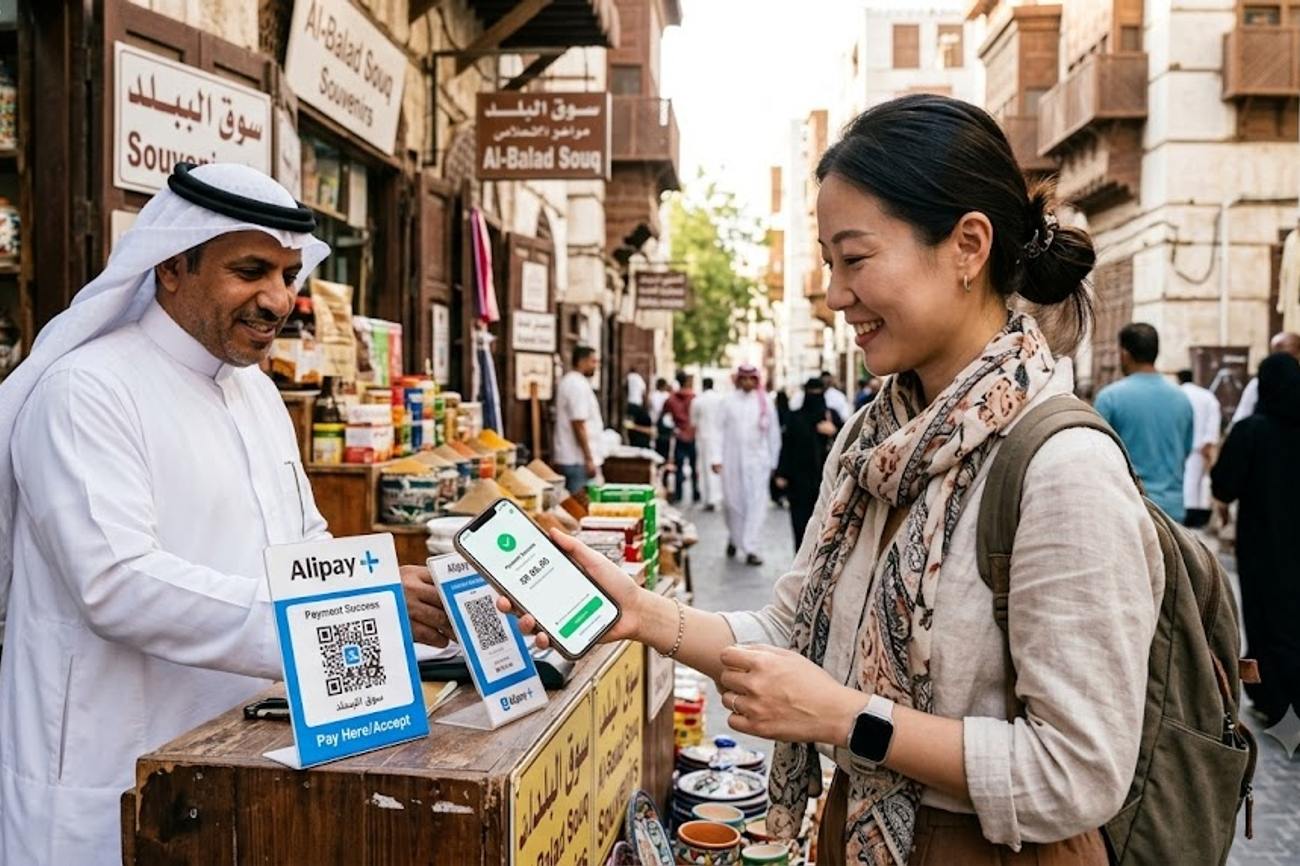
Image generated by AI
[Riyadh, October 2025] — Saudi Arabia is pivoting its digital financial strategy away from the institutional mBridge project to prioritize consumer-facing payment systems, signaling a strategic shift toward facilitating international tourism. The Kingdom's reported withdrawal from the mBridge initiative marks a move away from a central bank digital currency (CBDC) framework focused on the Chinese digital yuan in favor of broader, retail-oriented payment integrations.
The Saudi Central Bank (SAMA), the nation's monetary authority, is now accelerating the integration of global digital wallets into its domestic infrastructure. While mBridge served as a wholesale system for commercial bank settlements, the new focus centers on the "mada" national payment network. This shift ensures that as the Kingdom scales its tourism ambitions under Vision 2030, international visitors can utilize familiar digital payment tools at the point of sale.
The mBridge Departure
The decision to exit mBridge represents a decoupling of institutional banking experiments from retail tourism needs. SAMA had officially joined the mBridge project in June 2024, participating in its Minimum Viable Product (MVP) platform. The project, supported by the Bank for International Settlements (BIS), aimed to create a multi-central-bank wholesale digital currency system.
The primary goal of mBridge was to streamline cross-border payments between commercial banks across different jurisdictions, specifically involving monetary authorities from China, Thailand, Hong Kong, and the UAE. By utilizing a distributed-ledger platform, the project sought to reduce the operational complexity, cost, and time associated with institutional settlements. However, because mBridge operated exclusively at the institutional level, it provided no direct utility for a tourist attempting to pay for a meal in Riyadh or a hotel stay in AlUla.
Markets and Users Impacted
The transition from wholesale CBDC exploration to retail payment expansion affects several distinct groups. The following table outlines the specific impact across different sectors:
| Affected Group | Previous Framework (mBridge) | New Framework (Alipay+/mada) | Impact Status |
|---|---|---|---|
| Chinese Tourists | No direct consumer access | Full digital wallet integration via Alipay+ | Positive/Expanding |
| Commercial Banks | Wholesale CBDC settlement | Traditional & Digital Wallet routing | Shift in focus |
| Saudi Merchants | No change to POS systems | Ability to accept international wallets | Increased revenue potential |
| Global Travelers | Reliance on credit cards/cash | Integration of Google Pay and JCB | Improved convenience |
The shift is most pronounced for visitors from Asia. The agreement signed in September 2025 between SAMA and Ant International ensures that Alipay+ acceptance will be rolled out through the mada system during 2026. This allows users of international digital wallets connected to the Alipay+ ecosystem to make seamless purchases at participating Saudi merchants.
Practical Traveler Advisory and Strategic Insights
For the average traveler, the exit from mBridge is a non-event; however, the expansion of the mada network is a significant upgrade. In plain language, this means the "friction" of spending money in Saudi Arabia is disappearing.
Previously, international visitors relied heavily on traditional credit cards or cash. Starting in 2026, travelers using Alipay+ compatible wallets will be able to pay at merchants using the mada system—the same system Saudi locals use for almost everything. This removes the need for currency exchange or the risk of card rejection at smaller vendors.
Furthermore, the Saudi payment ecosystem is becoming "wallet-agnostic." With the January 2025 agreement to introduce Google Pay via mada and the February 2025 announcement that mada now supports JCB International cards at ATMs and point-of-sale terminals, the Kingdom is ensuring that whether a tourist is from the US, Japan, or China, their preferred digital method will likely work.
The Digitalization of the Saudi Economy
This policy shift is not happening in a vacuum but is a response to the rapid digitalization of the domestic economy. SAMA data from 2026 reveals a massive surge in cashless transactions:
The expansion of Alipay+ payment systems aims to streamline financial logistics for Chinese tourists visiting the Kingdom by 2026. Travelers can find comprehensive entry requirements and visa application guidelines through the official Visit Saudi portal to ensure a seamless arrival.
- Retail Payment Share: Electronic payments accounted for 85% of all retail transactions in 2025, a significant jump from 79% in 2024.
- Transaction Volume: Total electronic transactions reached 14.6 billion in 2025, compared to 12.6 billion the previous year.
This domestic trend creates a natural bridge for international systems. Because Saudi merchants are already equipped with mada-compatible terminals for 85% of their business, adding international layers like Alipay+ or Google Pay requires minimal hardware changes and maximum efficiency.
Tourism Growth and Economic Stakes
The urgency of these payment upgrades is driven by the staggering growth in visitor numbers. According to the Saudi Vision 2030 Annual Report 2025, the Kingdom recorded 123 million total tourists in 2025. Of these, more than 30 million were international visitors.
The economic footprint of this growth is substantial:
- Tourism Spending: US$81 billion was spent by tourists in 2025.
- Future Targets: The Kingdom aims to hit 150 million visitors by 2030.
- Geographic Expansion: Growth is no longer limited to religious pilgrimage sites but extends to luxury and adventure hubs including AlUla, Diriyah, Aseer, and the Red Sea coast.
The stakes extend beyond convenience to employment. Data from the Saudi Statistics Authority shows that in the second quarter of 2024, 959,175 people were employed in tourism-related activities. This represents 5.7% of the total national workforce, marking a 5.1% increase year-over-year. For these nearly one million workers—and the businesses that employ them—the ability to accept diverse international payments directly correlates to higher spending per visitor and improved operational efficiency.
FAQ: Saudi Arabia Digital Payments 2026
Can I use my digital wallet in Saudi Arabia right now? Google Pay is being integrated via the mada system as of early 2025. Alipay+ integration is scheduled for wider availability throughout 2026. Always check with your specific wallet provider for current compatibility.
Does the mBridge exit mean I can't use Chinese currency? No. mBridge was a bank-to-bank settlement system, not a consumer app. The exit does not affect your ability to spend money; in fact, the Alipay+ agreement makes it easier for Chinese visitors to pay.
Will I need a local SIM or bank account to use these services? No. The goal of the mada integration with Alipay+, Google Pay, and JCB is to allow international visitors to use their existing home-country wallets and cards at Saudi merchants.
Where will these payment methods be accepted? Integration is happening via the national mada network, meaning acceptance will span from major hotels in Riyadh to smaller shops and attractions in emerging destinations like AlUla and the Red Sea coast.
The Kingdom is trading institutional experimentation for retail reality.
Related Travel Guides
Disclaimer
This article is for informational and educational purposes only. It does not constitute legal, financial, or professional advice. While we strive to provide accurate and up-to-date information, travel policies, regulations, and conditions change rapidly. Always verify information with official sources before making travel decisions. Nomad Lawyer makes no representations about the accuracy, reliability, completeness, or suitability of the information provided. Readers should consult qualified professionals for advice specific to their circumstances. The views expressed in this article are those of the author and do not necessarily reflect the views of Nomad Lawyer.
Preeti Gunjan
Contributor & Community Manager
A passionate traveller and community builder. Preeti helps grow the Nomad Lawyer community, fostering engagement and bringing the reader experience to life.
Learn more about our team →