
Travel Chaos at SFO: 225 Flight Delays and 8 Cancellations Cripple United, SkyWest, and Global Operations
San Francisco International Airport faces massive operational disruption as major US and international airlines struggle with cascading flight delays and cancellations.

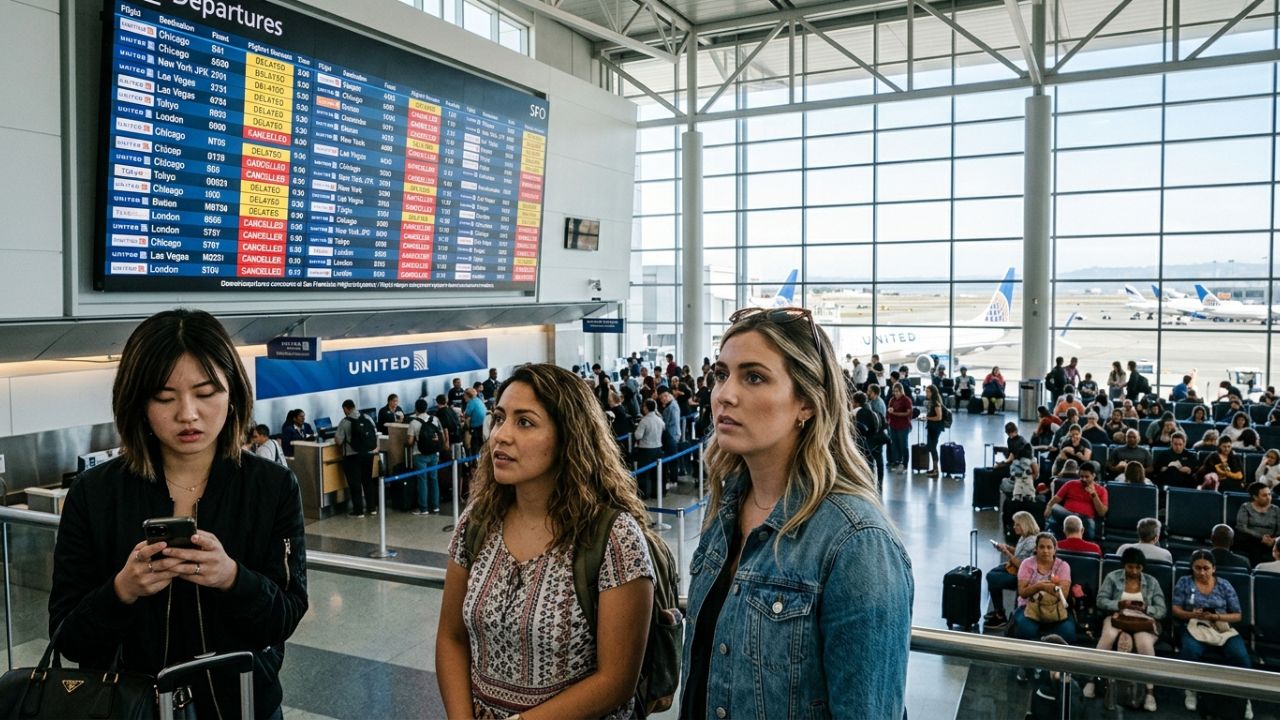
Image generated by AI
Travel Chaos at SFO: 225 Flight Delays and 8 Cancellations Cripple United, SkyWest, and Global Operations
Massive operational bottlenecks at San Francisco International Airport trigger widespread itinerary destruction across critical US domestic corridors and high-yield international routes.
A severe wave of travel chaos has violently struck San Francisco International Airport (SFO), as intense operational pressure shatters flight schedules across both domestic and international networks. On June 21st, 2026, the massive West Coast aviation hub officially recorded a staggering 225 flight delays alongside 8 outright flight cancellations. This escalating logistical nightmare has heavily impacted dominant domestic operators and prestigious international carriers alike, with United Airlines, Frontier, SkyWest, Air Canada, and Southwest experiencing massive delay pressures.
As one of the United States' most critical international gateways, any airport disruptions in San Francisco immediately trigger a brutal ripple effect across the broader aviation network. Currently, highly congested flight corridors linking SFO to Chicago, New York City, Las Vegas, Montreal, and Rome are facing extreme instability. For thousands of frantic passengers caught in the crossfire of this massive airline news event, agonizing uncertainty and severely extended waiting times have replaced their seamless travel expectations.
Aviation Updates: The Scale of the Disruption at SFO
The rapidly deteriorating situation at San Francisco International Airport serves as a brutal reminder of how interconnected modern air travel has become. The primary disruption zone is heavily centered around the airport's massive departure and arrival banks, where the sheer volume of delayed flights has placed unbearable pressure on terminal movement and gate allocation.
Because SFO plays an absolutely critical role in both long-haul international connectivity and high-frequency domestic travel, these operational disruptions are rapidly radiating outward. Airline ground handlers and air traffic coordination systems are currently overwhelmed by cumulative, cascading delays. Consequently, both inbound and outbound travel flows through San Francisco have been significantly slowed, generating widespread schedule destruction that shows little sign of immediate relief.
Section-Wise Breakdown: A Global Network Compromised
The geographical footprint of this disruption is immense, tearing through short-haul domestic hops and ultra-long-haul intercontinental routes.
Domestic Corridors Choked
Travel activity heavily originating or terminating in San Francisco has been particularly compromised on high-demand domestic routes. Passengers traveling to and from Chicago, New York City, and Las Vegas are enduring some of the most severe delays. Furthermore, a massive list of regional and transcontinental destinations—including Austin, Nashville, Baltimore, Charlotte, Dallas, Denver, Washington, Los Angeles, Seattle, and Honolulu—are locked in a vicious cycle of rolling delays, completely destabilizing the US domestic travel network.
Transborder Operations Severed
Critical North American transborder operations have also taken a severe hit. High-yield routes directly linking San Francisco to major Canadian hubs such as Montreal, Edmonton, Vancouver, Calgary, and Toronto are deeply affected by the chaos, trapping transborder business travelers and vacationers alike.
International Long-Haul Impact
The travel chaos heavily extends across the Atlantic and Pacific oceans. Vital international travel flows linking the US with massive global destinations such as Rome, Munich, Frankfurt, and Hong Kong have been aggressively slowed. International passengers are facing extreme anxiety as the highly complex air traffic sequencing required to slot wide-body aircraft into the congested SFO hub entirely breaks down.
Flight Details and Operational Data
According to verified operational data, the disruption heavily targeted specific routes and carriers. While cancellations were contained to 8 flights, the massive volume of 225 delays utterly crippled schedule reliability.
Routes Affected by Cancellations: Chicago, Montreal, Jackson Hole, Ontario.
Routes Affected by Delays: Munich, McKinleyville, Austin, Bakersfield, Bishop, Nashville, Boise, Burbank, Baltimore, Bozeman, Cleveland, Charlotte, Columbus, Dallas, Denver, Spokane, Kalispell, Washington, Indianapolis, New York City, Las Vegas, Los Angeles, Monterey, Minneapolis–Saint Paul, North Bend, Portland, Philadelphia, Phoenix, Pittsburgh, Palm Springs, San Diego, San Luis Obispo, Seattle, San Jose, Salt Lake City, Santa Ana, St Louis, Rome, Mexico City, Monterrey, San José del Cabo, Honolulu, Hong Kong, Edmonton, Vancouver, Calgary, Toronto, Frankfurt.
Confirmed Airline Disruption Matrix
| Airline | Cancelled | Cancelled (%) | Delayed | Delayed (%) |
|---|---|---|---|---|
| United | 4 | 0% | 67 | 13% |
| Frontier | 2 | 7% | 1 | 3% |
| SkyWest | 1 | 0% | 43 | 23% |
| Air Canada | 1 | 6% | 3 | 18% |
| All Nippon Airways | 0 | 0% | 1 | 20% |
| Alaska Airlines | 0 | 0% | 12 | 20% |
| Condor | 0 | 0% | 2 | 100% |
| Cathay Pacific | 0 | 0% | 1 | 25% |
| Delta Air Lines | 0 | 0% | 7 | 7% |
| Lufthansa | 0 | 0% | 1 | 25% |
| EVA Air | 0 | 0% | 2 | 33% |
| ITA Airways | 0 | 0% | 2 | 100% |
| JetBlue | 0 | 0% | 2 | 6% |
| Jazz (Air Canada Jazz) | 0 | 0% | 2 | 50% |
| Korean Air | 0 | 0% | 1 | 33% |
| Breeze Airways | 0 | 0% | 1 | 16% |
| Philippine Airlines | 0 | 0% | 1 | 50% |
| Porter Airlines | 0 | 0% | 1 | 50% |
| Qantas | 0 | 0% | 1 | 50% |
| Air Canada Rouge | 0 | 0% | 1 | 50% |
| Starlux Airlines | 0 | 0% | 1 | 50% |
| Southwest Airlines | 0 | 0% | 39 | 65% |
| Swiss International Air Lines | 0 | 0% | 1 | 50% |
| American Airlines | 0 | 0% | 28 | 35% |
| WestJet | 0 | 0% | 3 | 50% |
| Air France | 0 | 0% | 1 | 25% |
United Airlines recorded the highest absolute level of disruption (67 delays, 4 cancellations). Regional connector SkyWest suffered 43 delays, while Southwest Airlines absorbed 39 delays, heavily impacting their short-haul network.
Passenger Impact: Uncertainty and Itinerary Destruction
For the traveling public actively navigating San Francisco International Airport, the immediate consequences are incredibly stressful. The layered disruption scenario means that precisely timed domestic connections are violently failing.
Passengers traveling on United and SkyWest are the most severely affected due to massive network density at SFO. A single delay arriving from Seattle or Las Vegas can brutally sever a crucial transcontinental connection to New York or an international flight to Rome. Consequently, exhausted passengers are facing unexpected overnight hotel stays, lost deposits, and the agonizing task of navigating automated rebooking systems that offer little immediate relief during peak congestion windows.
Industry Analysis: The Mechanics of Hub Congestion
Aviation analysts monitoring the SFO crisis point to the inherent vulnerabilities of heavily utilized West Coast transit hubs. While no structural conclusions can be definitively drawn beyond the reported data, the disruption heavily reflects a snapshot of severe operational conditions. When an unforeseen challenge arises—whether driven by air traffic control constraints, weather anomalies, or cascading late arrivals—the massive volume of aircraft movement at SFO quickly consumes any available schedule buffer. This forces airlines into extended turnaround times and drastically altered departure sequencing, which predictably leads to mass delays and strategic flight cancellations.
Conclusion: A Difficult Road to Normalization
The massive travel setback at San Francisco International Airport clearly illustrates how rapidly a centralized node of aviation disruption can infect the entire US network. With 225 delays and 8 cancellations currently tearing through itineraries, major airlines like United, American, and Southwest are frantically attempting to stabilize their operations. Travelers must maintain extreme vigilance; closely monitoring official airline notifications and leveraging flexible booking options will be absolutely critical as the US aviation system battles to restore operational stability in the coming days.
Key Takeaways
- Massive Disruptions: San Francisco International Airport recorded 225 flight delays and 8 cancellations on June 21st, 2026.
- United Airlines Hit Hardest: The major carrier absorbed 4 cancellations and an absolutely staggering 67 delayed flights.
- Regional Networks Choked: SkyWest (43 delays) and Southwest Airlines (39 delays) suffered massive operational failures across short-haul routes.
- Widespread Route Destruction: Delays impacted domestic heavyweights (Chicago, NYC, Las Vegas) and international routes (Rome, Montreal, Frankfurt, Hong Kong).
- Cascading Failures: Severe pressure on gate allocation and terminal movement aggressively fueled the delay spiral.
- Passenger Action Required: Travelers must strictly monitor real-time updates directly from their airlines and prepare for extensive rebooking scenarios.
Related Travel Guides
Los Angeles Airport Flight Cancellations Disrupt Global Networks
Travel Chaos at Dubai Airport: Over 100 Flight Delays Disrupt Emirates and Global Routes
Disclaimer
This article is for informational and educational purposes only. It does not constitute legal, financial, or professional advice. While we strive to provide accurate and up-to-date information, travel policies, regulations, and conditions change rapidly. Always verify information with official sources before making travel decisions. Nomad Lawyer makes no representations about the accuracy, reliability, completeness, or suitability of the information provided. Readers should consult qualified professionals for advice specific to their circumstances. The views expressed in this article are those of the author and do not necessarily reflect the views of Nomad Lawyer.
Preeti Gunjan
Contributor & Community Manager
A passionate traveller and community builder. Preeti helps grow the Nomad Lawyer community, fostering engagement and bringing the reader experience to life.
Learn more about our team →