
Rising Diesel Costs Transform Southeast Asian Bus and Ferry Networks Travel as Thailand, Indonesia And Other Push Fuel Surcharges Higher
Rising Diesel Costs Transform Southeast Asian Bus and Ferry Networks Travel as Thailand, Indonesia And Other Push Fuel Surcharges Higher

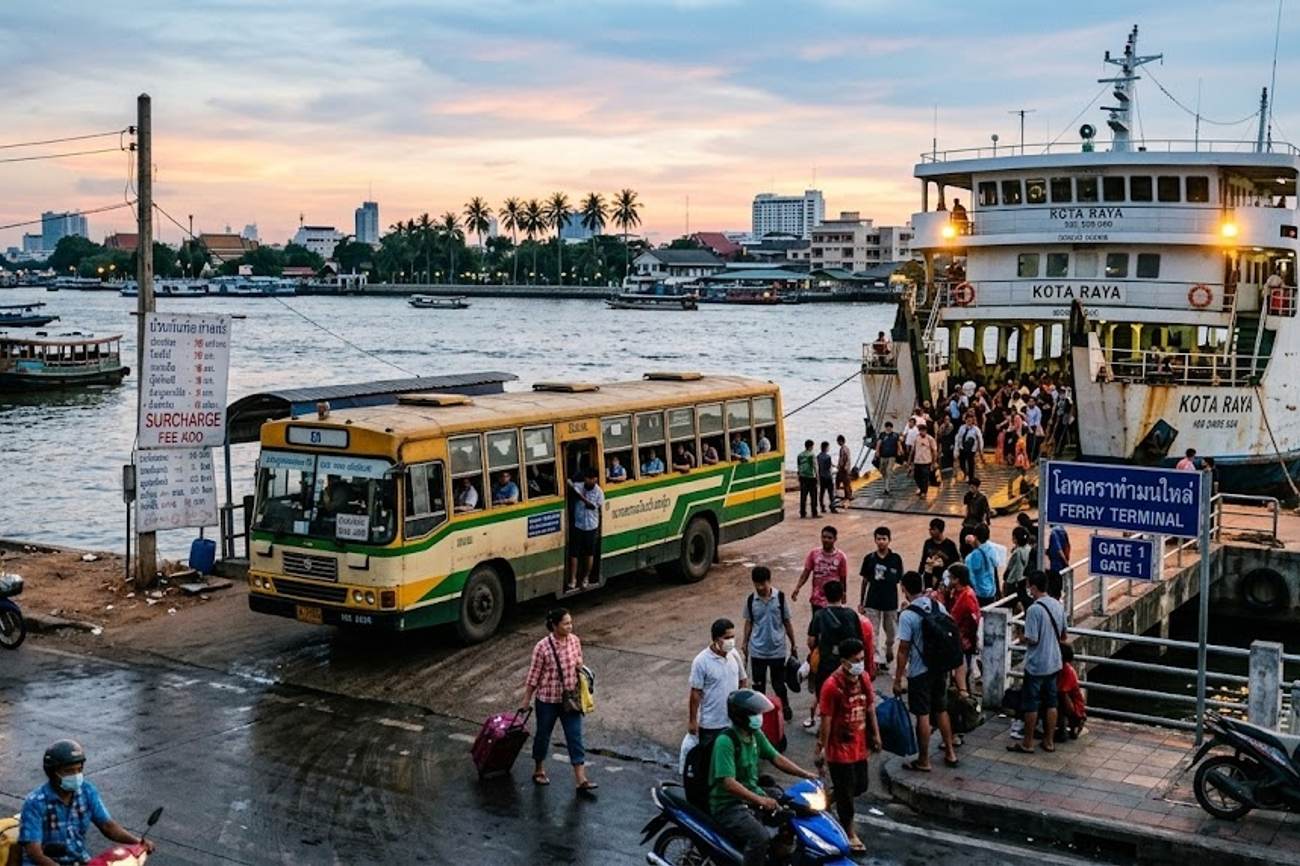
Image generated by AI
[Bangkok, October 2023] — A systemic economic crisis is destabilizing Southeast Asia’s overland and maritime transport networks as surging diesel prices trigger a "fuel surcharge cascade" across the region. While global aviation often absorbs fuel volatility through dynamic pricing, ground and sea operators are trapped between rising energy costs and rigid government-mandated fare caps.
The crisis is most acute across Thailand, Indonesia, and the Philippines, where diesel expenses now consume up to 55% of total operating costs for certain vessel types. Because these services are classified as essential public utilities, operators cannot unilaterally raise ticket prices, leading to a liquidity squeeze that is forcing fleet reductions, the cancellation of off-peak schedules, and a total restructuring of wholesale tourism packages.
The Mechanics of the Fuel Surcharge Cascade
The current instability stems from a fundamental difference in how transport sectors manage revenue. Commercial airlines utilize sophisticated revenue management platforms and international tariff structures, allowing them to index fuel costs into ticket prices almost instantly. In contrast, interprovincial coach services and domestic roll-on/roll-off (Ro-Ro) ferry networks operate under strict statutory oversight and fixed public concessions.
When refineries in hubs such as Singapore, Rayong, and Balikpapan increase wholesale prices, the impact hits commercial supply chains within days. Ground and maritime operators lack the complex multi-year hedging contracts or derivative desks used by major airlines. Instead, they rely on short credit windows or cash payments at highway filling stations and marine bunkering berths.
This creates a "vice" effect: diesel costs rise immediately, but retail fares remain frozen by law. For a private operator running a 45-seater VIP coach over an 800-kilometre corridor at 50% capacity, the operation becomes cash-negative the moment diesel exceeds a specific baseline. While state-owned entities may receive treasury subventions to cover losses, private concessionaires must drain their operating reserves to survive.
Who Is Affected: Operational Impact by Mode
The financial burden is not distributed evenly across the transport sector. High-speed vessels and long-haul coaches face the most severe margin compression due to their thermodynamic and regulatory constraints.
| Transport Mode | Fuel Expense Share (% of OpEx) | Regulatory Mechanism | Hedging Ability | Demand Elasticity |
|---|---|---|---|---|
| Intercity Express Coach | 35% – 45% | Departmental fare caps (fixed tariff bands) | Negligible (Retail pump) | High (Leisure) / Low (Commuter) |
| High-Speed Catamaran | 40% – 55% | Maritime agency surcharge ceilings | Limited short-term bunker forwards | Moderate (Limited by geography) |
| Ro-Ro Passenger Ferry | 30% – 42% | State enterprise tariff integration | Moderate state-backed bunkering | Low (Freight) / High (Foot passengers) |
| Tourism Minivans | 22% – 30% | Unregulated private market | None (Spot retail price) | Low to Moderate (Bundled tours) |
The crisis is particularly visible in high-density corridors. In the Thailand Southern Island Artery, connecting Bangkok (Mo Chit 2 / Sai Tai Mai) to Surat Thani and the islands of Koh Samui, Phangan, and Tao, a clash has emerged between regulated land transport caps and the variable bunker surcharges applied by private catamaran operators.
What This Means for Travelers
For passengers booking travel within Southeast Asia, the "silent crisis" translates into several immediate practical disruptions. You should not assume that a confirmed ticket guarantees a departure or a consistent price.
1. Unpredictable Scheduling Operators are slashing "irregular" or off-peak timetables to preserve solvency. Travelers may find that mid-week or late-night departures are suddenly cancelled without significant notice, as operators prioritize high-load-factor windows to minimize losses.
2. The "Hidden" Surcharge While base fares may remain static due to government caps, travelers are seeing an increase in "ancillary" fees. These may appear as "terminal fees," "service charges," or "fuel supplements" that are not subject to the same statutory ceilings as the primary ticket price.
3. Deteriorating Fleet Quality Because cash flow is being diverted to fuel, capital investment in vehicle maintenance is freezing. Passengers may encounter older, less reliable vehicles as operators cannibalize retired fleets for spare parts rather than purchasing new components.
4. Package Restructuring Inbound tour operators and Destination Management Companies (DMCs) are currently rewriting their wholesale contracts. If you have booked a bundled tour, you may be asked to pay an additional fuel supplement upon arrival, or find that your itinerary has been altered to favor rail connections over private coach transfers.
The Regulatory Deadlock and Future Outlook
The path to stability requires a synchronization between market prices and government policy. Currently, private transport associations must petition ministries of transport for emergency tariff relief. However, the administrative process—involving multi-agency hearings and socioeconomic impact assessments—often takes weeks or months.
By the time the Ministry of Transport or similar regional bodies sanction a fare increase, the structural damage is often permanent. Marginal operators exit the market entirely, reducing overall competition and capacity.
To mitigate these risks, there is an accelerating shift toward multimodal integration. Operators are increasingly pushing passengers toward rail networks, which often benefit from different subsidy structures or more efficient energy profiles. In the maritime sector, the high hydrodynamic drag of fast-craft vessels—where fuel consumption increases non-linearly with speed—is forcing a re-evaluation of cruising speeds. Reducing speed from 30 knots to 20 knots can significantly lower the fuel-to-revenue ratio, though it increases transit times for passengers.
Industry analysts expect a period of consolidation. Smaller, family-owned coach and ferry lines are likely to be absorbed by larger conglomerates that possess the liquidity to weather prolonged periods of negative cash flow.
FAQ: Southeast Asia Transport Crisis 2023
Why can't bus and ferry companies just raise their prices? Most interprovincial transit is legally designated as an essential public utility. Governments enforce statutory fare ceilings to protect public mobility, meaning operators need formal ministerial approval before changing ticket prices.
Will this affect my pre-booked tour package? Yes. Many tour operators are restructuring ground transport costs. You may face additional fuel surcharges or find that your private transfer has been replaced by a shared shuttle or rail option.
Which routes are most likely to see cancellations? Off-peak and low-occupancy routes are most vulnerable. High-speed catamaran routes to remote islands and mid-week long-haul coach schedules are currently the most likely to be reduced.
Are there alternatives to avoid these disruptions? Where available, state-run rail networks are more stable. For maritime travel, larger Ro-Ro ferries are generally more resilient than high-speed catamarans due to lower fuel-burn per passenger.
The region's transit arteries are tightening, leaving travelers to navigate a landscape of shrinking schedules and rising hidden costs.
#ThailandTransport2023 #ASEANLogistics #DieselCrisis #BangkokToKohSamui #MaritimeSurcharges #SEATransitUpdate
Related Travel Guides
Disclaimer
This article is for informational and educational purposes only. It does not constitute legal, financial, or professional advice. While we strive to provide accurate and up-to-date information, travel policies, regulations, and conditions change rapidly. Always verify information with official sources before making travel decisions. Nomad Lawyer makes no representations about the accuracy, reliability, completeness, or suitability of the information provided. Readers should consult qualified professionals for advice specific to their circumstances. The views expressed in this article are those of the author and do not necessarily reflect the views of Nomad Lawyer.
Raushan Kumar
Founder & Lead Developer
Full-stack developer with 11+ years of experience and a passionate traveller. Raushan built Nomad Lawyer from the ground up with a vision to create the best travel and law experience on the web.
Learn more about our team →