
Queen Alia Airport Chaos: 28 Flights Axed, 27 Delayed
Queen Alia International Airport in Amman, Jordan, cancelled 28 flights and delayed 27 others on March 18, 2026, affecting Royal Jordanian, Saudia, Emirates, and Egypt Air. Hundreds of passengers stranded as regional airspace tensions escalate.

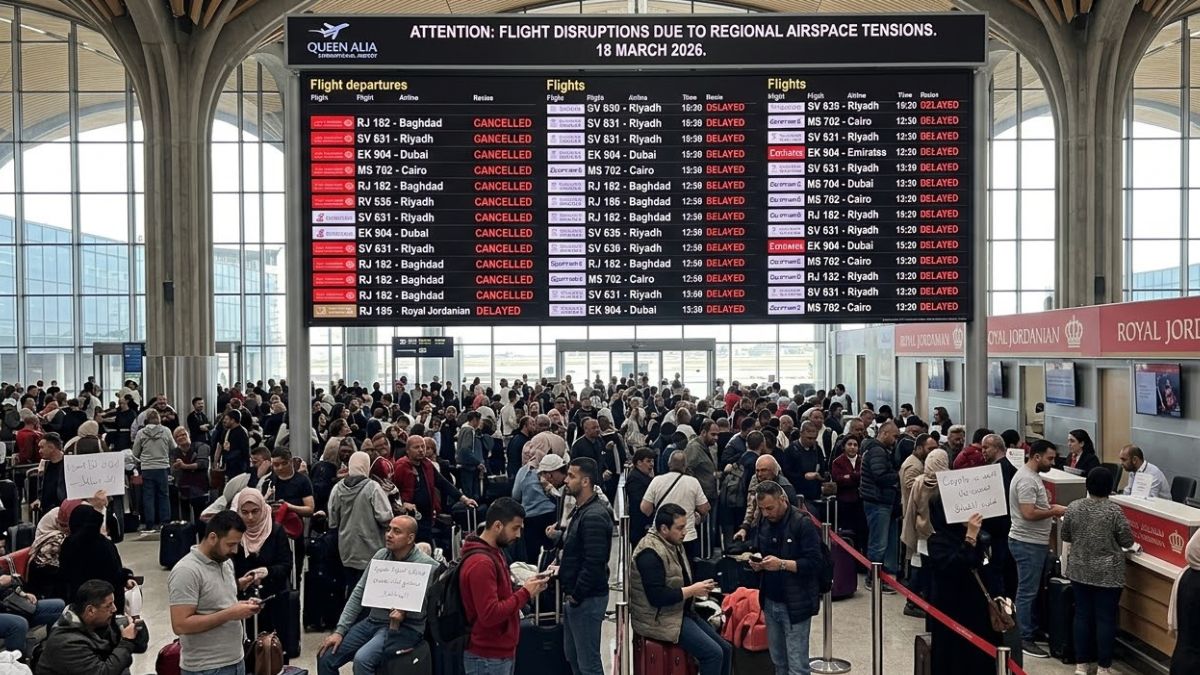
Image for illustrative purposes
Quick Summary
- Queen Alia International Airport (AMM): 28 flights cancelled and 27 delayed on March 18, 2026, affecting hundreds of passengers
- Airlines Hit Hardest: Royal Jordanian, Saudia, Emirates, Flynas, and Egypt Air experiencing major operational disruptions
- Routes Affected: Flights to Cairo, Doha, Damascus, Beirut, Baghdad, and other regional destinations grounded or significantly delayed
- Traveler Action Required: Check flight status immediately, contact airlines for rebooking options, and verify refund eligibility under regional aviation regulations
Queen Alia Airport Faces Massive Operational Meltdown
Queen Alia International Airport (AMM/OJAC) in Amman, Jordan, experienced severe flight disruptions on March 18, 2026, with 28 cancellations and 27 delays, affecting hundreds of passengers and five major international carriers. The cascading cancellations and delays have stranded travelers across the Middle East, North Africa, and Europe, compounding ongoing regional instability that has crippled aviation throughout the Levant and Persian Gulf for weeks.
The disruptions underscore the fragility of Middle Eastern aviation infrastructure amid escalating geopolitical tensions. Queen Alia, which serves as Jordan's primary international gateway and handles roughly 60 percent of normal flight volumes under current conditions, has become a focal point for the broader air travel crisis gripping the region.
Royal Jordanian Bears Brunt of Cancellations
Royal Jordanian, the national carrier and largest operator at Queen Alia, suffered the most significant impact, with multiple flight cancellations affecting its primary network. The airline's operations have been decimated across its core routes, leaving passengers without alternative routing options and forcing the carrier to issue widespread rebooking waivers.
Royal Jordanian announced that passengers holding tickets issued between March 3 and March 20, 2026, for travel through December 31, 2026, would receive one free rebooking change. However, the sheer volume of cancellations has overwhelmed rebooking capacity, leaving many passengers unable to secure alternative flights within days of their original departure.
Saudia, Emirates, Egypt Air, and Flynas Grounded
Saudia (Saudi Arabian Airlines) suspended multiple routes serving Amman, with no confirmed restart date publicly announced. The carrier's suspension reflects broader Saudi aviation strategy in response to regional airspace closures and security concerns.
Emirates has reduced its Dubai–Amman service to a limited schedule, with passengers advised to verify flight status before travel and offered flexibility in rebooking through March 31, 2026. The airline's reduced operations mirror network-wide capacity cuts across the Persian Gulf.
Egypt Air reported 5 cancellations and 62 percent of its flights delayed at Queen Alia on March 14, the most recent comparable disruption event. The carrier's Cairo–Amman route, a key regional connection, has been subject to intermittent suspensions and delays.
Flynas, Saudi Arabia's low-cost carrier, also suspended services to Amman, citing airspace security concerns and operational uncertainty.
Routes Most Affected: Cairo, Doha, Damascus, Beirut, Baghdad
Passengers traveling to and from Cairo (CAI), Doha (DOH), Damascus (DAM), Beirut (BEY), and Baghdad (BGW) faced the highest cancellation rates on March 18. These routes represent critical regional connectivity for business travelers, tourists, and expatriates.
Cairo remains accessible via limited Egypt Air operations, though delays routinely exceed 4 hours. Doha flights have been effectively suspended across most carriers, with Qatar Airways maintaining only advisory-level operations pending airspace clearance. Damascus and Beirut routes have been cancelled by major European carriers including Lufthansa Group through late March, and regional carriers have followed suit. Baghdad flights remain sporadic, with Iraqi Airways and regional operators managing minimal schedules.
Broader Middle East Aviation Crisis
Queen Alia's March 18 disruptions are part of a region-wide aviation collapse triggered by escalating military tensions. On March 2, 2026, Jordan announced a partial nightly closure of its airspace from 6:00 p.m. (GMT 1600) to 9:00 a.m. the following day, following large-scale joint U.S.–Israeli attacks on Iran and subsequent Iranian retaliatory strikes targeting sites in Israel and U.S. military bases across the Gulf and Jordan.
The airspace restrictions have cascaded through the entire Middle Eastern network. FlightAware data shows that on March 6, Dubai recorded 118 departures, Muscat 56, and Abu Dhabi 16, while Doha and Bahrain recorded zero outbound flights. British Airways suspended flights to Tel Aviv, Bahrain, and Amman. Air Canada extended cancellations through March 23 for both Tel Aviv and Dubai. Delta Air Lines cancelled New York–Tel Aviv services through March 31.
Impact on Hundreds of Stranded Passengers
The 28 cancellations and 27 delays on March 18 affected an estimated 4,000–5,000 passengers, many of whom were left without accommodation, meals, or clear rebooking timelines. Passengers reported waiting 6–8 hours at Queen Alia before learning their flights were cancelled, with airline staff unable to provide alternative routing due to network-wide capacity constraints.
Families traveling to regional destinations for business meetings, medical appointments, and holiday travel were forced to rebook on flights departing days later, incurring additional hotel and transportation costs. Many passengers expressed frustration with lack of communication from airlines and airport authorities, citing minimal real-time updates via airline apps and websites.
Key Facts at a Glance
| Detail | Data |
|---|---|
| Airport | Queen Alia International Airport (AMM / OJAC), Amman, Jordan |
| Date of Disruption | March 18, 2026 |
| Total Cancellations | 28 flights |
| Total Delays | 27 flights |
| Airlines Most Affected | Royal Jordanian, Saudia, Emirates, Flynas, Egypt Air |
| Primary Routes Disrupted | Amman–Cairo, Amman–Doha, Amman–Damascus, Amman–Beirut, Amman–Baghdad |
| Normal Daily Operations | ~120 flights (60% of pre-crisis capacity) |
| Primary Cause | Regional airspace security restrictions and geopolitical tensions |
| Airspace Closure Hours | 6:00 p.m.–9:00 a.m. local time (nightly, effective March 2–ongoing) |
What This Means for Travelers
Passengers booked on flights from Queen Alia through March 31, 2026, should assume potential disruptions and plan accordingly. Airlines have implemented flexible rebooking policies allowing one free change for tickets issued during the March 3–20 window, but availability is severely limited.
Under U.S. Department of Transportation regulations and international aviation standards, passengers on cancelled flights are entitled to either a full refund or rebooking on the next available flight at no additional cost. However, regional carriers operating under different regulatory frameworks may offer vouchers or travel credits instead of cash refunds—passengers should insist on cash refunds where applicable.
Travelers connecting through Amman to European, North American, or African destinations should consider routing through alternative hubs including Istanbul (IST), Dubai (DXB), or Abu Dhabi (AUH), though these airports are also experiencing reduced capacity.
Traveler Action Checklist
- Check your flight status immediately via Royal Jordanian, Saudia, Emirates, or Egypt Air mobile apps or websites before heading to the airport
- Contact your airline directly to confirm departure time and activate rebooking waivers if your flight is cancelled—do not wait for automatic rebooking
- Know your passenger rights: Under international aviation law, cancelled flights entitle you to a full cash refund (not a voucher) or rebooking on the next available flight at no additional cost
- Keep all receipts for meals, hotels, ground transportation, and alternative flights—these may be reimbursable under airline liability or travel insurance
- Consider alternative airports: Amman–Istanbul (IST), Amman–Dubai (DXB), or Amman–Doha (DOH) via ground transport may provide faster onward routing despite regional disruptions
Challenges Ahead: No Near-Term Relief Expected
Aviation experts warn that Queen Alia and regional airports face weeks—potentially months—of reduced capacity. Airspace closures remain in effect pending diplomatic resolution, and military escalation risks could trigger additional restrictions. Airlines have signaled no firm restart dates for suspended services, with most guidance limited to weekly reviews.
The tourism industry in Jordan, which relies heavily on international arrivals, faces mounting losses. Hotel occupancy rates have plummeted, tour operators have cancelled group bookings, and ground transportation services report 40–50 percent revenue declines. The Dead Sea, Petra, and Jerash—Jordan's primary tourist attractions—remain accessible only to passengers willing to endure multi-day delays and alternative routing.
Frequently Asked Questions
Which airline is experiencing the worst cancellations at Queen Alia? Royal Jordanian, as the national carrier and largest operator at Queen Alia, has absorbed the highest number of cancellations. On March 14, the airline reported 16 cancellations (12 percent of flights) and 18 delays (14 percent of flights). Saudia and Flynas have suspended service entirely pending airspace clearance.
What are my passenger rights if my flight is cancelled? Under international aviation standards and U.S. DOT regulations (where applicable), passengers are entitled to either a full cash refund or rebooking on the next available flight at no additional cost. Regional carriers may initially offer vouchers; insist on cash refunds for cancelled flights. Retain all receipts for incidental expenses (meals, hotels, ground transport) for potential reimbursement claims.
Are flights to Cairo, Doha, and Beirut still operating? Limited Egypt Air flights to Cairo (CAI) are operating with significant delays. Qatar Airways flights to Doha (DOH) remain suspended pending airspace safety clearance. Beirut (BEY) flights have been cancelled by major European carriers through late March; regional carriers offer sporadic service with 8+ hour delays.
When will normal operations resume at Queen Alia? No firm restart date has been announced. Airlines are conducting weekly reviews of airspace conditions. Queen Alia is currently operating at 60 percent of normal capacity (approximately 120 daily flights). Full recovery depends on regional diplomatic resolution and airspace authority clearance, which could take weeks to months.
Related Travel Guides
Middle East Flight Cancellations: Complete Airline Suspension List and Restart Dates
Passenger Rights in Middle East Flight Cancellations: Refunds, Rebooking, and Compensation
Disclaimer
This article is for informational and educational purposes only. It does not constitute legal, financial, or professional advice. While we strive to provide accurate and up-to-date information, travel policies, regulations, and conditions change rapidly. Always verify information with official sources before making travel decisions. Nomad Lawyer makes no representations about the accuracy, reliability, completeness, or suitability of the information provided. Readers should consult qualified professionals for advice specific to their circumstances. The views expressed in this article are those of the author and do not necessarily reflect the views of Nomad Lawyer.
Raushan Kumar
Founder & Lead Developer
Full-stack developer with 11+ years of experience and a passionate traveller. Raushan built Nomad Lawyer from the ground up with a vision to create the best travel and law experience on the web.
Learn more about our team →