
Puerto Plata Dominican Republic Caribbean Carnival Expands Surplus Meal Donation Programme Strengthening Community Support Across Cruise Ports in Latin America
Thailand launches "Pay Like a Local" QR payment system for 2026, enabling tourists from China, Singapore, and more to pa

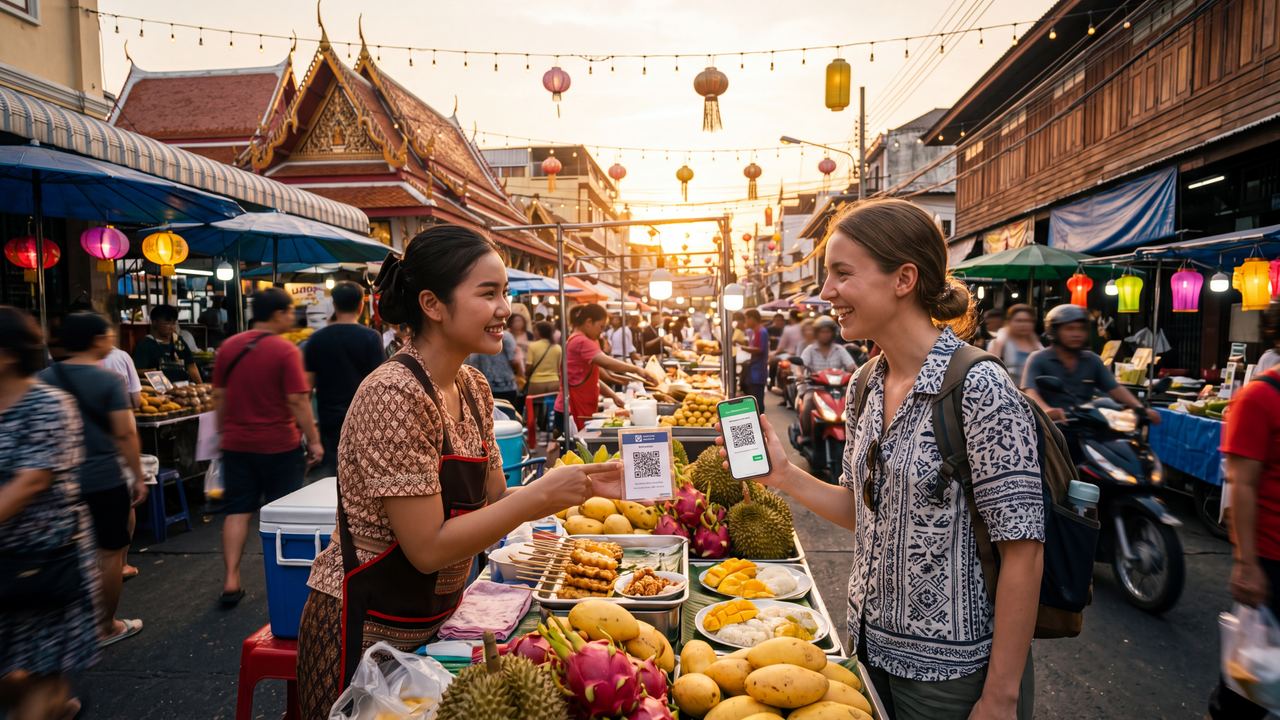
Image generated by AI
[Bangkok, June 27, 2026] — Thailand is implementing a sweeping digital overhaul of its tourism economy by launching a nationwide cross-border QR payment framework designed to let international visitors “pay like a local.” Led by the Tourism Authority of Thailand (TAT) under the Ministry of Tourism and Sports, the initiative aims to eliminate the friction of currency exchange and cash dependency for millions of global travelers visiting key hubs like Bangkok, Phuket, and Chiang Mai.
Digital Financial Integration in the Thai Tourism Sector
The transition toward a cashless tourism environment is being spearheaded by the Bank of Thailand, which is coordinating a massive integration effort involving eight primary financial institutions. These partners include Krungthai Bank, Bangkok Bank, Kasikornbank, Siam Commercial Bank, Bank of Ayudhya, ICBC Thai, the Bank for Agriculture and Agricultural Cooperatives, and CIMB Thai Bank.
To ensure the system works across international borders, the central bank is collaborating with global payment networks and critical switching partners. Key entities involved in this interoperability layer include National ITMX, Alipay, WeChat Pay, and UnionPay. This collective infrastructure allows tourists to bypass traditional currency exchange booths and instead transact directly in Thai baht using their native digital tools.
The digital payment layer is being embedded across all primary tourism touchpoints. This includes luxury hotels and international resorts, local restaurants, retail malls, major tourist attractions, and small-scale street vendors, ensuring a consistent payment experience from high-end districts to rural markets.
"Pay Like a Local" Framework Optimizes Visitor Spending
The core philosophy of the “Pay Like a Local” system is the removal of financial barriers between the traveler and the merchant. By scanning a standardized QR code, visitors can trigger instant payments through their home-country banking applications or approved e-wallet systems. This removes the need for physical cash handling, reducing the risk of theft and the inconvenience of carrying large amounts of foreign currency.
Currently, the interoperable system is active for visitors arriving from the following regions and nations:
| Eligible Regions/Countries | Payment Method Compatibility |
|---|---|
| China | Mobile Banking / E-Wallets |
| Singapore | Mobile Banking / E-Wallets |
| Malaysia | Mobile Banking / E-Wallets |
| Indonesia | Mobile Banking / E-Wallets |
| Viet Nam | Mobile Banking / E-Wallets |
| South Korea | Mobile Banking / E-Wallets |
| Lao PDR | Mobile Banking / E-Wallets |
| Cambodia | Mobile Banking / E-Wallets |
| Hong Kong | Mobile Banking / E-Wallets |
This infrastructure is particularly strategic for East Asian markets, where mobile-first payment habits are already the standard for daily commerce. By mirroring the domestic spending experience of these travelers, Thailand is creating a frictionless journey that encourages higher spending and a more seamless exploration of the country.
Bangkok Merchant Roadshow Accelerates Digital Adoption
To ensure the infrastructure is supported by actual vendors on the ground, the Thai government is executing a Merchant Activation Roadshow. This high-visibility campaign is currently centered at Asiatique The Riverfront Destination in Bangkok, a major tourism hub located along the Chao Phraya River.
Operating specifically between Warehouses 8 and 9, the event serves as a practical laboratory where food service providers, retail merchants, and tour operators can experience the QR system in a live operational environment. The roadshow provides several critical services to local businesses:
- Technical Onboarding: Direct assistance with system registration and technical setup.
- Readiness Checks: Verification that merchants can successfully receive and verify international payments.
- Consultation Services: On-site booths where banks provide financial guidance to small business owners.
- Incentive Programs: The use of promotional campaigns and lucky draws to motivate rapid adoption among skeptical or traditional vendors.
This effort ensures that small and medium enterprises (SMEs), which form the backbone of the Thai tourism experience, are not left behind in the transition to a digital economy.
Udon Thani Pilot Program Establishes Operational Blueprint
The current expansion in Bangkok is the result of successful testing in Udon Thani, where a pilot program was launched on March 31, 2026. This pilot was specifically designed to test the system's efficacy in preparing local operators for a surge in international arrivals, with a particular focus on the Chinese market.
The Udon Thani phase utilized a dual-track approach to training. First, a formal seminar was hosted at the Monthathip Hall Convention Centre, where 52 selected tourism operators underwent rigorous training on transaction handling and system integration.
Following the seminar, the program moved into the streets. Mobile outreach units were deployed along Thong Yai Road and within the UD Town area to provide real-time onboarding for micro-merchants. This combination of classroom instruction and field support proved that the QR system could be scaled beyond primary cities and into secondary tourism provinces, effectively diversifying the economic benefits of international tourism.
Impact on the Regional Tourism Economy
The shift toward a unified digital payment ecosystem is expected to significantly increase the velocity of money within the Thai tourism sector. By lowering the barrier to payment, the government is making it easier for tourists to make impulsive, small-scale purchases at street stalls and local craft markets—areas where credit card acceptance has historically been low.
Furthermore, the integration of eight major banks and global networks like UnionPay and Alipay creates a level of financial security and transparency that benefits both the consumer and the merchant. For the merchant, it reduces the risks associated with handling cash and counterfeit currency; for the tourist, it provides a clear digital trail of spending.
Why This Matters: The Shift to Smart Tourism Infrastructure
Thailand's move toward a comprehensive cross-border QR network is more than a convenience update; it is a strategic repositioning of the nation as a "Smart Tourism" leader in Asia. By integrating the financial backend of multiple nations into a single, interoperable layer, Thailand is effectively removing one of the last remaining "friction points" of international travel.
This development signals a broader trend in Southeast Asia where the traditional reliance on the US dollar or physical currency exchange is being replaced by direct, bank-to-bank digital settlements. For the aviation and travel industry, this suggests a future where the "traveler's wallet" is entirely virtual, potentially influencing how travel agencies and tour operators package their services.
By empowering small-scale vendors in secondary cities like Udon Thani to accept global payments, Thailand is democratizing the wealth generated by tourism. This prevents the "leakage" of tourism revenue, ensuring that a higher percentage of visitor spending stays within the local community rather than being captured by large currency exchange conglomerates. As this model scales, it will likely serve as the blueprint for other ASEAN nations seeking to modernize their tourism infrastructure.
Related Travel Guides
Disclaimer
This article is for informational and educational purposes only. It does not constitute legal, financial, or professional advice. While we strive to provide accurate and up-to-date information, travel policies, regulations, and conditions change rapidly. Always verify information with official sources before making travel decisions. Nomad Lawyer makes no representations about the accuracy, reliability, completeness, or suitability of the information provided. Readers should consult qualified professionals for advice specific to their circumstances. The views expressed in this article are those of the author and do not necessarily reflect the views of Nomad Lawyer.
Preeti Gunjan
Contributor & Community Manager
A passionate traveller and community builder. Preeti helps grow the Nomad Lawyer community, fostering engagement and bringing the reader experience to life.
Learn more about our team →