
American Eagle Flight Makes Emergency Landing in Philadelphia Following Brutal Hydraulic Failure
A Portland-bound American Eagle flight faced immediate peril after critical nose gear steering and massive hydraulic systems failed mid-air, forcing a highly tense emergency landing.

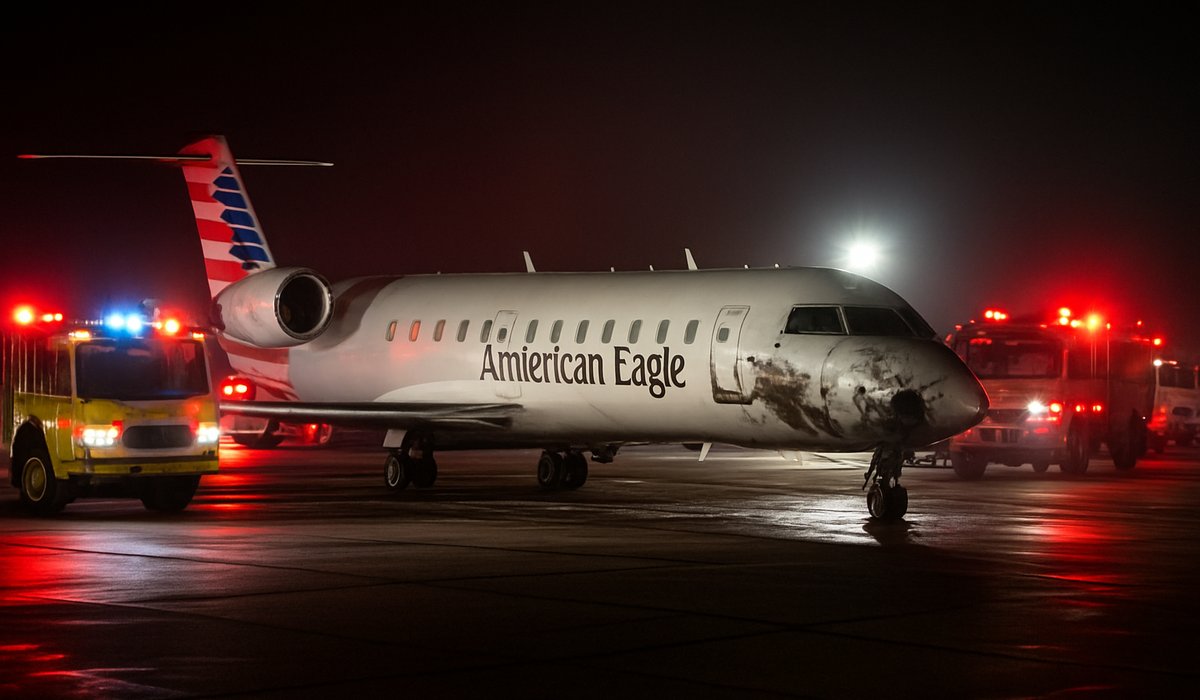
Image generated by AI
Mid-Air Scare Shocks the East Coast Aviation Corridor
Shattering the routine of the heavily traveled East Coast shuttle routes, American Eagle Flight 5422 was violently forced into an emergency diversion to Philadelphia International Airport (PHL) after suffering critical, cascading failures to its nose gear steering and primary hydraulic systems. The aircraft, physically operated by regional carrier PSA Airlines under the American Airlines banner, was originally bound for Portland, Maine from Washington Reagan National Airport (DCA) before cockpit alarms mandated an immediate, high-stress termination of the flight path.
A total loss of nose gear steering and hydraulic pressure is considered one of the highest-stakes mechanical emergencies in civil aviation. A commercial jetliner relies entirely on its highly pressurized hydraulic fluid to physically push the massive metal flight control surfaces on the wings—and critically, to execute heavy braking and steering upon hitting the asphalt. Landing without functional nose gear steering essentially turns the aircraft into a high-speed metal sled that cannot be easily commanded to exit the runway, massively elevating the risk of a high-speed runway excursion.
The Immediate Crew Response
When the primary systems flagged the catastrophic bleed-out of hydraulic pressure, the exceedingly well-trained pilots of Flight 5422 instantly declared an emergency with air traffic control.
Rather than attempting to circle back to the highly congested and dangerously short runways at Washington Reagan, the commander elected to immediately divert slightly north to Philadelphia. PHL possesses massively long, heavily reinforced international runways, granting the compromised aircraft the maximum possible stopping distance required when relying on backup aerodynamic braking rather than primary hydraulic disc brakes.
Dissecting the Hydraulic Threat
| Mechanical Failure | Function of System | Threat if Failed |
|---|---|---|
| Primary Hydraulics | Deploys flaps, brakes, and landing gear | Aircraft cannot slow down upon landing |
| Nose Gear Steering | Physically turns the front wheels on the ground | Plane may violently veer off the runway into the grass |
| Hydraulic Redundancy | Backup fluid lines | Allows the pilots to secure a safe, though rough, emergency touchdown |
What Guests Get
- Behind-the-scenes flight physics — realizing that an airplane isn't steered by a steering wheel, but by incredibly complex, pressurized fluid systems that are statistically highly reliable but deeply deadly when compromised.
- Pilot psychology insight — grasping why aircraft almost never factor the closest airport in an emergency, but rather aggressively hunt down the longest, safest runway within gliding distance.
- Aviation safety assurance — proving that despite terrifying alarm bells, modern passenger jets are engineered with layers of invisible safety redundancies designed strictly to save lives during a plunge.
What This Means for Travelers
If you hold tickets on regional carriers (like PSA Airlines or Republic Airways): Understand the structure of modern American aviation. When you purchase a ticket on "American Airlines" for a short one-hour flight, you are almost identically flying on a vastly smaller regional jet mathematically contracted out to a third-party company like PSA. While these regional operators adhere strictly to the exact same Federal Aviation Administration (FAA) maintenance safety schedules as the mainline giants, they operate a drastically different fleet, primarily relying on highly utilized Bombardier CRJ or Embraer aircraft.
What happens if your flight declares an emergency? If you are on an active flight that violently diverts, absolutely follow the cabin crew. Leave every single piece of luggage on the aircraft. Passengers stopping to reach into the overhead bins to grab a laptop during a compromised landing drastically increase the fatality risk for the person trapped behind them if the aircraft catches fire.
FAQ: Aircraft Hydraulic Emergencies
How does an airplane land without steering? If the nose wheels lock straight or fail to turn via hydraulics, the pilots use "differential braking." By violently stepping on the left main landing gear brake while leaving the right wheel spinning locally, the immense friction yanks the nose of the aircraft to the side, allowing rudimentary, jerky steering.
Was anyone hurt on American Eagle 5422? Current reporting indicates zero injuries among the passengers or crew. The aircraft successfully landed and remained on the pavement, though it had to be physically towed off the active runway by tug-trucks because it could not steer itself to the gate.
Why do planes divert so quickly for minor issues? Airlines utilize hyper-conservative "Zero Risk" parameters. Because an airplane is an isolated metal tube flying miles above the earth, anything short of absolute mechanical perfection warrants grounding the aircraft immediately to prevent a minor valve leak from snowballing into a fatal engine failure.
Related Travel Guides
- Saudia Expands Boeing 787 Business Class Deployment Across Key Global Routes
- Aviation Updates: China Eastern Airlines Shocks Market with Massive Airbus Mega Deal to Insulate Against Global Travel Chaos
- Tragedy at Orlando International: Delta Air Lines Ground Crew Member Killed in Fatal Tug Vehicle Accident; Major Flight Cancellations and Travel Chaos as FAA Launches Urgent Safety Probe in May 2026
Disclaimer
This article is for informational and educational purposes only. It does not constitute legal, financial, or professional advice. While we strive to provide accurate and up-to-date information, travel policies, regulations, and conditions change rapidly. Always verify information with official sources before making travel decisions. Nomad Lawyer makes no representations about the accuracy, reliability, completeness, or suitability of the information provided. Readers should consult qualified professionals for advice specific to their circumstances. The views expressed in this article are those of the author and do not necessarily reflect the views of Nomad Lawyer.
Raushan Kumar
Founder & Lead Developer
Full-stack developer with 11+ years of experience and a passionate traveller. Raushan built Nomad Lawyer from the ground up with a vision to create the best travel and law experience on the web.
Learn more about our team →