
Passengers Left Stranded in Denmark After SAS, British Airways, Danish Air, and More Airlines Face Five New Flight Cancellations at Copenhagen Airport Disrupting Travel to London, Mumbai, Warsaw, Santorini, and More Amid Widespread Network Disruption
Five flights cancelled at Copenhagen Airport disrupt travel to London, Mumbai, Warsaw, and more. SAS and British Airways

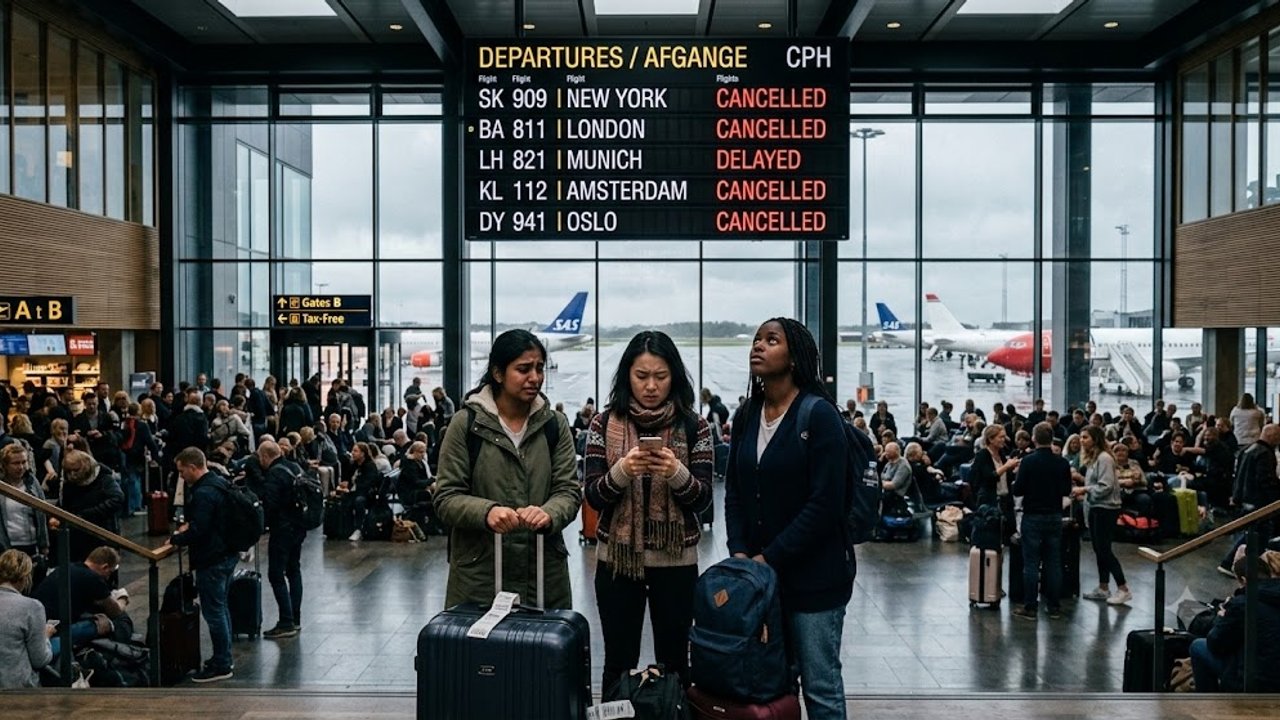
Image generated by AI
[Copenhagen, June 23, 2026] — A sudden wave of flight cancellations at Copenhagen Airport has triggered significant travel disruptions across Europe and Asia, leaving numerous passengers stranded. Five scheduled services were scrubbed from the flight board, impacting critical routes to London, Mumbai, Warsaw, Santorini, and Bornholm.
The disruption affected a diverse array of carriers, including SAS, British Airways Cityflyer, Danish Air Transport, and Sun-Air of Scandinavia. Because the cancellations spanned both short-haul regional hops and long-haul intercontinental journeys, the operational ripple effect has been felt across multiple aviation corridors, complicating travel for business commuters and leisure tourists alike.
Regional Connectivity Disruptions in Northern and Central Europe
The cancellation of flights to Warsaw and Bornholm has created immediate gaps in regional connectivity. These routes serve as vital links for maintaining the flow of passengers between Scandinavia and Central Europe. The suspension of the service to Bornholm specifically interrupted a key domestic artery, separating the island from mainland Denmark.
Furthermore, the loss of the London Heathrow connection has hampered one of the most frequented business travel routes in the region. Industry observers note that in a hub-and-spoke system like Copenhagen’s, even a small number of cancellations can lead to a cascade of missed connections. When a primary feeder flight is cancelled, passengers are often unable to reach their final destinations, leading to a backlog of stranded travelers and an increased burden on airport ground services.
Global Impact of Long-Haul Cancellations to Mumbai
While regional flights caused local congestion, the cancellation of flight SAS969 to Mumbai (Chhatrapati Shivaji Int’l) represents the most severe blow to global connectivity in this series of events. Intercontinental routes are high-capacity operations that are essential for the passenger flow between Europe and South Asia.
Flight tracking data and industry reports indicate that the cancellation of a long-haul wide-body aircraft, such as the Airbus A333, creates complex logistical challenges. These disruptions typically extend beyond the immediate loss of a flight, as they interfere with aircraft rotation schedules and crew duty limits. Because there are fewer direct alternatives for the Mumbai route, affected passengers face significantly longer recovery times and more complex rebooking processes compared to those on short-haul European routes.
Operational Breakdown of Cancelled Services
The technical data reveals that the disruptions were not limited to a single aircraft family or airline, suggesting a systemic scheduling or operational issue rather than a fleet-specific mechanical failure. The affected aircraft range from the ATR 72 turboprop used for domestic hops to the Airbus A330neo for long-distance travel.
| Flight Code | Aircraft Type | Destination | Departure Time | Airline |
|---|---|---|---|---|
| SZS1913 | A20N | Santorini (JTR) | Wed 06:40 AM CEST | SZS |
| BCY2751 | CRJ9 | Warsaw (WAW) | Tue 05:45 PM CEST | BCY |
| SAS969 | A333 | Mumbai (BOM) | Tue 04:10 PM CEST | SAS |
| DTR38 | AT72 | Bornholm (RNN) | Tue 11:30 AM CEST | DTR |
| SAS501 | A20N | London (LHR) | Tue 08:10 AM CEST | SAS |
Analysis of Airline Response and Systemic Failures
Reports suggest that the cancellations were the result of a combination of operational pressures. The diversity of the aircraft involved—A20N, CRJ9, AT72, and A333—indicates that the issue likely stemmed from air traffic flow coordination or airport capacity revisions rather than a specific grounding of a plane type.
Industry analysts point to several recurring factors that contribute to such network disruptions:
- Crew Logistics: Limitations in crew scheduling can lead to flight cancellations if pilots or cabin crew exceed their legal flying hours.
- Aircraft Rotation: A delay in one leg of a journey can cause a "domino effect," where the aircraft is not available for its next scheduled departure.
- Maintenance Planning: Unexpected technical requirements can pull a plane from service, requiring immediate schedule adjustments.
- Air Traffic Coordination: Changes in slot allocations at a major hub like Copenhagen (EKCH) can force airlines to prioritize certain routes over others.
Passenger Consequences and Network Efficiency
The immediate impact on passengers has been characterized by missed connections and a sharp decrease in travel flexibility. For those traveling to Mumbai, the lack of immediate direct alternatives has turned a simple delay into a multi-day logistical hurdle.
From a network perspective, these cancellations decrease overall efficiency. When a hub airport experiences these "micro-clusters" of cancellations, airlines must reallocate resources on the fly. This often results in further adjustments to subsequent departures, potentially extending the period of instability across the airline's broader network.
The scale of the disruption is summarized as follows:
- Total Flights Cancelled: 5
- Primary Hub: Copenhagen Airport (EKCH)
- Key Destinations Affected: London, Mumbai, Warsaw, Santorini, Bornholm
- Carriers Involved: SAS, BCY, DTR, SZS
- Aircraft Diversity: High (Narrow-body, Wide-body, and Turboprop)
The current situation underscores the fragility of the modern aviation ecosystem. As airlines strive for maximum efficiency with lean rotations, there is very little margin for error. A disruption at a central node like Copenhagen can quickly evolve from a local inconvenience into a global scheduling crisis, impacting the stability of international aviation corridors.
Related Travel Guides
Disclaimer
This article is for informational and educational purposes only. It does not constitute legal, financial, or professional advice. While we strive to provide accurate and up-to-date information, travel policies, regulations, and conditions change rapidly. Always verify information with official sources before making travel decisions. Nomad Lawyer makes no representations about the accuracy, reliability, completeness, or suitability of the information provided. Readers should consult qualified professionals for advice specific to their circumstances. The views expressed in this article are those of the author and do not necessarily reflect the views of Nomad Lawyer.
Preeti Gunjan
Contributor & Community Manager
A passionate traveller and community builder. Preeti helps grow the Nomad Lawyer community, fostering engagement and bringing the reader experience to life.
Learn more about our team →