
Middle East Airports Hit by 910 Delays and 36 Cancellations as Dubai, Erbil, and Regional Hubs Face Flight Disruptions
Flight operations across Dubai, Erbil, Riyadh, Jeddah, and Sabiha Gökçen faced 910 delays and 36 cancellations due to airspace shifts and operational pressures.

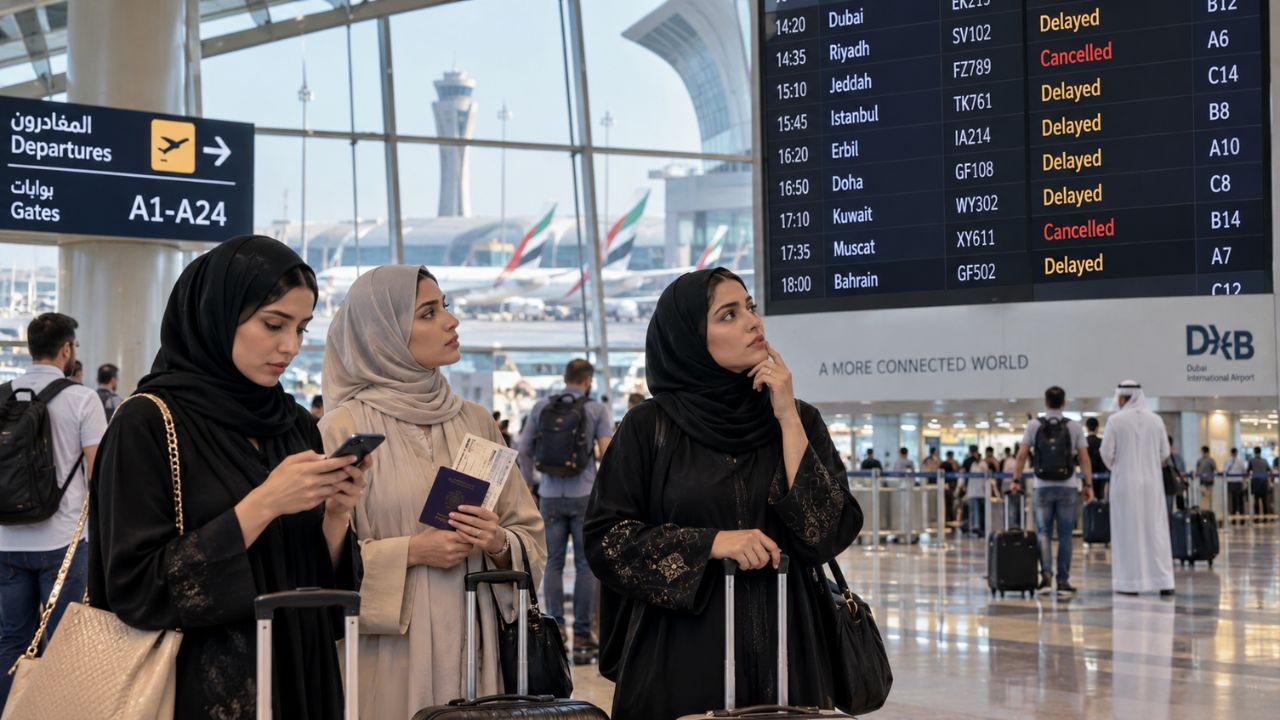
Image Credit: Dubai Airport
Air travel across key Middle Eastern hubs encountered significant operational pressure, with 910 flight delays and 36 cancellations recorded across major airports in the UAE, Saudi Arabia, Türkiye, and Iraq.
DUBAI, United Arab Emirates — Key aviation hubs in the Middle East faced widespread flight schedule disruptions as real-time tracking data from FlightAware logged a total of 910 delays and 36 cancellations. Operational bottlenecks affected connecting passengers at major international gateways, including Dubai International Airport (DXB), Istanbul Sabiha Gökçen International Airport (SAW), King Abdulaziz International Airport in Jeddah (JED), King Khalid International Airport in Riyadh (RUH), and Erbil International Airport (EBL).
The operational strain stems from a combination of shifting regional airspace conditions, security protocols, and tactical schedule realignments executed by international and Gulf-based carriers.
| Airport Gateway | Country | Scheduled Delays | Cancellations | Impacted Connecting Corridors |
|---|---|---|---|---|
| Dubai International (DXB) | UAE | 255 Delays | 7 Cancellations | Global transfer hub connecting Asia, Europe, & Africa |
| Istanbul Sabiha Gökçen (SAW) | Türkiye | 237 Delays | 2 Cancellations | European, Turkish, & Middle East regional connections |
| King Abdulaziz Int'l (JED) | Saudi Arabia | 122 Delays | 5 Cancellations | Western KSA, Hajj/Umrah, & Red Sea transit routes |
| King Khalid Int'l (RUH) | Saudi Arabia | 120 Delays | 7 Cancellations | Capital business transit & domestic feeder lines |
| Sharjah International (SHJ) | UAE | 76 Delays | 2 Cancellations | Regional LCC hub for Air Arabia routes |
| King Fahd Int'l (DMM) | Saudi Arabia | 50 Delays | 1 Cancellation | Eastern Province commercial & oil corridor |
| Abha Regional (AHB) | Saudi Arabia | 44 Delays | 4 Cancellations | Southern regional domestic connections |
| Erbil International (EBL) | Iraq | 6 Delays | 1 Cancellation | Kurdistan regional international gateway |
| Gizan Regional (GIZ) | Saudi Arabia | 0 Delays | 3 Cancellations | Southwestern domestic short-haul lines |
| Najran Domestic (EAM) | Saudi Arabia | 0 Delays | 4 Cancellations | Border region domestic passenger routes |
| Cumulative Network Total | 4 Countries | 910 Delays | 36 Cancellations | Widespread Middle Eastern flight disruption |
Dubai and Sabiha Gökçen Suffer Highest Airport-Level Operational Stress
Dubai International Airport (DXB), operated by Dubai Airports, experienced the highest volume of disruptions among individual airports, logging 255 delays and 7 cancellations. As the world's busiest airport by international passenger traffic, delays in Dubai create cascading schedule knock-ons for long-haul connecting passengers transferring between Europe, South Asia, Australasia, and North America.
In Türkiye, Istanbul's Sabiha Gökçen International Airport (SAW) recorded 237 delays and 2 cancellations. Serving as a primary base for Pegasus Airlines and Turkish Airlines' regional network, the delays highlighted heightened congestion along air corridors linking Europe to the Levant and Arabian Peninsula.
In Saudi Arabia, six commercial airports logged combined totals of 336 delays and 24 cancellations across major urban centers and regional airports, including Riyadh, Jeddah, Dammam, Abha, Jizan, and Najran.
| National Aviation Network | Total Delays Recorded | Total Cancellations | Primary Affected Hubs |
|---|---|---|---|
| Saudi Arabia Network | 336 Delays | 24 Cancellations | Riyadh (RUH), Jeddah (JED), Dammam (DMM), Abha (AHB) |
| United Arab Emirates Network | 331 Delays | 9 Cancellations | Dubai International (DXB) & Sharjah International (SHJ) |
| Türkiye Network | 237 Delays | 2 Cancellations | Istanbul Sabiha Gökçen International (SAW) |
| Iraq Network | 6 Delays | 1 Cancellation | Erbil International Airport (EBL) |
Turkish Airlines, Air India, and Gulf Carriers Experience Schedule Changes
Major international and regional airlines operating across Middle Eastern air routes experienced elevated delay percentages and service cancellations.
Turkish Airlines logged the highest delay count among individual carriers, reporting 273 delayed flights (a 15% delay rate) and 1 cancellation. Air India recorded 255 delays (a 35% delay rate) and 7 cancellations, reflecting heavy passenger demand and tight turnaround windows on high-density corridors connecting Indian metropolitan hubs with the Gulf Cooperation Council (GCC) countries.
Gulf flag carriers and low-cost airlines were similarly impacted. FlyDubai logged 89 delays (25% delay rate) and 1 cancellation, while Sharjah-based Air Arabia reported 72 delays (28% delay rate) and 2 cancellations. National carrier Saudia recorded 69 delays (12% delay rate) alongside 12 cancellations—representing the highest cancellation volume among listed operators.
| Airline Operator | Home Base / Country | Cancelled Flights | Cancellation Rate | Delayed Flights | Delay Percentage Rate |
|---|---|---|---|---|---|
| Turkish Airlines | Türkiye | 1 Flight | 0% | 273 Delays | 15% |
| Air India | India | 7 Flights | 0% | 255 Delays | 35% |
| FlyDubai | UAE (Dubai) | 1 Flight | 0% | 89 Delays | 25% |
| Air Arabia | UAE (Sharjah) | 2 Flights | 0% | 72 Delays | 28% |
| Saudia | Saudi Arabia | 12 Flights | 2% | 69 Delays | 12% |
Essential Passenger Contingency Measures and Airline Rebooking Rights
Travelers transiting through or originating from Middle Eastern airports during periods of operational disruption are advised to adhere to structured passenger protocols:
- Pre-Departure Flight Status Verification: Check live flight status via official airline mobile applications or airport portals prior to departing for terminal buildings.
- Rebooking and Waiver Options: Airlines operating in the Middle East typically activate flexible rebooking policies during regional airspace disruptions, allowing passengers to reschedule without change fees.
- Connecting Flight Protection: Passengers traveling on single-ticket multi-leg itineraries receive automated re-accommodation on the next available flight if missed connections occur at transfer hubs like Dubai or Riyadh.
- Documentation & Expense Tracking: Retain digital copies of boarding passes, delay notifications, and receipts for food or lodging required during extended airport layovers.
| Contingency Step | Recommended Action for Travelers | Target Protection Benefit |
|---|---|---|
| Status Monitoring | Track FlightAware or airline app updates | Avoid unnecessary waiting in public terminal halls |
| Rebooking Request | Contact carrier helpdesks via digital channels | Secure alternate flights before gate queues form |
| Policy Verification | Review carrier fee waiver announcements | Access fee-free date changes or full ticket refunds |
Frequently Asked Questions
Which Middle Eastern airport had the highest number of flight delays?
Dubai International Airport (DXB) in the UAE reported the highest number of delays, with 255 delayed flights and 7 cancellations.
Which airline experienced the highest number of delays during this period?
Turkish Airlines recorded the highest number of delayed flights with 273 delays (15% delay rate), followed by Air India with 255 delays (35% delay rate).
How many total delays and cancellations were logged across the region?
A total of 910 delays and 36 cancellations were recorded across airports in the UAE, Saudi Arabia, Türkiye, and Iraq.
What should passengers do if their flight through the Middle East is affected?
Passengers should verify their flight status online before going to the airport, contact their airline directly to request free rebooking or refunds under waiver policies, and allow extra time for airport processing.
Related Travel Guides
Disclaimer
This article is for informational and educational purposes only. It does not constitute legal, financial, or professional advice. While we strive to provide accurate and up-to-date information, travel policies, regulations, and conditions change rapidly. Always verify information with official sources before making travel decisions. Nomad Lawyer makes no representations about the accuracy, reliability, completeness, or suitability of the information provided. Readers should consult qualified professionals for advice specific to their circumstances. The views expressed in this article are those of the author and do not necessarily reflect the views of Nomad Lawyer.
Kunal K Choudhary
Co-Founder & Contributor
A passionate traveller and tech enthusiast. Kunal contributes to the vision and growth of Nomad Lawyer, bringing fresh perspectives and driving the community forward.
Learn more about our team →