
Middle East Airspace Crisis: 8 Nations Unite to Rescue Stranded Travelers
Bahrain leads emergency coordination with Saudi Arabia, Qatar, Jordan, Israel, UAE, Syria, and Oman as Iranian missile attacks trigger unprecedented airspace closures across the Gulf. Thousands of passengers trapped.

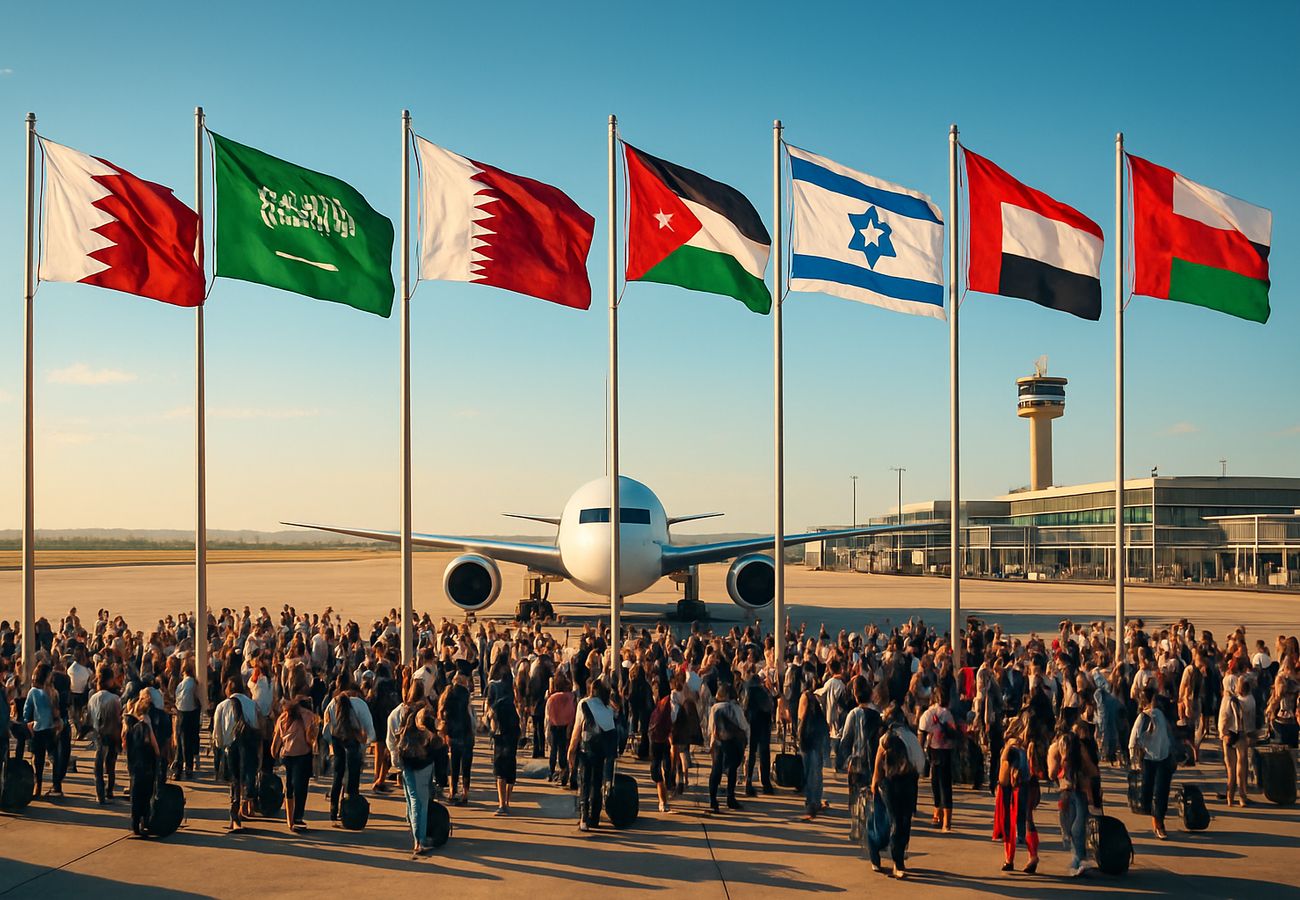
Image generated by AI
The Middle East just experienced one of its most severe aviation emergencies in decades. On June 3, 2026, escalating tensions triggered a regional cascade of airspace closures that left thousands of international travellers stranded across the Gulf. What started as a security incident evolved into a full-scale humanitarian crisis requiring coordinated action from eight nations working in tandem to evacuate passengers and maintain critical flight corridors.
Bahrain took the lead, rallying Saudi Arabia, Qatar, Jordan, Israel, UAE, Syria, Oman, and neighbouring countries into an unprecedented emergency coalition. The trigger: alleged Iranian missile and drone attacks targeting Kuwait and Bahrain itself. While most projectiles were reportedly intercepted by regional defence systems, authorities chose to err on the side of caution—shutting down civilian airspace across the region and forcing airlines into emergency protocols that left passengers confused, stranded, and increasingly desperate.
The Immediate Crisis: Airspace Shutdown and Passenger Chaos
The speed of the closure was startling. Within hours, major aviation hubs including Dubai, Abu Dhabi, Doha, and Riyadh were implementing holding patterns and flight diversions. Airlines operating through these corridors faced impossible choices: cancel flights outright, divert hundreds of kilometers off-course to avoid restricted airspace, or ground aircraft entirely while passengers waited in airport terminals.
Reddit: "We've been stuck in Doha for 14 hours. No updates, no real information. My connection to London was supposed to be hours ago. The airport staff look as confused as we do." — r/travel
Thousands of passengers—tourists, business travellers, and connecting passengers—suddenly found themselves in limbo. Hotels near major hubs filled to capacity. Airlines faced unprecedented rebooking demands. The tourism and hospitality sectors braced for a massive economic impact as the crisis unfolded in real time across social media and news outlets.
Bahrain's Decisive Response: The Command Center
Bahrain's aviation authorities didn't hesitate. On the morning of June 3rd, they issued the order: complete airspace closure. As a critical gateway connecting Europe, Asia, and Africa, Bahrain's shutdown created an immediate bottleneck effect across regional aviation networks.
But Bahrain didn't act alone. The kingdom's civil aviation directorate immediately convened emergency meetings with neighbouring nations. The strategy: establish safe evacuation corridors, negotiate emergency landing slots at alternative airports, and coordinate ground operations to manage the surge of stranded passengers. Hotels were mobilized to house travellers. Ground transport was organized. Within hours, Bahrain transformed from a transit hub into a crisis management centre.
The challenge was multifaceted: keeping civilians safe while maintaining essential connectivity. Bahrain's authorities implemented rigorous security protocols, monitored missile trajectories in real-time, and worked with international partners to communicate updates (however limited) to increasingly anxious passengers.
Saudi Arabia: Protecting the Northern Corridor
Saudi Arabia, sharing critical airspace with Bahrain and the UAE, faced dual pressures. The kingdom is simultaneously a major transit hub for pilgrims, business travellers, and tourists—and a potential target given regional tensions.
Saudi aviation regulators deployed emergency protocols: adjusted landing slots, opened emergency communication channels with airlines, and rerouted flights away from sensitive zones. Flights previously routed through the Gulf suddenly had to take southern corridors, adding hundreds of kilometres to journeys and burning additional fuel.
Tourism operators were advised to halt arrivals to Riyadh and Dammam temporarily. The knock-on effects rippled through the tourism sector—hotel cancellations, guide cancellations, tour postponements. Yet the kingdom's coordinated response prevented a complete aviation collapse.
Qatar's Doha Hub: Strategic Evacuation Point
Qatar positioned Hamad International Airport as the regional evacuation hub—a critical lifeline for stranded passengers. Airlines prioritized flights carrying trapped travellers, while temporary air corridors were negotiated with neighbouring states.
The operational challenge was immense: managing diversion volumes, ensuring passenger safety, and preventing total congestion. Ground handlers and airline staff worked extended shifts. Local authorities coordinated with tourism agencies to provide accommodation, meals, and real-time travel guidance. Doha's infrastructure was pushed to its limits—but it held.
Jordan, Israel, UAE, Syria, and Oman: The Coordination Web
Each nation played a specific role in the emergency response:
Jordan rerouted flights through Amman's Queen Alia International Airport while managing congestion pressures and monitoring military activity in neighbouring territories.
Israel implemented partial closures and rerouting measures, ensuring that trapped passengers could reach Israeli destinations or transit safely to other international hubs via secure corridors.
The UAE—with both Dubai and Abu Dhabi as global aviation powerhouses—experienced flight holding patterns and temporary operational halts. Tourism operators faced immediate challenges: stranded passengers needing accommodation, safety advisories, and ground transportation coordination.
Syria and Oman managed regional transit restrictions, ensuring emergency evacuation routes remained operational while avoiding congested neighbouring airports.
This wasn't bureaucratic coordination—it was real-time crisis management involving air traffic control, military liaison, diplomatic channels, and commercial airline operations all operating simultaneously.
Kuwait: At the Epicenter
Kuwait, the primary target, faced immediate airport closures and flight suspensions. The country rapidly deployed air traffic control measures to coordinate safe departures for stranded passengers—a monumental task under active threat conditions.
The Human Cost and Ongoing Uncertainties
Behind the headline numbers—thousands of cancelled flights, hundreds of thousands of affected passengers—were individual human stories. Business deals postponed. Family reunions cancelled. Medical appointments missed. Holiday plans destroyed.
The International Air Transport Association (IATA) has not yet released official impact assessments, but preliminary estimates suggest potential disruption to tens of thousands of bookings across regional carriers.
Airlines operating in the region—including Emirates, Qatar Airways, Saudi Arabian Airlines, Bahrain Airways, and others—faced impossible operational decisions in real-time, with minimal advance notice and evolving threat assessments.
What Comes Next
As of June 3rd, airspace closures remained in effect across the region. The eight-nation coordination effort continues to evolve. Airlines are implementing contingency plans, rebooking passengers on alternative routes, and maintaining emergency reserves for evacuation operations.
Travel advisories have been updated across major governments. The U.S. State Department and similar agencies worldwide have issued guidance recommending against non-essential travel to the region.
The stability of regional aviation networks—and the safety of international travellers—remains dependent on de-escalation of underlying tensions and gradual resumption of normal airspace operations.
For now, the unprecedented coalition of eight nations continues its coordinated response. It's a sobering reminder that modern travel infrastructure, however sophisticated, remains vulnerable to geopolitical volatility.
The skies over the Middle East are watching and waiting.
Related Travel Guides
Canada Travel Airlines: 39 Flights Cancelled at Toronto Pearson
Disclaimer
This article is for informational and educational purposes only. It does not constitute legal, financial, or professional advice. While we strive to provide accurate and up-to-date information, travel policies, regulations, and conditions change rapidly. Always verify information with official sources before making travel decisions. Nomad Lawyer makes no representations about the accuracy, reliability, completeness, or suitability of the information provided. Readers should consult qualified professionals for advice specific to their circumstances. The views expressed in this article are those of the author and do not necessarily reflect the views of Nomad Lawyer.
Raushan Kumar
Founder & Lead Developer
Full-stack developer with 11+ years of experience and a passionate traveller. Raushan built Nomad Lawyer from the ground up with a vision to create the best travel and law experience on the web.
Learn more about our team →