
Aviation Updates: Fragile Ceasefire Reopens Middle East Airspace, but British Airways Extends Suspensions Amid Massive Travel Chaos
As a highly fragile ceasefire reopens Middle Eastern aviation corridors, a massive divide emerges: Emirates normalizes schedules while British Airways and global legacy carriers extend Dubai suspensions until late 2026.

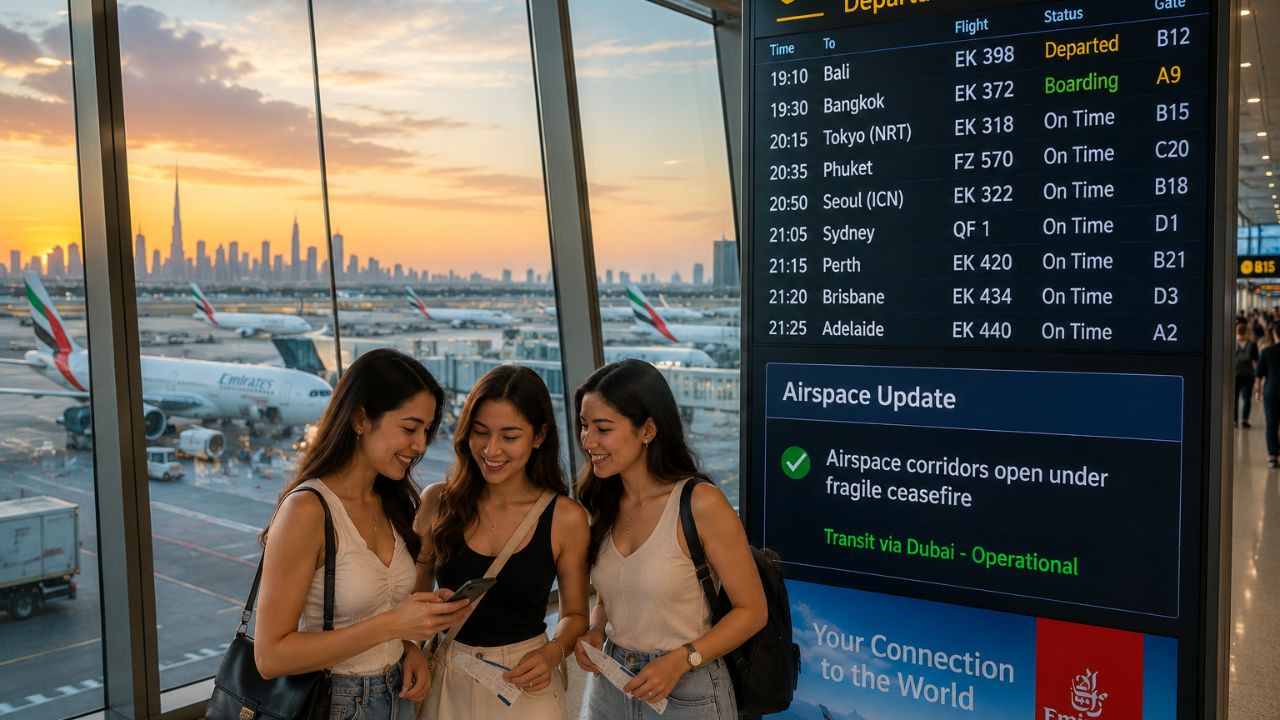
Image generated by AI
Aviation Updates: Fragile Ceasefire Reopens Middle East Airspace, but British Airways Extends Suspensions Amid Massive Travel Chaos
While an unprecedented diplomatic breakthrough has successfully reopened vital Middle Eastern aviation corridors, a monumental strategic divide has erupted across the industry, with regional mega-carriers rapidly restoring flights while Western giants extend massive route suspensions deep into late 2026, perpetuating severe global travel chaos.
Image generated by AI
As top-tier airline news platforms rapidly issue critical aviation updates regarding the stabilization of the Middle East, the global travel network is violently attempting to rebuild following months of absolute logistical paralysis. Following a highly volatile conflict that erupted on February 28, 2026, resulting in massive, immediate airspace closures across the Gulf, an immense diplomatic breakthrough has finally materialized. Formal diplomatic briefs have confirmed that the United States and Iran have executed a landmark memorandum of understanding, enforcing an immediate pause on active military hostilities and establishing a framework for bilateral peace talks. However, the legacy of this conflict has left permanent scars on the aviation sector. While regional carriers are aggressively exploiting the ceasefire to restart networks, the intense military reality prior to the truce—where UAE defense networks intercepted an astonishing 2,274 drones, 551 ballistic missiles, and 29 cruise missiles—has terrified Western legacy carriers. Consequently, major international airlines are extending their flight suspensions, triggering continuous flight cancellations and localized airport disruptions that guarantee long-term travel chaos for global transit passengers.
Expanded Overview: The Military Legacy and the Ceasefire
To fully understand the massive hesitation plaguing Western airlines, one must analyze the sheer scale of the military engagement preceding the current ceasefire.
The declassified defense data officially released by the UAE government paints a terrifying picture of the pressure exerted on local civilian infrastructure. The interception of nearly 2,300 drones and hundreds of ballistic and cruise missiles over a compressed timeline proves that the regional airspace was functioning as an active combat zone. While the formal memorandum of understanding between the US and Iran has successfully halted the kinetic exchange, the sheer volume of intercepted munitions explains why global aviation risk assessors remain on extreme high alert. The ceasefire is currently holding, but the underlying geopolitical friction forces airlines to choose between reclaiming highly lucrative transit routes and absolutely guaranteeing passenger safety against the threat of sudden escalation.
Section-Wise Breakdown: The Airspace Recovery Architecture
While diplomatic progress has silenced the immediate threat, the physical reality of navigating the Middle East remains incredibly complex.
According to official civil aviation directives, the United Arab Emirates officially cleared its sovereign airspace to return to standard, pre-war capacity on May 2. However, commercial flights transiting the region are far from flying freely. Aircraft are strictly mandated to utilize heavily monitored, highly specific aviation corridors designed to keep civilian traffic entirely insulated from sensitive military zones. Furthermore, total regional normalization has not occurred. Civil aviation authorities in both Kuwait and Iran continue to enforce severe operational limits, keeping massive segments of their domestic airspace either completely closed or aggressively restricted to civilian traffic, forcing airlines to rely on narrow, congested transit highways.
Section-Wise Breakdown: The Massive Airline Strategy Divide
The ceasefire has triggered an unprecedented fracture in how the world’s major airlines approach the Middle East, violently splitting regional operators from Western legacy carriers.
On one side of the divide, Dubai’s flagship carriers, Emirates and flydubai, have aggressively normalized operations out of Dubai International Airport (DXB) and Al Maktoum International (DWC). Flydubai notably maintained extreme flexibility during the crisis, offering full refunds or free 30-day rebooking windows for affected passengers. Similarly, regional giants like Qatar Airways and Air India are rapidly restoring frequencies to absorb stranded transit traffic.
Conversely, Western legacy airlines have completely abandoned short-term recovery. British Airways sent shockwaves through the aviation sector by officially announcing a massive prolongation of its Dubai route suspension until October 25, 2026. Top-tier global operators, including Cathay Pacific, Singapore Airlines, and KLM, have immediately followed suit, extending their flight suspensions for several months, actively choosing to sacrifice massive revenue rather than risk operating within the fragile ceasefire parameters.
Flight Details: Middle East Aviation Conflict and Recovery Matrix
To fully comprehend the timeline, the defense statistics, and the severe operational divergence between global carriers, the critical data has been consolidated into the mandatory operational matrix below.
| Operational Metric | Verified Conflict & Recovery Data |
|---|---|
| Conflict Trigger Date | February 28, 2026 |
| UAE Defense Interceptions | 2,274 Drones, 551 Ballistic Missiles, 29 Cruise Missiles |
| UAE Airspace Clearance | Returned to pre-war capacity on May 2 |
| Restricted Airspace Regions | Kuwait and Iran (Severe civilian traffic limits) |
| British Airways Suspension | Dubai flights suspended until October 25, 2026 |
| US State Dept. Advisory | Level-3 ("Reconsider Travel") to UAE, Saudi Arabia, Bahrain, Kuwait, Qatar, Oman, Jordan |
Passenger Impact: Travel Advisories and the Insurance Crisis
For the global transit passenger, the physical reopening of airspace is entirely overshadowed by a massive crisis in travel insurance and government advisories.
While the Dubai government has formally guaranteed that the city is fully secure, fully operational, and that all hospitality and corporate sectors are running uninterrupted, Western governments disagree. The UK Foreign, Commonwealth & Development Office (FCDO) is actively maintaining a strict travel warning against all but essential travel to the UAE. Simultaneously, the US Department of State continues to enforce a severe Level-3 advisory, explicitly urging Americans to "reconsider travel" across the UAE, Saudi Arabia, Bahrain, Kuwait, Qatar, Oman, and Jordan.
This creates a catastrophic trap for transit passengers. If a sudden geopolitical flare-up forces a short layover in Dubai to morph into an overnight delay, requiring passengers to clear customs and enter the city landside, standard travel insurance policies will immediately void all coverage. Because the traveler has physically entered a territory flagged under a government "do not travel" or "essential travel" restriction, they are suddenly entirely liable for all emergency accommodation and repatriation costs.
Industry Analysis: Rewriting the Rules of Passenger Protection
Recognizing that international passengers are refusing to transit through the Gulf due to the total collapse of third-party insurance coverage, local mega-carriers are executing a radical industry intervention.
Emirates and Etihad Airways have officially announced highly aggressive joint initiatives to launch specialized, heavily subsidized travel insurance policies exclusively designed for their international visitors. Sir Tim Clark, President of Emirates, has explicitly confirmed that the airline is actively collaborating with elite global underwriters to roll out comprehensive protection frameworks. These revolutionary policies guarantee that passengers will be safely rerouted or repatriated, completely insulating them from the devastating financial fallout of sudden airspace closures, voided standard insurance, or third-party airline cancellations across Asia, Europe, and the Middle East.
Conclusion: A Fractured Aviation Ecosystem
Ultimately, the fragile ceasefire in the Middle East has succeeded in reopening critical airspace corridors, but it has completely failed to restore unified global confidence. While the United Arab Emirates has successfully defended its infrastructure against thousands of incoming munitions and cleared its airspace on May 2, the severe operational divide remains. As Emirates and regional partners aggressively rebuild their networks, the refusal of giants like British Airways, KLM, and Singapore Airlines to return until late 2026 ensures that massive transit bottlenecks and extreme travel chaos will define the summer season. Until the revolutionary insurance initiatives pioneered by Emirates and Etihad fully neutralize the financial terror imposed by Western travel advisories, the Gulf transit corridor will remain a highly fragmented, high-stakes environment.
Key Takeaways
- Diplomatic Breakthrough: The US and Iran have signed a formal memorandum of understanding, establishing a fragile ceasefire and pausing military hostilities triggered on February 28, 2026.
- Massive Defense Action: Prior to the truce, UAE defense networks intercepted an unprecedented 2,274 drones, 551 ballistic missiles, and 29 cruise missiles.
- The Airline Divide: While Emirates, flydubai, Air India, and Qatar Airways are normalizing operations, British Airways has extended its Dubai flight suspensions until October 25, 2026.
- Insurance Trap: US Level-3 advisories and UK FCDO warnings are voiding standard travel insurance policies for transit passengers forced to enter the UAE during unforeseen delays.
- Carrier Intervention: Emirates and Etihad are jointly launching specialized, highly subsidized insurance policies to protect passengers from airspace closures and government travel warnings.
FAQ: Middle East Airspace Ceasefire & Flight Suspensions
What triggered the recent reopening of Middle Eastern airspace? A formal memorandum of understanding was executed between the United States and Iran, creating a pause on active hostilities and allowing the UAE to return to pre-war airspace capacity on May 2.
How many attacks did the UAE intercept during the conflict? Declassified defense data reveals that UAE air defense networks successfully intercepted 2,274 drones, 551 ballistic missiles, and 29 cruise missiles prior to the ceasefire.
Why are flights still being cancelled if the airspace is open? While regional carriers like Emirates and flydubai have normalized schedules, major Western airlines like British Airways, Cathay Pacific, KLM, and Singapore Airlines are taking a highly cautious approach, extending flight suspensions (in BA's case, until October 25, 2026) due to perceived geopolitical risks.
How do government travel advisories affect transit passengers in Dubai? The US Level-3 advisory and UK FCDO "essential travel" warnings mean that if a transit passenger is forced to clear customs and enter Dubai due to a delay, standard travel insurance policies will typically void coverage, leaving the passenger financially exposed.
Related Travel Guides
Etihad Airways EY382 Abu Dhabi Dhaka Travel Chaos 2026
Edelweiss Zurich Kefalonia Route Travel Chaos 2026
Middle East Regional Flight Disruption Survival Guide 2026
Disclaimer: This article is strictly for informational and aviation crisis response analysis purposes. The specific conflict statistics (2,274 drones, 551 ballistic missiles, 29 cruise missiles), airspace reopening dates (May 2), route suspension timelines (British Airways until October 25, 2026), and government advisory status (US Level-3, UK FCDO) are based on verified diplomatic briefs, defense data, and official airline statements available at the time of publication. Geopolitical ceasefires and international aviation corridors are incredibly fragile; travel advisories, flight schedules, airspace closures, and travel insurance coverage terms are subject to immediate, unannounced modification without prior notice. Passengers transiting through the Middle East must explicitly verify their flight status directly with their operating carrier and consult specialized insurance underwriters to guarantee coverage under current government advisories prior to travel.
Disclaimer
This article is for informational and educational purposes only. It does not constitute legal, financial, or professional advice. While we strive to provide accurate and up-to-date information, travel policies, regulations, and conditions change rapidly. Always verify information with official sources before making travel decisions. Nomad Lawyer makes no representations about the accuracy, reliability, completeness, or suitability of the information provided. Readers should consult qualified professionals for advice specific to their circumstances. The views expressed in this article are those of the author and do not necessarily reflect the views of Nomad Lawyer.
Preeti Gunjan
Contributor & Community Manager
A passionate traveller and community builder. Preeti helps grow the Nomad Lawyer community, fostering engagement and bringing the reader experience to life.
Learn more about our team →