
Lufthansa Flight Frankfurt to Lisbon Diverts to Lyon After Cabin Power Bank Fire: In-Flight Lithium Battery Rules and Passenger Safety Guide
Lufthansa flight LH1170 carrying 198 passengers from Frankfurt to Lisbon diverted to Lyon after a passenger's portable power bank caught fire mid-air.

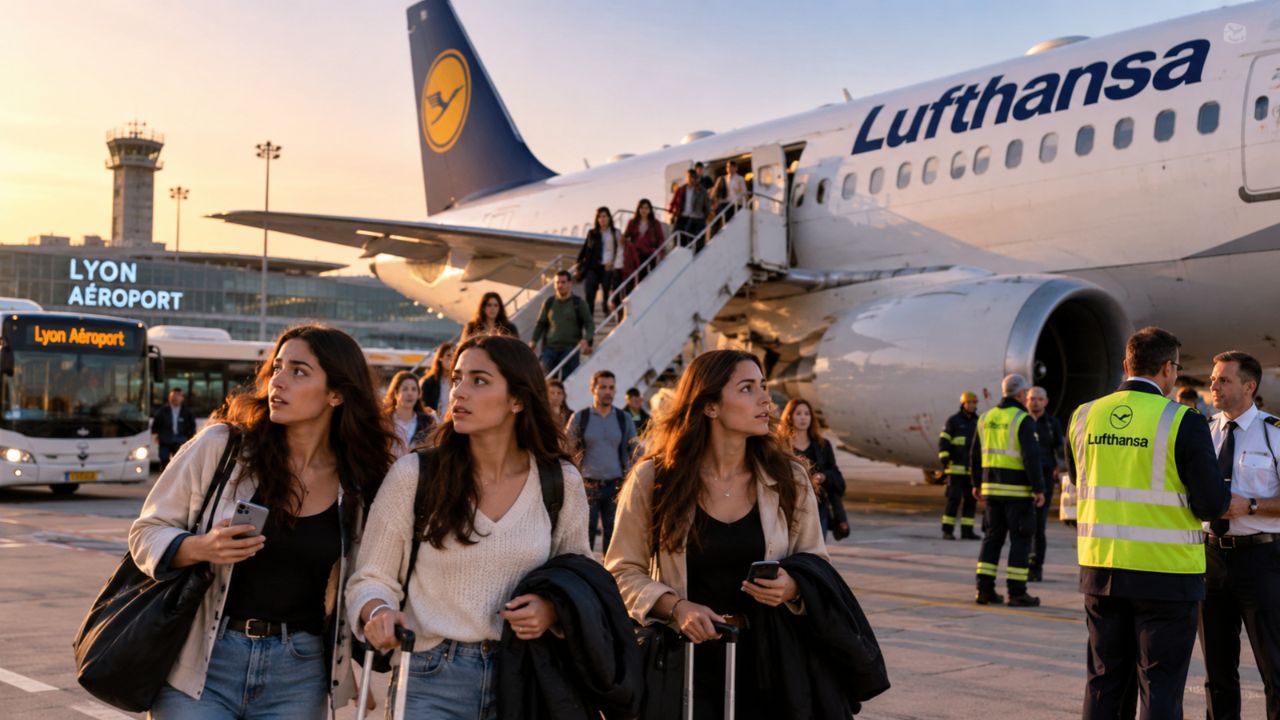
Image generated by AI
Placing a portable lithium-ion power bank inside checked luggage is strictly illegal on all commercial flights worldwide, but even inside the cabin, airlines now forbid passengers from charging devices from external battery packs during flight. This critical safety protocol was demonstrated mid-air when Lufthansa flight LH1170, carrying 198 passengers and six crew members from Frankfurt to Lisbon, was forced to execute an emergency diversion into Lyon, France, after a traveler's portable battery suffered thermal runaway and caught fire near a passenger seat.
The In-Flight Battery Fire and Emergency Landing in France
The incident unfolded on a Saturday evening as the Airbus aircraft cruised southwest toward Portugal. A passenger's portable power bank began overheating rapidly, releasing smoke and open flames in the seating area. Cabin crew responded immediately using onboard fire containment protocols, sealing the burning device inside a specialized fire-resistant lithium battery containment bag to isolate heat and toxic gas emissions.
Although the immediate fire was extinguished, flight commanders initiated a precautionary descent into Lyon-Saint Exupéry Airport to ensure cabin air quality and undergo full aircraft safety inspections. The aircraft landed safely at approximately 10:00 PM. Lufthansa provided hotel accommodation and meal vouchers in Lyon for all 198 travelers before transferring them onto replacement flights to Lisbon the following morning.
The diversion marked the second precautionary rerouting for Lufthansa that weekend; another widebody flight departing Frankfurt for Toronto carrying 371 passengers diverted safely to Manchester, England, following an unrelated in-cabin technical indication. Real-time facility updates are maintained by Frankfurt Airport.
Understanding Aviation Lithium Battery Risks and Storage Rules
Lithium-ion batteries carry significant chemical energy. If internal separator layers are punctured, crushed, or subjected to electrical short-circuits, they can enter an uncontrollable chemical reaction known as thermal runaway, generating temperatures exceeding 600°C (1,100°F).
To mitigate fire risks in pressurized cabins, international aviation bodies have enacted strict carriage mandates:
- Checked Baggage Prohibition: Power banks and loose lithium spare batteries are universally banned from cargo holds because cargo fires cannot be accessed or extinguished manually by flight crews.
- Under-Seat Storage Requirements: Under Lufthansa Group guidelines, power banks must remain easily accessible—either on your person, in a seat pocket, or inside a personal item placed under the seat in front of you. Storing battery packs inside overhead bins is prohibited because delays in identifying smoldering luggage in overhead racks increase cabin fire risks.
- No In-Flight Device Charging: Passengers are prohibited from operating or recharging external power banks while airborne, except for certified personal medical equipment.
Passenger Travel and Electronics Insider Tips
- Inspect Power Banks Before Flying: Never board an aircraft with a power bank that exhibits physical swelling, cracked casing, or extreme heat during home charging. Damaged cells are significantly more susceptible to thermal failure under cabin pressure changes.
- Capacity Limits (Watt-Hours): Ensure your portable battery rating does not exceed 100 Watt-hours (Wh)—roughly equivalent to 27,000 milliampere-hours (mAh). Batteries rated between 101 Wh and 160 Wh require explicit airline approval, while units over 160 Wh are prohibited entirely.
- Handling Overheating Electronics: If your smartphone, laptop, or power bank becomes uncomfortably hot, emits an acrid chemical odor, or begins smoking, alert flight attendants immediately. Never attempt to pour standard drinking water on a smoldering battery pack yourself.
- Terminal Power Alternatives: Utilize built-in AC and USB outlets located at airport boarding gates and aircraft seatbacks rather than relying on high-capacity portable chargers while in transit.
Regulatory Standards and Global Safety Context
Aviation battery transport guidelines are formulated under hazardous materials frameworks established by the International Air Transport Association (IATA) and technical instructions from the European Union Aviation Safety Agency (EASA).
Flight attendants undergo rigorous practical training involving dedicated fire gloves, water dousing techniques, and thermal containment bags designed to withstand explosive battery cell ruptures. As passenger carry-on electronic density increases, airlines continue refining automated safety briefings to ensure travelers store and manage power banks responsibly throughout every flight sector.
FAQ: Flying With Portable Power Banks in 2026
Can travelers pack power banks in checked suitcases?
No. International aviation law strictly bans power banks and loose lithium-ion batteries from checked baggage due to cargo fire hazards.
Are passengers allowed to charge their phones using a power bank during a flight?
Many international airlines, including Lufthansa Group carriers, prohibit operating or charging power banks while airborne to prevent thermal runaway.
What is the maximum battery capacity allowed in carry-on luggage?
Passengers may bring power banks rated up to 100 Watt-hours (Wh) without prior airline approval, typically allowing up to two spare batteries per traveler.
What should a passenger do if their device begins smoking on board?
Notify cabin crew immediately without attempting to move or conceal the device. Flight attendants are equipped with certified thermal containment bags to safely neutralize burning electronics.
Adhering strictly to carry-on lithium battery regulations ensures that portable power remains a convenient travel tool rather than an in-flight safety hazard.
Disclaimer
This article is for informational and educational purposes only. It does not constitute legal, financial, or professional advice. While we strive to provide accurate and up-to-date information, travel policies, regulations, and conditions change rapidly. Always verify information with official sources before making travel decisions. Nomad Lawyer makes no representations about the accuracy, reliability, completeness, or suitability of the information provided. Readers should consult qualified professionals for advice specific to their circumstances. The views expressed in this article are those of the author and do not necessarily reflect the views of Nomad Lawyer.
Preeti Gunjan
Contributor & Community Manager
A passionate traveller and community builder. Preeti helps grow the Nomad Lawyer community, fostering engagement and bringing the reader experience to life.
Learn more about our team →