
Boeing 757's Unique Mid-Cabin Boarding Strategy: Why Airlines Embrace This Unconventional Approach
Breaking airline news and aviation industry updates for 2026.

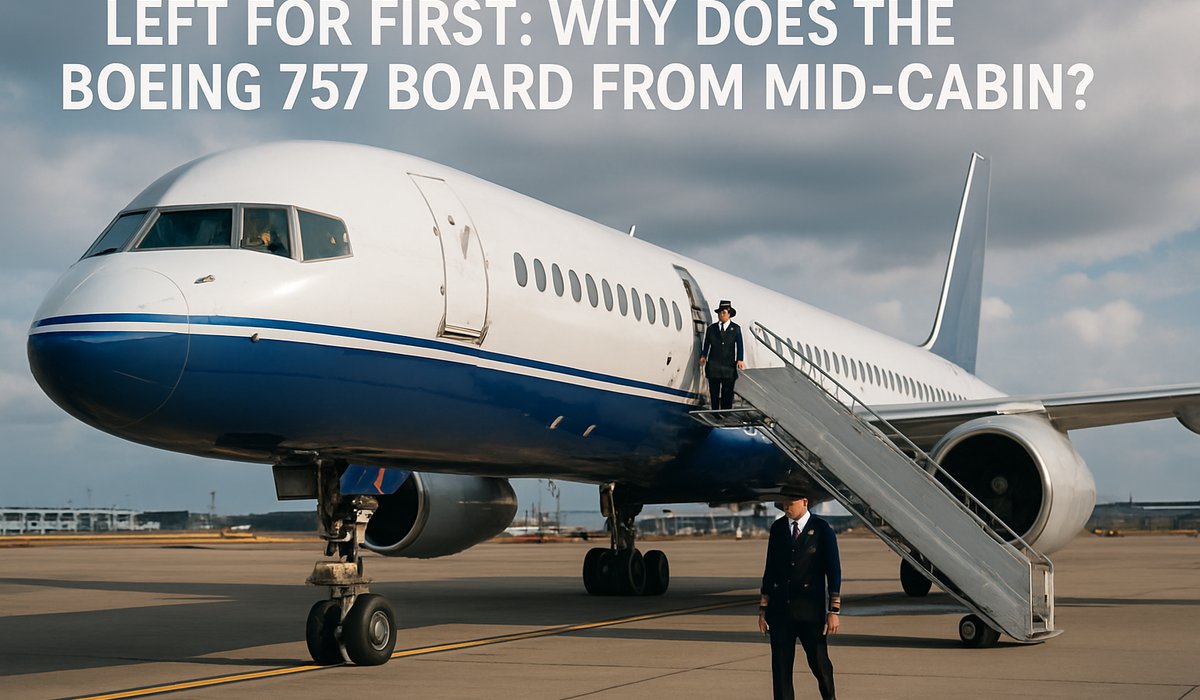
Image generated by AI
Boeing 757's Unique Mid-Cabin Boarding Strategy: Why Airlines Embrace This Unconventional Approach
The iconic narrowbody jet's distinctive passenger loading method offers operational advantages that explain its continued preference decades after design
The 757's Singular Boarding Architecture Sets It Apart
The Boeing 757 stands alone among contemporary narrowbody commercial aircraft in routinely deploying mid-cabin boarding procedures that fundamentally diverge from industry standard practices. This operational distinction reflects deliberate engineering choices made during the aircraft's original design phase and continues to shape how carriers manage passenger flow across their 757 fleets today.
How the Mid-Cabin Entry Reshapes Passenger Movement
When gate infrastructure supports the practice, all passengers funnel through door 2L—positioned at the cabin's midpoint—creating an elegant operational solution that segregates premium and economy service flows without physical bottlenecking. Upon entry, first-class travelers naturally proceed forward toward the aircraft's nose section, while economy passengers simultaneously move aft toward the rear cabin. This bifurcated approach eliminates the traditional single-file boarding congestion that characterizes most contemporary narrowbody operations, where passengers must navigate through premium cabins to reach economy seating.
Operational Efficiency Meets Cabin Configuration
The 757's architectural design facilitates this unconventional procedure through its specific fuselage proportions and internal cabin layout. Unlike competing narrowbody platforms that concentrate primary entry points at the forward door, the 757's mid-cabin location enables carriers to optimize ground turnaround times—a critical metric affecting daily aircraft utilization and profitability across the aviation industry.
This boarding methodology delivers measurable advantages: reduced aircraft dwell time at gates, minimized aisle congestion during the boarding sequence, and improved cabin service readiness. For airlines operating intensive short-haul and medium-haul networks, these efficiency gains accumulate substantially across thousands of annual boarding operations.
Why Other Aircraft Never Adopted This Strategy
Despite these operational benefits, no other narrowbody aircraft currently in production has replicated the 757's mid-cabin boarding capability. Newer platforms, including the Boeing 737 MAX and Airbus A320 family, maintain conventional forward-door entry configurations that reflect different design philosophies and competitive positioning within the market.
The 757's continued utility in this specialized role underscores why legacy narrowbody aircraft remain operationally valuable despite their age. Airlines continue retrofitting and extending 757 service lives precisely because such distinctive operational features deliver tangible cost advantages in competitive route environments.
FAQs: Understanding the 757's Distinctive Boarding Process
Why don't modern aircraft use mid-cabin boarding like the 757? Contemporary aircraft designs prioritize different operational priorities, including standardized gate compatibility across global networks and crew training simplification. The 757's mid-cabin door configuration requires specific gate infrastructure that many airports cannot accommodate.
Does mid-cabin boarding actually reduce turnaround times? Yes—operational studies indicate measurable reductions in ground dwell time when both cabin classes board simultaneously from separate entry points, improving daily aircraft utilization metrics.
Can airlines retrofit other aircraft with mid-cabin doors? Structural and regulatory constraints make retrofitting prohibitively expensive, explaining why this advantage remains exclusive to original 757 configurations.
What percentage of 757 flights utilize mid-cabin boarding? Availability depends entirely on gate infrastructure; international hub operations may support the procedure more frequently than regional airports with standardized gate designs.
Will Boeing replicate this feature in future aircraft? Industry analysts suggest newer platforms prioritize universal gate compatibility over single-route optimization, making 757-style mid-cabin boarding unlikely in next-generation designs.
Related Travel Guides
Flight Delay Compensation Guide 2026
Understanding Airline Route Changes
Airport Security Process Updated (2026)
External Resources
Disclaimer
This article is for informational and educational purposes only. It does not constitute legal, financial, or professional advice. While we strive to provide accurate and up-to-date information, travel policies, regulations, and conditions change rapidly. Always verify information with official sources before making travel decisions. Nomad Lawyer makes no representations about the accuracy, reliability, completeness, or suitability of the information provided. Readers should consult qualified professionals for advice specific to their circumstances. The views expressed in this article are those of the author and do not necessarily reflect the views of Nomad Lawyer.
Raushan Kumar
Founder & Lead Developer
Full-stack developer with 11+ years of experience and a passionate traveller. Raushan built Nomad Lawyer from the ground up with a vision to create the best travel and law experience on the web.
Learn more about our team →