
Runway Sequencing and Gate Limitations Trigger Major Flight Disruptions at Los Angeles International Airport
Los Angeles International Airport (LAX) records 277 delays and 6 cancellations, triggering flight disruption cascades across the US and trans-Pacific.

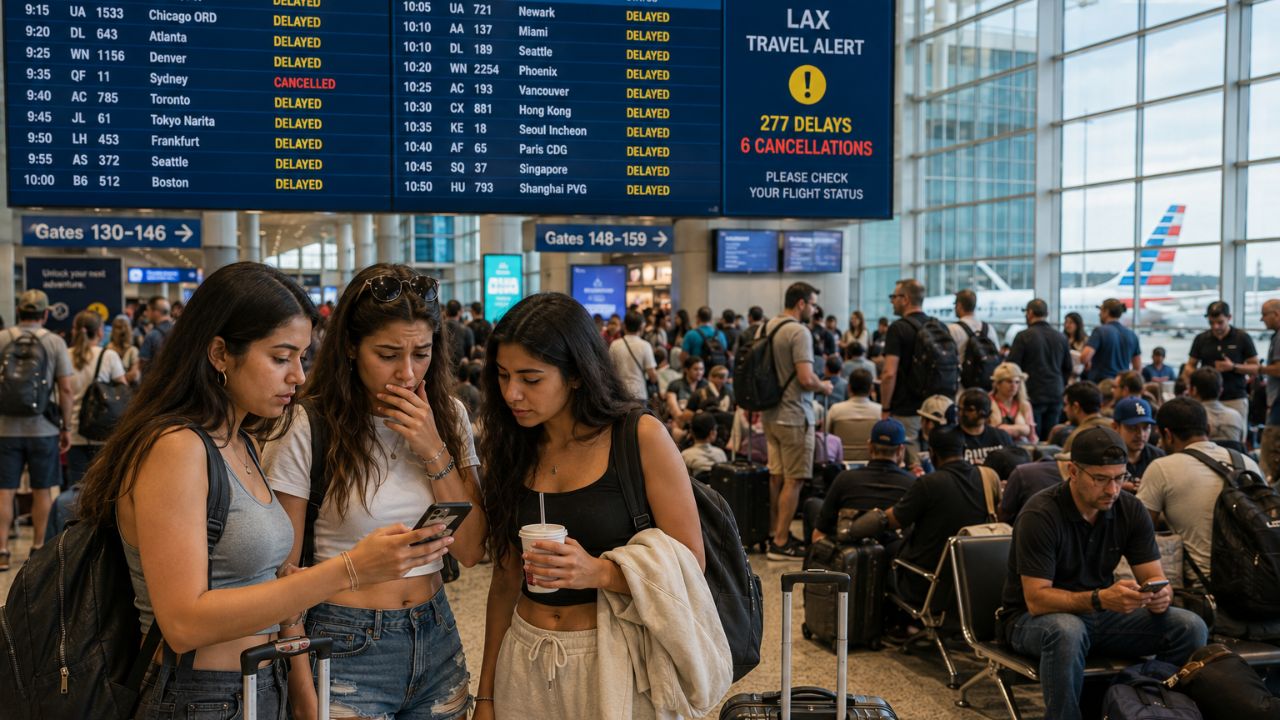
Image generated by AI
Los Angeles International Airport flight delays and cancellations have disrupted schedules across the global aviation network. Severe gate constraints and runway sequencing issues at LAX have triggered 277 delays and six cancellations.
Runway and Gate Congestion Limits West Coast Hub Operations
Terminal operations monitored at Los Angeles International Airport confirm that the hub experienced capacity constraints on July 4, 2026. A combination of runway sequencing backlogs and gate shortages resulted in significant scheduling compression.
Airlines prioritized maintaining scheduled services over making pre-emptive flight cancellations, causing delays to accumulate across successive departure banks.
The resulting scheduling backlog at the primary US West Coast gateway affected both high-frequency domestic routes and long-haul international flights.
Domestic Carriers Absorb Upstream Congestion at Terminal Gates
Mainline carriers experienced the highest volume of delays due to flight frequency at the hub. American Airlines led the disruption statistics with 69 delays, followed by Southwest Airlines with 44 delays and United Airlines with 31 delays and three cancellations.
Delta Air Lines registered 25 delays, while regional partner SkyWest recorded 36 delays, highlighting the vulnerability of regional feeder services.
JetBlue Airways also faced minor delays, contributing to passenger waiting times during peak departure banks.
LAX Airport and Carrier Disruption Statistics
The tables below display the carrier disruptions and downstream hub impacts originating from Los Angeles.
Flight Cancellations and Delays at LAX by Carrier
| Airline Carrier Name | Cancelled Flights | Delayed Flights | Hub Network Classification |
|---|---|---|---|
| American Airlines | 0 | 69 | Mainline US Trunk |
| Southwest Airlines | 0 | 44 | Mainline Domestic Trunk |
| SkyWest Airlines | 0 | 36 | Regional Feeder Carrier |
| United Airlines | 3 | 31 | Mainline US Trunk |
| Delta Air Lines | 0 | 25 | Mainline US Trunk |
| JetBlue Airways | 0 | 9 | Domestic Mainline |
| Qantas Airways | 2 | 2 | Trans-Pacific Carrier |
Downstream Hub Impacts from LAX Disruption
| Affected Destination Airport | Airport Code | Cancelled Flights | Delayed Flights | Downstream Region |
|---|---|---|---|---|
| Chicago O'Hare | ORD | 0 | 13 | US Midwest Hub |
| San Francisco | SFO | 0 | 12 | US West Coast Hub |
| Newark Liberty | EWR | 0 | 8 | US East Coast Hub |
| John F. Kennedy | JFK | 0 | 8 | US East Coast Hub |
| Beijing Capital | PEK | 0 | 4 | Asia-Pacific Hub |
| Sydney Airport | SYD | 2 | 0 | Oceania Hub |
| Chengdu Tianfu | TFU | 1 | 0 | Asia-Pacific Hub |
| Toronto Pearson | YYZ | 0 | 2 | Canadian Hub |
Long-Haul Trans-Pacific and Transatlantic Operations Face Downstream Ripple Effects
Long-haul scheduling operations managed by Qantas Airways recorded two cancellations and two delays, impacting passengers on flights to Sydney.
Trans-Pacific flights operated by Japan Airlines, Cathay Pacific, Singapore Airlines, and China Southern Airlines experienced minor to moderate delays.
In Europe, transit gateways including Frankfurt, Munich, Paris CDG, and London Heathrow reported minor delays as aircraft arrivals from LAX were pushed back.
Canadian carriers, including Air Canada, also registered delays on flights connecting Vancouver and Toronto Pearson to Los Angeles.
Why This Matters
Our analysis of the flight data indicates that LAX operates as a primary trans-Pacific gateway, meaning that even minor terminal delays quickly cascade internationally. Because trans-Pacific flights require large aircraft with long turnaround times, a delay in gate access at LAX directly postpones the return flight.
This vulnerability is why Qantas experienced a high ratio of cancellations relative to its flight frequency.
Additionally, domestic hubs like Chicago O'Hare and San Francisco absorb the largest volume of downstream delays. When delayed flights arrive from LAX, they occupy gates scheduled for other incoming domestic flights, creating secondary delays that affect onward passenger itineraries.
Industry Outlook
Market trends suggest that airport operators will need to optimize gate allocation algorithms to prevent aircraft from idling on taxiways. Airlines are expected to increase ground connection buffers for trans-Pacific routes to protect schedules from terminal congestion.
Expect terminal coordinators to prioritize international departure slots during peak evening traffic blocks. The current scheduling irregularities are projected to resolve as passenger volumes stabilize.
Key Takeaways
- Systemic Delay: LAX recorded 277 delays and six cancellations due to runway and gate constraints.
- Domestic Congestion: American and Southwest airlines reported the highest number of flight delays.
- Trans-Pacific Cascades: Qantas recorded two cancellations, disrupting key trans-Pacific passenger rotations.
- Hub Redistribution: Chicago O'Hare and San Francisco absorbed the highest volume of downstream domestic delays.
- Operational Strategy: Airlines prioritized maintaining flight schedules over cancellations, causing delays to accumulate.
FAQ
What caused the flight disruptions at Los Angeles International Airport?
The delays were caused by runway sequencing backlogs and gate limitations during peak traffic periods.
How many flights were affected at LAX?
The airport recorded 277 delayed flights and six cancelled flights across the daily schedule.
Which airline was hardest hit by cancellations?
United Airlines and Qantas Airways recorded the highest number of cancellations, with three and two cancelled flights respectively.
Why do delays at LAX cause delays at other airports?
Delayed departures from LAX prevent aircraft from arriving at their destinations on time, disrupting subsequent flights scheduled for those same planes.
Related Travel Guides
Disclaimer
This article is for informational and educational purposes only. It does not constitute legal, financial, or professional advice. While we strive to provide accurate and up-to-date information, travel policies, regulations, and conditions change rapidly. Always verify information with official sources before making travel decisions. Nomad Lawyer makes no representations about the accuracy, reliability, completeness, or suitability of the information provided. Readers should consult qualified professionals for advice specific to their circumstances. The views expressed in this article are those of the author and do not necessarily reflect the views of Nomad Lawyer.
Kunal K Choudhary
Co-Founder & Contributor
A passionate traveller and tech enthusiast. Kunal contributes to the vision and growth of Nomad Lawyer, bringing fresh perspectives and driving the community forward.
Learn more about our team →