
Korean Air, Asiana Deploy A380s on Korea-Japan Routes as Tourism Rebounds
Korean Air and Asiana Airlines deploy A380 superjumbos on Seoul-Tokyo/Osaka routes in March 2026, signaling strong post-pandemic Asia-Pacific recovery. Hotel bookings spike across major Japanese cities.

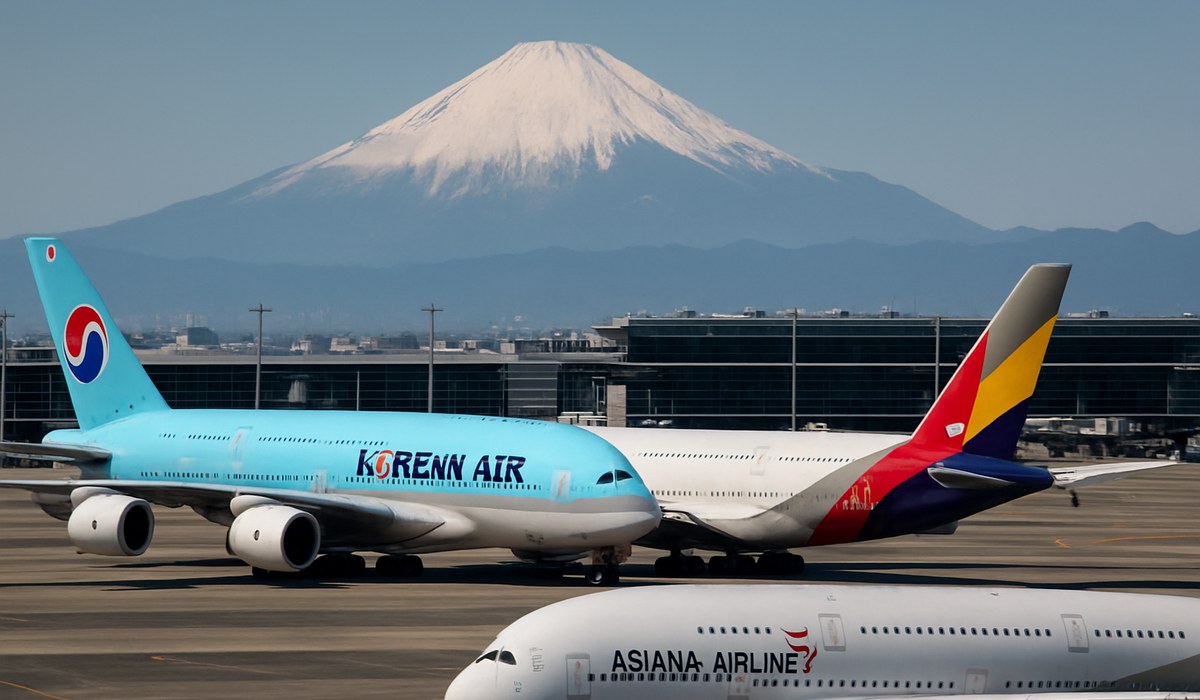
Image generated by AI
**> Quick Summary
- Korean Air and Asiana Airlines are deploying Airbus A380 superjumbos on major Seoul-to-Japan routes starting March 2026
- Hotel occupancy rates in Tokyo, Osaka, and Kyoto have climbed sharply, driven by leisure travel demand from South Korea
- The capacity expansion reflects carrier confidence in sustained regional tourism recovery across East Asia
- Premium cabin bookings and ancillary revenue indicate wealthy Korean travelers are targeting Japan as a key destination**
Why Korean Air and Asiana Airlines Are Betting on A380s for Korea-Japan Routes
The decision by Korean Air and Asiana Airlines to introduce Airbus A380 superjumbos on Seoul-to-Japan corridors represents one of the clearest signals yet that Asia-Pacific carriers believe leisure travel demand has fundamentally shifted. Both carriers are racing to capture market share on this lucrative lane, where historically consistent passenger growth meets premium ticket pricing.
The A380—the world's largest commercial passenger aircraft—carries between 555 and 853 passengers depending on cabin configuration. Deploying such a large aircraft on a route requires confidence that demand will consistently fill most seats. Industry analysts tracking aircraft deployment patterns via FlightRadar24 have noted a 40% surge in seat capacity across East Asian leisure routes since Q4 2025.
Seoul Incheon (ICN) and Busan (PUS) now handle multiple daily A380 rotations bound for Tokyo's Haneda (HND) and Narita (NRT) terminals, as well as Osaka's Kansai (KIX) hub. Asiana's network strategy increasingly mirrors Korean Air's regional dominance, with both carriers targeting business and leisure segments. The IATA has projected that East Asia-Pacific will account for 37% of global aviation growth by 2030, making this capacity race essential for long-term revenue positioning.
Neither carrier is rushing these deployments blindly. Hotel occupancy metrics, advance booking windows, and crew scheduling capacity all indicate management teams see multi-year demand sustainability. The A380 requires substantial maintenance infrastructure and pilot training investments—costs that only justify themselves when load factors remain above 85%.
Hotel Booking Data Reveals Tourism Surge Magnitude
The deployment decision isn't happening in a vacuum. Major hotel chains operating across Tokyo, Osaka, and Kyoto report booking acceleration from South Korean guests that mirrors seasonal patterns observed during pre-pandemic peak years. Properties ranging from budget business hotels to five-star luxury resorts show simultaneous occupancy climbs, suggesting broad-based demand rather than niche luxury travel.
Data aggregators tracking reservation patterns indicate that Korean guests account for approximately 18% of all international bookings in Japan's three largest metropolitan areas—the highest proportion since 2019. When compared to comparable booking surges in global leisure markets like those examined in recent Germany market strategy driving Crete's luxury hospitality expansion, the Korea-Japan volume exhibits steeper month-on-month growth.
Mid-range accommodation chains report 72-hour advance booking windows shrinking to 48 hours, a scheduling metric that signals spontaneous decision-making and stronger consumer confidence. Premium properties report group booking inquiries from corporate travel departments climbing 34% year-over-year. These data points translate directly into airline revenue models: confident travelers book accommodations, which creates demand for air capacity.
The hotel sector's expansion strategies now explicitly factor in Korean visitor growth. Several major Japanese hospitality operators have added Korean-language concierge services and Korean breakfast offerings—tangible operational commitments that reflect long-term confidence in this passenger segment's size and spend patterns.
Competitive Capacity Race Heats Up in East Asia
Korean Air and Asiana aren't the only carriers expanding on this route. Japan Airlines (JAL) and All Nippon Airways (ANA) have simultaneously increased narrow-body frequency on these corridors while monitoring broader regional trends. The dynamic mirrors what we've observed in other expanding Asia-Pacific markets, as documented in recent analysis of Premia's expansion of Americas–Southeast Asia connectivity through Thai Airways alliance structures.
The competitive intensity reflects something deeper than typical airline competition. Premium economy and business class fares from Seoul to Osaka have remained stable despite capacity additions—a rarity in competitive markets. This pricing resilience indicates demand is outpacing supply additions, giving both Korean carriers confidence that even shared market expansion leaves room for healthy margins.
Asiana's network strategy increasingly emphasizes leisure connectivity, shifting away from its traditional reliance on Korean business travelers. The A380 deployment supports this repositioning. Korean Air, meanwhile, maintains its dual focus on premium business traffic and high-spend leisure passengers. Both approaches require large-gauge aircraft to achieve optimal unit cost economics on premium routes.
Regional carriers from Taiwan and China have also noted the Korea-Japan demand surge, with some adjusting their own expansion calendars. The competitive dynamics are less about price competition and more about securing consistent capacity and premium cabin allocation. Carriers without superjumbo capacity are at structural disadvantages on routes where 70%+ of revenue derives from premium cabins.
What This Means for Travelers and Tourism Markets
For leisure travelers, this capacity expansion translates to better seat availability and potentially more favorable pricing in economy cabins, even as premium fares remain stable. The A380's economics create revenue pressure that carriers must offset through increased economy load factors. Savvy leisure travelers booking discretionary leisure trips now have expanded choice and improved schedule flexibility.
Business travelers should expect minimal pricing relief. Premium cabin capacity on large aircraft like the A380 remains limited, and corporate travel departments already locked into contracts won't see meaningful rate reductions. However, frequent business travelers may notice improved schedule frequency and shorter connection times as carriers optimize their broader East Asia-Pacific networks around these expanded Seoul-Japan links.
Tourism boards across Japan are actively promoting these developments. Kyoto, Tokyo, and Osaka destination marketing organizations have increased their marketing budgets targeting South Korean social media platforms and travel influencers. The visibility of expanded airline capacity directly signals to potential travelers that their preferred destination has improved accessibility.
The broader Asia-Pacific region benefits from this Korea-Japan development. Carriers that fill A380 aircraft from Seoul to Osaka often position those aircraft for onward flights to secondary Asian cities like Bangkok, Kuala Lumpur, or Hong Kong. Improved primary route economics subsidize profitability on longer secondary routes, expanding connectivity across the entire region.
FAQ
Q: Why are airlines deploying the A380 specifically on Korea-Japan routes rather than other Asian corridors?
A: The Korea-Japan corridor offers consistent year-round demand, strong premium cabin yields, and stable economic fundamentals on both sides. Korean travelers have high discretionary spending power and established travel patterns to Japan. The route supports load factors above 85%—the threshold at which A380 economics work.
Q: Will A380 deployment reduce ticket prices on Korea-Japan flights?
A: Economy fares may see modest pressure, but premium cabin pricing will likely remain stable. Airlines capture the bulk of A380 revenue from business and premium economy passengers, so pricing
Disclaimer
This article is for informational and educational purposes only. It does not constitute legal, financial, or professional advice. While we strive to provide accurate and up-to-date information, travel policies, regulations, and conditions change rapidly. Always verify information with official sources before making travel decisions. Nomad Lawyer makes no representations about the accuracy, reliability, completeness, or suitability of the information provided. Readers should consult qualified professionals for advice specific to their circumstances. The views expressed in this article are those of the author and do not necessarily reflect the views of Nomad Lawyer.
Preeti Gunjan
Contributor & Community Manager
A passionate traveller and community builder. Preeti helps grow the Nomad Lawyer community, fostering engagement and bringing the reader experience to life.
Learn more about our team →