
Korean Air Pilots Execute Heroic Aborted Landing at Tokyo Narita as Severe Crosswinds Destabilize Airbus A321neo
Korean Air pilots successfully execute a go-around at Tokyo Narita after strong crosswinds destabilize an Airbus A321neo (HL8532), averting a potential runway disaster.

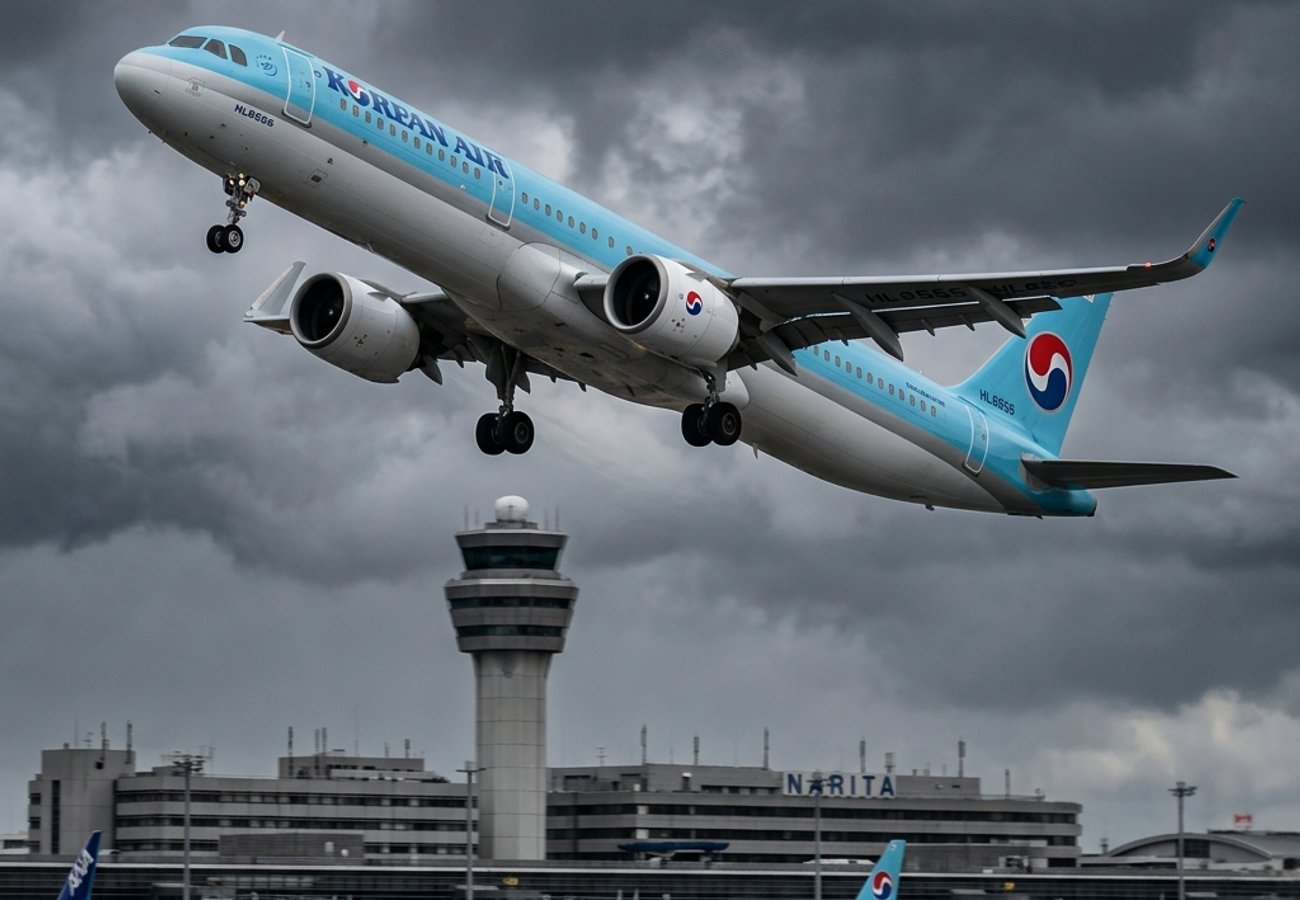
Image generated by AI
Korean Air Pilots Execute Heroic Aborted Landing at Tokyo Narita as Severe Crosswinds Destabilize Airbus A321neo: Aviation Updates Confirm Narrow Escape from Potential Runway Disaster in Japan
Viral Footage Captures HL8532 Wobbling Uncontrollably Before Skilled Flight Crew Initiates Emergency Go-Around Amid Surging Travel Chaos and Airport Disruptions
In a heart-stopping display of professional airmanship and technical precision, the flight crew of a Korean Air Airbus A321neo successfully averted a potential catastrophe at Tokyo Narita International Airport (NRT) on May 12, 2026. As the aircraft, registered as HL8532, was on its final approach to the Japanese gateway, it was struck by a series of high-intensity, unpredictable crosswinds that caused the airframe to wobble dangerously close to the tarmac. With the wings dipping and the fuselage oscillating uncontrollably, the pilots made a split-second decision to apply full thrust and execute a high-performance go-around.
This textbook maneuver, performed just moments before the wheels would have touched the unstable surface, has been hailed by the global aviation community as a masterclass in safety-first decision-making during severe airport disruptions. As aviation updates continue to highlight the increasing volatility of seasonal weather patterns, the Korean Air incident serves as a stark reminder of the "fractions of seconds" that define the thin line between a routine landing and a high-stakes travel chaos event.
Expanded Overview: The Battle Against the Narita Crosswinds
The incident involving Korean Air has quickly become the focus of airline news worldwide, especially after viral social media footage showcased the raw power of the seasonal gusts that frequently plague Tokyo’s primary international hub. The Airbus A321neo, a modern workhorse powered by advanced Pratt and Whitney PW1000G engines, was subjected to lateral forces that threatened to exceed its certified crosswind limits. In such a high-stakes environment, the risk of a "wing strike" or a "hard landing" is immense.
By breaking off the approach and climbing back into the safety of the patterns, the Korean Air crew ensured that all passengers and staff remained unharmed, effectively mitigating the threat of the flight cancellations that often follow a runway incident. The 2.6-year-old aircraft sustained no damage, and after a brief period of vectoring by air traffic control, it was able to return for a second, successful attempt at landing. This event underscores the critical role of modern aviation technology and rigorous pilot training in maintaining a global standard of safety despite the ongoing challenges of airport disruptions.
Section-Wise Breakdown: Narrating the Narrow Escape
The Approach to Narita: A Vulnerable Alignment
Tokyo Narita International Airport is historically known for its exposure to strong seasonal winds, particularly those crossing the path of its two primary parallel runways. On May 12, the local meteorological conditions created a "perfect storm" of surface gusts that challenged several incoming flights. For HL8532, the crosswinds were not just strong—they were erratic, striking the aircraft at the most vulnerable stage of its descent.
HL8532: The Moment of Crisis
As the A321neo crossed the runway threshold, the footage shows the aircraft tilting sharply as the wind caught its vertical stabilizer. The pilots were seen working the controls to maintain the centerline, but as the oscillation increased, the "Stabilized Approach" criteria were no longer being met. Without hesitation, the captain called for a go-around, applying maximum take-off thrust to pull the jet away from the danger zone.
The Role of A321neo Technology
Korean Air currently operates a fleet of 20 Airbus A321neos, all equipped with state-of-the-art fly-by-wire systems. These systems are designed to assist pilots in maintaining control during severe turbulence, but they cannot replace the human judgment required to abort a landing. The responsiveness of the Pratt and Whitney engines was crucial in providing the immediate lift needed to climb away from the ground while in a low-energy state.
Flight Details & Operational Profile
The incident highlights the operational resilience of Korean Air's short-to-medium haul fleet.
- Date: May 12, 2026
- Airline: Korean Air
- Aircraft: Airbus A321-271NX (A321neo)
- Registration: HL8532
- Aircraft Age: 2.6 Years
- Engines: 2x P&W PW1133G-JM
- Airport: Tokyo Narita (NRT)
- Outcome: Successful Go-Around and Safe Second Landing
Korean Air HL8532 Narita Incident Summary 2026
| Category | Details | Status |
|---|---|---|
| Incident Type | Aborted Landing (Go-Around) | Successfully Executed |
| Primary Cause | Severe Crosswinds / Wind Shear | Weather-Induced |
| Passenger Safety | 100% Safety Maintained | No Injuries |
| Aircraft Condition | No Visible Damage | Serviceable |
| Secondary Attempt | Landed Safely (Second Approach) | Completed |
Passenger Impact: The Reality of the Go-Around
For the passengers on board HL8532, the experience was likely one of intense turbulence followed by a sudden surge in engine power. While a go-around can be unnerving for those unfamiliar with aviation procedures, it is the safest possible outcome in an unstable situation.
- Safety Over Speed: The maneuver added approximately 15-20 minutes to the total flight time, but it prevented a potential "hard landing" that could have grounded the aircraft for weeks.
- Professional Assurance: The crew’s ability to stabilize the aircraft immediately after the go-around provides passengers with the confidence that they are in the hands of elite professionals.
- Logistical Minimal Impact: Unlike a flight cancellation, a go-around allows the journey to be completed on the same day, avoiding the travel chaos of hotel vouchers and rebooking.
Industry Analysis: The Standard of the "Go-Around"
Aviation safety experts emphasize that a go-around should never be viewed as an emergency, but rather as a routine and essential safety tool. The Flight Safety Foundation recommends that crews should never feel "pressured" to land if conditions are not 100% optimal. The incident at Narita is a textbook example of how a "no-blame" culture in aviation encourages pilots to prioritize the safety of the aircraft over the pressure of adhering to a strict schedule. As airport disruptions become more common due to changing climate patterns and increased air traffic, the industry must continue to champion these rigorous standards.
Conclusion: A Masterclass in Aviation Safety
The successful recovery of Korean Air Flight HL8532 at Tokyo Narita on May 12, 2026, is a powerful testament to the synergy between human skill and advanced technology. While the viral footage may look dramatic, it represents the aviation system working exactly as it was designed to. By choosing to abort the landing under severe crosswinds, the pilots demonstrated why commercial aviation remains one of the safest modes of travel in the world. As the airline continues to expand its A321neo fleet, this incident will undoubtedly be used in future training as a prime example of excellence in the face of unpredictable environmental challenges.
Key Takeaways
- Incident: Korean Air HL8532 performed a go-around at Tokyo Narita due to severe crosswinds.
- Zero Casualties: All passengers and crew members were safe, with no injuries reported.
- Technical Excellence: The 2.6-year-old Airbus A321neo sustained no damage during the maneuver.
- Safety Protocol: A go-around is a routine safety procedure, not an emergency.
- Environmental Factors: Narita’s runway alignment makes it particularly vulnerable to seasonal gusts.
- Professionalism: The flight crew has been widely praised for their swift and decisive actions.
Related Travel Guides
- China Aviation Crisis: 42 Cancellations and 150 Delays Hit Shanghai, Beijing, Chengdu, and 6 More Airports
- EU Entry System Chaos: Four-Hour Airport Queues Devastate Summer Travel Across Europe's Biggest Hubs
- Southwest Airlines Flight WN2832 Boeing 737 MAX 8 Diverts to Milwaukee: Midwest Aviation Network Stability in Action
Disclaimer
This article is for informational and educational purposes only. It does not constitute legal, financial, or professional advice. While we strive to provide accurate and up-to-date information, travel policies, regulations, and conditions change rapidly. Always verify information with official sources before making travel decisions. Nomad Lawyer makes no representations about the accuracy, reliability, completeness, or suitability of the information provided. Readers should consult qualified professionals for advice specific to their circumstances. The views expressed in this article are those of the author and do not necessarily reflect the views of Nomad Lawyer.
Kunal K Choudhary
Co-Founder & Contributor
A passionate traveller and tech enthusiast. Kunal contributes to the vision and growth of Nomad Lawyer, bringing fresh perspectives and driving the community forward.
Learn more about our team →