
Korean Air, Delta Eye Direct Seoul-Austin Route for Samsung Chip Boom
Korean Air and Delta Air Lines are exploring a direct flight between Incheon International Airport and Austin-Bergstrom to support Samsung's $37 billion semiconductor manufacturing expansion in Texas.

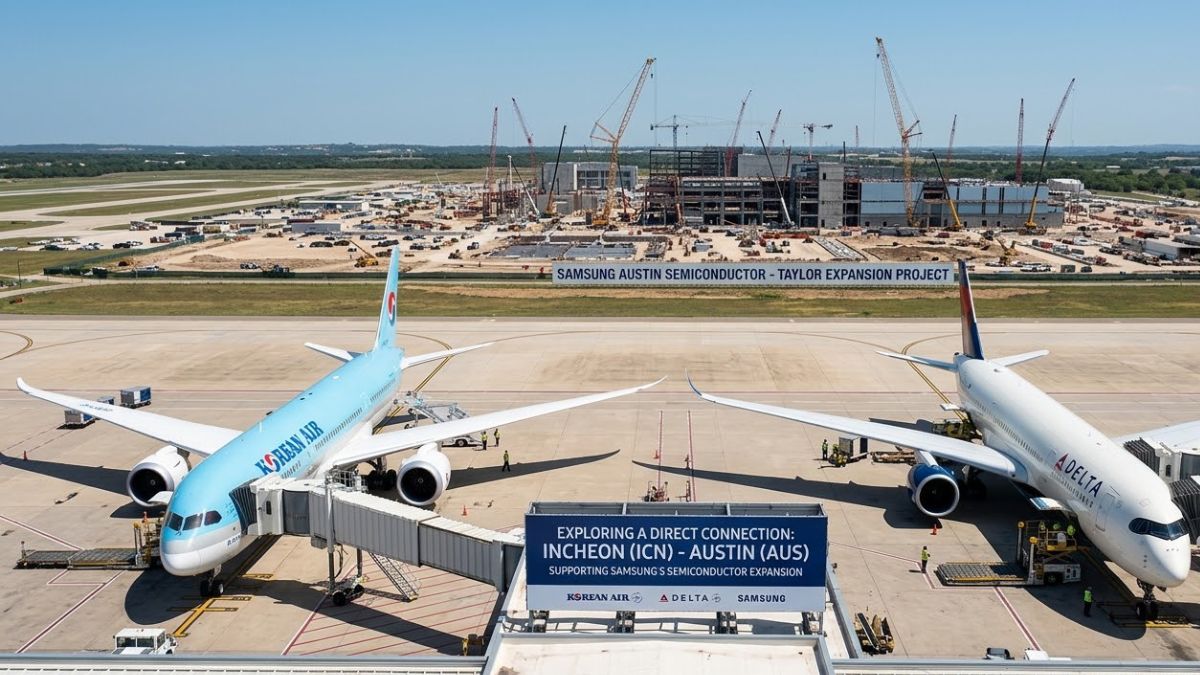
Image for illustrative purposes
Quick Summary
- Airlines in Talks: Korean Air and Delta Air Lines are negotiating a direct flight service between Seoul's Incheon International Airport (ICN) and Austin-Bergstrom International Airport (AUS)
- Strategic Driver: Samsung's $37 billion semiconductor manufacturing facility expansion in Texas is fueling demand for dedicated air connectivity
- Route Benefit: Direct service would eliminate current one-stop connections, reducing travel time by up to 8–10 hours for business and executive passengers
- Timeline: Airlines are assessing feasibility; no launch date confirmed yet, though industry sources suggest potential deployment within 12–18 months
Two Major Carriers Explore Direct Link Between Seoul and Austin for Tech Manufacturing Boom
Korean Air and Delta Air Lines are in discussions to launch a direct flight service connecting Incheon International Airport (ICN) in Seoul and Austin-Bergstrom International Airport (AUS), according to industry sources familiar with the negotiations. The proposed route is being driven by Samsung's massive $37 billion semiconductor expansion project in Texas, which is expected to generate substantial demand for executive, business, and skilled workforce travel between South Korea and the Austin region.
Currently, passengers traveling between Seoul and Austin must connect through major US hubs such as Atlanta, Detroit, or San Francisco, with total journey times exceeding 20–30 hours depending on layover duration. A direct service would compress this timeline significantly, making it more attractive for Samsung engineers, executives, supply-chain partners, and Korean government officials overseeing the investment.
Why This Route Matters for Samsung's Texas Expansion
Samsung's semiconductor investment represents one of the largest foreign direct investments in Texas history. The project requires sustained movement of South Korean personnel, engineers, and supply-chain executives between Seoul headquarters and the Austin manufacturing site. Current routing options via connecting hubs create operational friction and increase travel costs for corporate teams managing the rollout.
A dedicated direct flight would streamline logistics for Samsung's workforce rotation, reduce fatigue for frequent business travelers, and position Austin as a more accessible destination for Korean technology companies considering similar investments in the region. The route would also strengthen economic ties between South Korea and Texas, signaling long-term commitment to the partnership.
Korean Air's Strategic Position
Korean Air (KE) operates extensive service from Incheon International Airport to major US destinations, including flights to Atlanta, Los Angeles, and New York. The carrier has already published round-trip fares from Seoul to Austin starting at KRW 1,597,900 (approximately $1,200–$1,300 USD) for economy travel in off-peak periods like December 2026. Adding a direct service would allow Korean Air to capture premium business-class demand from Samsung-related travel and eliminate reliance on interline partnerships with US carriers for the Seoul-Austin corridor.
Current Korean Air flights to Austin from Incheon require a single stop, with flight times ranging from 19 to 32 hours depending on connection city and layover duration. A nonstop service would position Korean Air as the preferred carrier for Korean executives and Samsung personnel, strengthening its competitive position against rival carriers in the Seoul-US market.
Delta's Role and US Domestic Network Advantage
Delta Air Lines operates significant service from Seoul and maintains a robust domestic network across Texas, including multiple daily flights into Austin-Bergstrom. Delta's partnership with Korean Air (through their joint venture and codeshare agreements) makes the carrier a natural collaborator for this route. Delta would benefit from feed traffic originating in South Korea and other Asian markets, while Korean Air would gain access to Delta's extensive US domestic and international network.
Delta has already published round-trip fares from Seoul to Austin starting at KRW 1,455,200 (approximately $1,100–$1,200 USD) for February–July 2026 travel windows. A direct service would allow Delta to differentiate its Seoul offering and capture market share from competitors serving the Samsung-driven travel surge.
Current Market for Seoul-Austin Travel
Flight search data reveals growing interest in Seoul-Austin connectivity. One-way fares on the route currently range from $413 to $545 USD, with round-trip options available from $701 to $1,089 USD depending on season and booking timing. October represents the cheapest travel month, while July is peak season. These price points suggest healthy demand elasticity—lower fares and faster travel times would likely drive significant volume growth, particularly among corporate and government travelers.
| Route Segment | Current Service | Flight Time | Typical Stops |
|---|---|---|---|
| Seoul (ICN) to Austin (AUS) | Connecting service via US hubs | 20–32 hours | 1 stop (ATL, DTW, SFO) |
| Proposed Direct Service | Korean Air / Delta (under discussion) | ~14–16 hours (estimated) | Nonstop |
Timeline and Next Steps
Neither Korean Air nor Delta has announced a firm launch date for the direct service. Industry analysts suggest that regulatory approvals, aircraft allocation, and demand forecasting studies could take 6–12 months, with potential service commencement in late 2027 or early 2028. Both carriers would need to secure necessary approvals from the US Department of Transportation and South Korean aviation authorities.
The feasibility study likely includes demand modeling based on Samsung's workforce expansion timeline, competing carrier analysis, and fuel cost projections. Korean Air may deploy a Boeing 787 Dreamliner or Airbus A350, both of which are fuel-efficient for long-haul routes and offer premium cabin configurations attractive to business travelers.
Broader Implications for Korean-American Aviation
A direct Seoul-Austin flight would mark a significant expansion of Korean Air's US footprint and underscore the growing economic integration between South Korea's technology sector and Texas. The route could also attract other Korean companies considering US manufacturing or R&D investments, as reliable air connectivity reduces expansion costs and improves executive mobility.
For Austin-Bergstrom International Airport, the service would elevate the airport's profile as a gateway for international business travel and strengthen its appeal to multinational corporations. The airport already handles significant traffic from Asia-Pacific carriers, and a Korean Air direct service would complement existing Delta, United, and American Airlines offerings.
What This Means for Travelers
If approved and launched, the direct Seoul-Austin flight would benefit:
- Samsung employees and contractors rotating between Seoul and Texas facilities
- Korean government officials overseeing the investment and trade relationship
- Supply-chain partners and vendors managing semiconductor component shipments
- Business travelers from South Korea visiting Austin-based technology and manufacturing companies
- Tourism passengers seeking faster access to Austin without connecting flights
Fares for the direct service are expected to be competitive with current connecting options, though business-class premium pricing may reflect the time savings and convenience. Frequent flyer members of Korean Air's Skypass program and Delta's SkyMiles would earn miles on the route, and both carriers' elite members would receive priority boarding and lounge access.
Frequently Asked Questions
When will the direct Seoul-Austin flight launch? No firm launch date has been announced. Industry sources suggest regulatory and operational planning could extend 12–18 months from the initial announcement, with potential service commencing in late 2027 or 2028, pending final approvals from the US Department of Transportation and South Korean aviation authorities.
Which airline will operate the flight? Korean Air is expected to be the primary carrier, with Delta Air Lines potentially offering codeshare service. Both carriers are currently in discussions and have not finalized the operational arrangement.
How long will the nonstop flight take? A direct Seoul-Austin flight is estimated to take approximately 14–16 hours, depending on prevailing winds and routing. This represents a significant time saving compared to current 20–32 hour connecting itineraries via US hub cities.
Will fares be cheaper than connecting flights? Direct service typically commands a premium over connecting options, though competitive pressure and high volume from Samsung-related travel may keep pricing aligned with current market rates. Economy fares are expected to remain in the $400–$600 USD range for one-way tickets, with round-trip options starting around $800–$1,200 USD.
How does Samsung's expansion drive this route? Samsung's $37 billion semiconductor manufacturing investment in Texas is generating sustained demand for travel between Seoul headquarters and the Austin facility. A direct flight eliminates costly layovers and reduces travel fatigue for executives, engineers, and supply-chain partners managing the project rollout.
Related Travel Guides
Korean Air Flight Routes Expand Across North America in 2026
Austin-Bergstrom Airport Strengthens International Connections with New Asian Routes
Samsung's Texas Chip Plant: A Boost for Austin's Business Travel Market
Disclaimer
This article is for informational and educational purposes only. It does not constitute legal, financial, or professional advice. While we strive to provide accurate and up-to-date information, travel policies, regulations, and conditions change rapidly. Always verify information with official sources before making travel decisions. Nomad Lawyer makes no representations about the accuracy, reliability, completeness, or suitability of the information provided. Readers should consult qualified professionals for advice specific to their circumstances. The views expressed in this article are those of the author and do not necessarily reflect the views of Nomad Lawyer.
Kunal K Choudhary
Co-Founder & Contributor
A passionate traveller and tech enthusiast. Kunal contributes to the vision and growth of Nomad Lawyer, bringing fresh perspectives and driving the community forward.
Learn more about our team →