
Aviation Updates: July 4 Flights USA 2026 Are Getting Cheaper But Independence Day Remains the Most Expensive Summer Travel Week — How to Beat the Travel Chaos With the Best Deals to Bozeman, Flagstaff, Fort Lauderdale, Hawaii, Gatlinburg and More as Economy Search Demand Surges Over 100%
US July 4 flights are declining in price but Independence Day week still ranks as the most expensive domestic travel window of summer 2026, with July 2 and July 1 commanding peak pricing while smart travelers pivot to Bozeman, Flagstaff, Gatlinburg, Fort Lauderdale, Myrtle Beach and Hawaii — as economy-class search demand surges more than 100% and flexibility drives an entirely new era of strategic holiday booking.

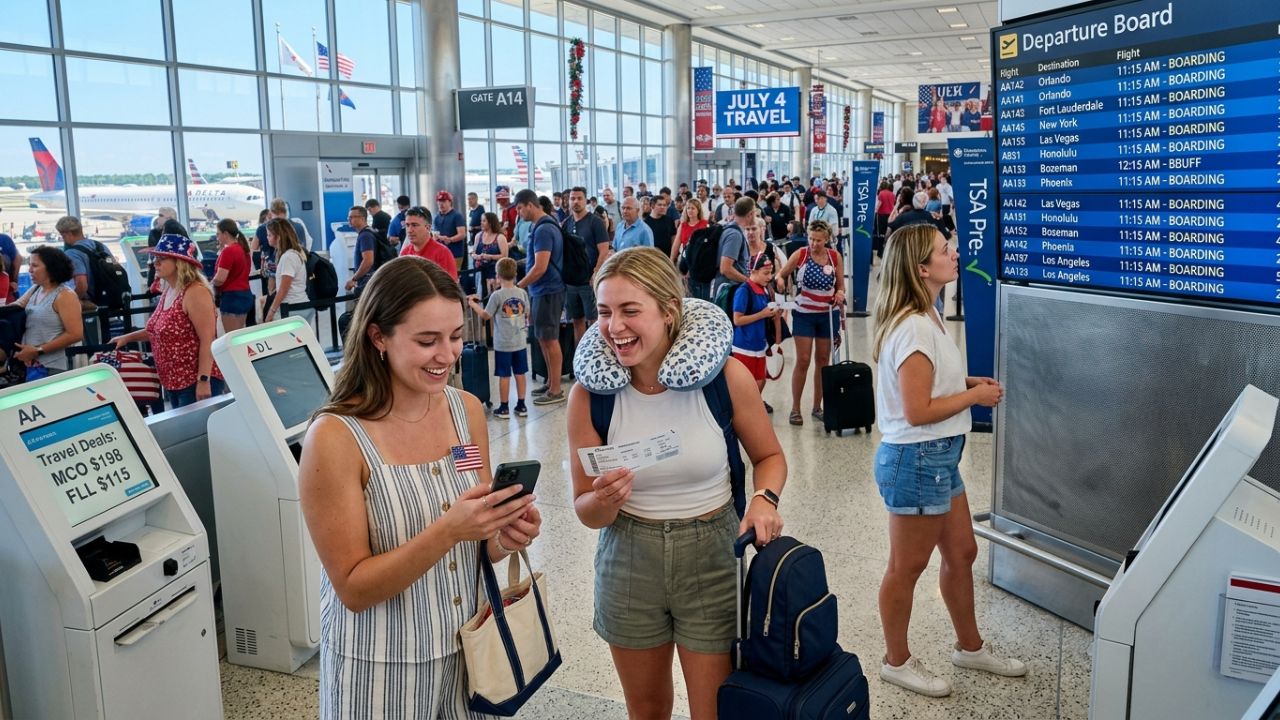
Image generated by AI
Aviation Updates: July 4 Flights USA 2026 Are Getting Cheaper But Independence Day Remains the Most Expensive Summer Travel Week — How to Beat the Travel Chaos With the Best Deals to Bozeman, Flagstaff, Fort Lauderdale, Hawaii, Gatlinburg and More as Economy Search Demand Surges Over 100%
The American holiday travel machine is spinning at full speed — but something has changed about how passengers are feeding into it this year. The days of reflexive early booking and passive acceptance of peak-season pricing are being replaced by something far more calculated, more flexible, and ultimately far more rewarding for travelers who understand how to read the system.
The latest airline news and real-time booking intelligence from US aviation tracking platforms confirms that the July 4 Independence Day travel window of 2026 is shaping up as one of the most strategically nuanced domestic holiday travel periods in recent memory. Fares are declining from their initial peak levels — but make no mistake: Independence Day week remains the single most expensive travel window of the 2026 US summer season, with prices on the most congested departure dates running significantly above what travelers will encounter flying to identical destinations in surrounding weeks. The travel chaos associated with America's most emotionally charged domestic holiday is real, it is measurable, and it is entirely possible to avoid if travelers are willing to make a few deliberately calculated choices about when and where they fly.
What makes the 2026 July 4 booking environment distinctive is not merely the pricing — it is the behavior shift it has triggered. Economy-focused flight searches have surged by more than 100% compared to equivalent prior-year periods. Budget filter usage during booking has risen dramatically. Flexible date search adoption is climbing rapidly. These are not marginal statistical shifts — they represent a fundamental restructuring of how American leisure travelers approach Independence Day air travel, one driven by sharper price sensitivity, greater platform literacy, and a growing willingness to make genuine itinerary adjustments rather than simply absorbing whatever the market demands.
Expanded Overview: Understanding the July 4 Pricing Architecture
The pricing dynamics of the July 4 travel period follow a recognizable but frequently misunderstood pattern that smart travelers can exploit with relatively modest flexibility. The core structural reality is that departure date matters more than almost any other variable in determining what you pay for an Independence Day flight — far more than airline choice, booking window, or cabin class on most routes.
The pricing hierarchy for the 2026 July 4 period breaks down with striking clarity:
- July 1 and July 2 sit at the top end of the pricing curve — the most expensive departure days of the entire holiday window, reflecting the behavior of travelers who prioritize early arrival at their destinations and are willing to pay a premium for the option.
- July 4 itself carries generally lower fares than the preceding days, as demand concentrates on outbound departures earlier in the week rather than on the holiday itself.
- Flights departing in the final days of the holiday window, as travelers return home, again face premium pricing pressure.
This is the textbook expression of peak travel pricing in US summer aviation — a demand surge concentrated into a narrow calendar window, which airlines price based on seat absorption rates and the declining availability of alternatives. The implication for travelers is direct: if shifting a departure by 24–48 hours is operationally possible, the fare difference can be substantial.
The airport disruptions and flight cancellations risk is also materially higher on peak travel days. When every hub in the US domestic network is simultaneously operating at or near maximum capacity — which is precisely what happens on the busiest July 4 departure days — the margin for absorbing routine operational friction disappears entirely. Weather delays, crew rotation pressures, and ATC flow control programs all hit harder on high-density travel days, making the case for date flexibility not just economic but operational.
Section-Wise Breakdown: Where Smart Travelers Are Going This July 4
Outdoor and Nature Destinations: The 2026 Independence Day Sweet Spot
The most significant trend in July 4 destination selection for 2026 is the pronounced shift toward outdoor, nature-based, and regional gateway destinations — a pattern that reflects both a genuine preference for less crowded travel environments and a pricing opportunity created by the relative affordability of routes serving smaller destination airports.
The most actively discussed July 4 destinations in this category include:
- Bozeman, Montana — a gateway to mountain escape travel, Yellowstone access, and outdoor recreation that has seen rapidly growing leisure demand
- Flagstaff, Arizona — elevated altitude, cooler temperatures, and access to Grand Canyon and desert landscape routes that offer genuine summer heat relief
- Gatlinburg, Tennessee — the primary commercial gateway to the Great Smoky Mountains, one of the most visited national park systems in the United States
- Mariposa, California — the key access point for Yosemite-region travel, serving the enormous Bay Area and Southern California demand for national park connectivity
- Moab, Utah — the iconic base for Arches and Canyonlands canyon landscape travel, with growing international recognition as an adventure tourism hub
These destinations share a common characteristic: they offer the Independence Day holiday experience that a growing segment of American travelers most wants — space, nature, and relative relief from the congestion that defines July 4 at major urban tourism centers — at price points that reward early or flexible booking with genuinely competitive fares.
Simultaneously, cities hosting major events — including Kansas City, New York, and San Antonio — are seeing elevated demand from travelers combining vacations with entertainment, sports events, and cultural programming.
Budget Destinations: Where July 4 Deals Still Exist
For travelers whose primary objective is affordable July 4 travel rather than specific destination preference, the 2026 landscape contains genuine opportunities — particularly on routes that have seen pricing ease compared to equivalent periods in prior years.
The most consistently affordable domestic options currently tracked by booking platforms for the July 4 window include:
- Fort Lauderdale, Florida — consistently among the lowest-priced beach routes in the US domestic market, benefiting from strong low-cost carrier competition
- Myrtle Beach, South Carolina — a perennially popular coastal break destination whose concentrated summer demand is partially offset by route volume and carrier competition
- West Palm Beach, Florida — another budget-accessible Gulf Coast alternative, serving the broader South Florida beach market at more competitive price points than Miami
- Select Hawaii routes — in a development that has surprised many travelers, certain Hawaii services are displaying pricing that has eased noticeably compared to prior-year levels, making the archipelago accessible for July 4 at price points that would have been unusual in recent summers
Verified July 4 2026 Travel Intelligence Matrix
Independence Day Pricing and Destination Summary
| Category | Key Detail |
|---|---|
| Most Expensive Days | July 1, July 2 (peak of pricing curve) |
| July 4 Pricing | Generally lower than early July departures |
| Economy Search Surge | Up more than 100% vs. prior year |
| Top Outdoor Destinations | Bozeman MT, Flagstaff AZ, Gatlinburg TN, Mariposa CA, Moab UT |
| Top Event Destinations | Kansas City, New York, San Antonio |
| Top Budget Routes | Fort Lauderdale FL, Myrtle Beach SC, West Palm Beach FL, select Hawaii |
| Key Booking Behavior Shift | Flexible date selection, budget filters, secondary airports |
| Hawaii Pricing Trend | Noticeably eased vs. prior years on select routes |
Data reflects US booking platform intelligence and aviation tracking data for the July 4 2026 travel window.
Passenger Impact: The Economics of Strategic Holiday Travel
For the American traveler navigating the 2026 July 4 booking environment, the practical consequences of the behavior shift currently underway are direct and financially significant. A traveler willing to fly on July 4 itself rather than July 2 may access a meaningfully lower fare on an identical route — a saving that, on a family booking, can reach several hundred dollars in aggregate. A traveler willing to consider Flagstaff rather than Phoenix, or Fort Lauderdale rather than Miami, may access the broader Florida or Arizona leisure market at a substantially lower entry price.
The more than 100% surge in economy-focused searches is the most telling single data point in the entire July 4 2026 travel intelligence picture. It does not indicate that Americans are canceling their Independence Day travel plans — it indicates that they are engaging with the booking process more actively, more analytically, and with a clearer understanding of where the value lies within the available fare structure. Budget filter usage and flexible date adoption follow logically from the same underlying shift in traveler sophistication.
The growing interest in secondary airports as alternative departure points — a trend that broadly mirrors the Avelo/Concord and Breeze/Burlington stories playing out simultaneously in the US regional aviation market — is another expression of the same fundamental intelligence: that the airport disruptions and premium pricing concentrated at major hub airports on peak July 4 departure days can be substantially mitigated by choosing a less congested departure point, even at the cost of a longer ground journey to the airport.
Industry Analysis: Why This Summer Is the Inflection Point
The behavioral evolution visible in the July 4 2026 booking data reflects something larger than a single holiday's pricing dynamics. It represents the maturation of the American domestic leisure traveler — a demographic that spent the pandemic period developing deeper familiarity with booking platforms, pricing tools, and fare alert systems, and is now applying that knowledge with increasing sophistication to every major travel decision.
For airlines, the implication is competitive pressure from their own customers. When more than 100% more travelers are actively filtering for economy options and using flexible date tools, the traditional practice of charging a static premium for holiday-week departures becomes less effective — because more of the market is actively routing around that premium by adjusting their departure date, destination, or departure airport. This competitive dynamic is, over time, one of the most powerful moderating forces on peak holiday pricing in the US domestic market.
Conclusion: The Smarter the Traveler, the Better the Deal
The July 4 flights USA 2026 story is ultimately one of traveler adaptation. Yes, Independence Day remains the most expensive travel week of the US summer — that structural reality has not changed and will not change for as long as 330 million Americans share the same federal holiday calendar. But the gap between the traveler who accepts peak pricing passively and the traveler who actively navigates around it is wider than ever in 2026, and that gap is measured in real dollars.
Fly on July 4 rather than July 2. Consider Bozeman, Flagstaff, or Gatlinburg rather than the same crowded urban destinations everyone else has booked. Check Fort Lauderdale when you'd reflexively searched Miami. Look at Hawaii — because the pricing data suggests it's closer than it's been in years. And watch the aviation updates closely in the final weeks before departure, because fares continue to shift as airlines release remaining inventory at progressively adjusted price points.
The travel chaos of peak-season Independence Day flying is real. But it is survivable — and for the traveler who plans strategically, it is increasingly optional.
Key Takeaways
- Peak Pricing Window: July 1 and July 2 are the most expensive departure days of the Independence Day 2026 travel window — significantly higher than flying on July 4 itself.
- Economy Demand Surge: Economy-focused flight searches have risen more than 100% compared to prior-year levels, signaling a fundamental shift in how US leisure travelers approach holiday booking.
- Best Outdoor Deals: Bozeman MT, Flagstaff AZ, Gatlinburg TN, Mariposa CA, and Moab UT are the standout outdoor and nature destinations offering the best July 4 value proposition.
- Best Budget Routes: Fort Lauderdale FL, Myrtle Beach SC, and West Palm Beach FL are consistently among the lowest-priced July 4 routes — while select Hawaii services are showing surprising price drops vs. prior years.
- Date Flexibility Is Decisive: Shifting departure by just 24–48 hours can produce meaningful fare savings — the single most impactful optimization available to July 4 travelers in 2026.
- Behavioral Shift Underway: Rising use of budget filters, flexible date tools, secondary airport departures, and loyalty points marks the emergence of a more strategically sophisticated American holiday traveler.
Related Travel Guides
Emirates Dubai Airport Summer Travel Chaos Warning 2026
San Francisco Airport 213 Delays 3 Cancellations Travel Chaos 2026
Global Flight Cancellation and Compensation Guide 2026
Disclaimer: This article is strictly for informational purposes only. Fare data, destination pricing trends, and booking behavior statistics reflect US aviation market intelligence as of June 25, 2026 and are subject to continuous change as airlines adjust pricing in real time. Promotional fares and pricing comparisons are illustrative of market trends and may not reflect availability at time of reading. Travelers are advised to verify current fares directly via airline and booking platform websites before making travel arrangements.
Disclaimer
This article is for informational and educational purposes only. It does not constitute legal, financial, or professional advice. While we strive to provide accurate and up-to-date information, travel policies, regulations, and conditions change rapidly. Always verify information with official sources before making travel decisions. Nomad Lawyer makes no representations about the accuracy, reliability, completeness, or suitability of the information provided. Readers should consult qualified professionals for advice specific to their circumstances. The views expressed in this article are those of the author and do not necessarily reflect the views of Nomad Lawyer.
Preeti Gunjan
Contributor & Community Manager
A passionate traveller and community builder. Preeti helps grow the Nomad Lawyer community, fostering engagement and bringing the reader experience to life.
Learn more about our team →