
JetBlue Launches Eleven Emergency Routes From Fort Lauderdale as Spirit Airlines Collapse Reshapes US Aviation
JetBlue announces 11 new routes from Fort Lauderdale starting July 2026, offering $99 rescue fares and 130 daily departures to restore connectivity after Spirit Airlines exit. Routes include Tennessee, Illinois, Texas, and Colombia.

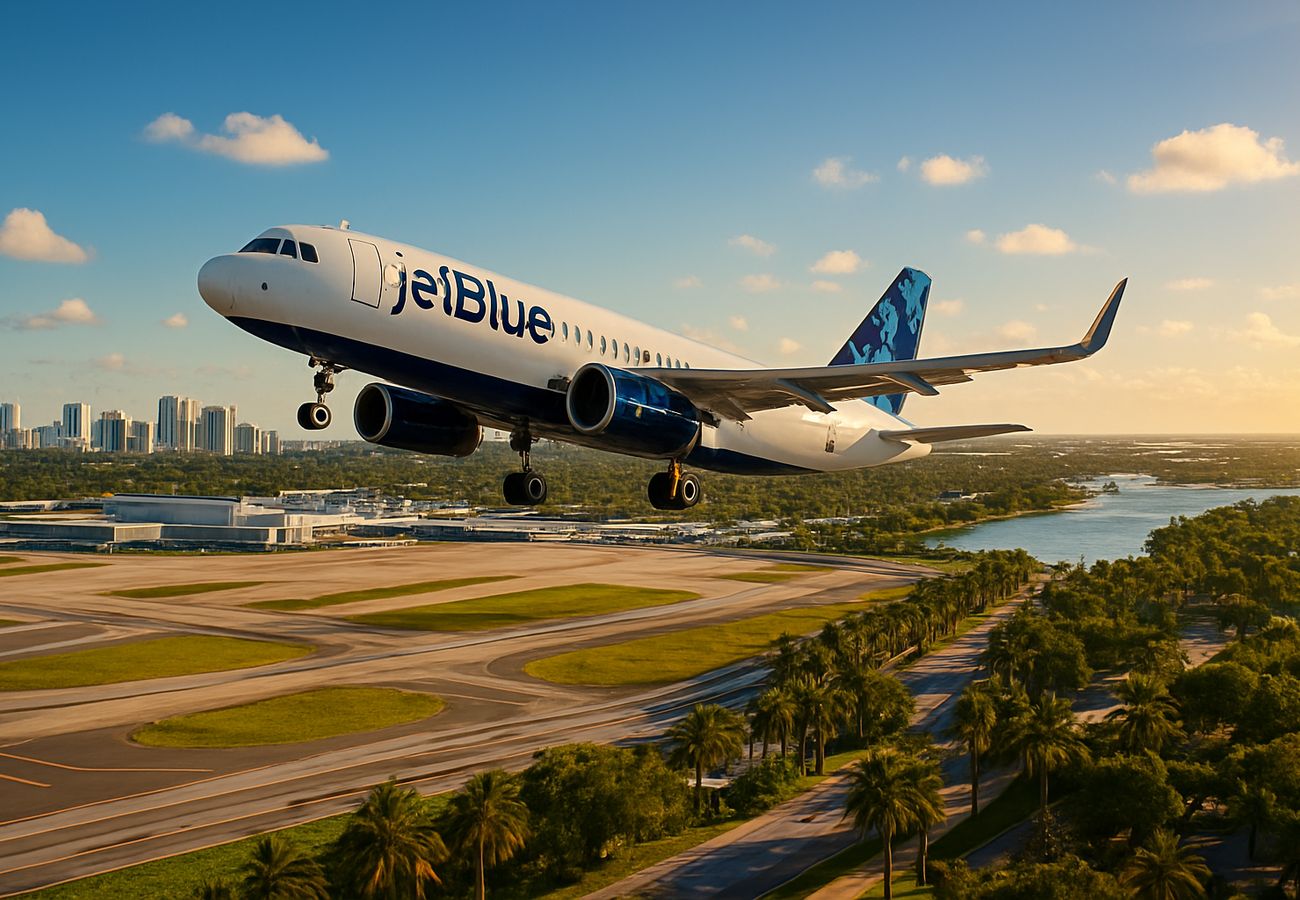
Image generated by AI
Quick Summary
- JetBlue launching 11 new routes from Fort Lauderdale between July–November 2026
- Offering $99 rescue fares and temporary $299 fare caps for stranded travelers
- Expanding service to nearly 130 daily departures from FLL (75% increase vs. 2025)
- New routes connect major US cities, Puerto Rico, and Colombia directly from South Florida
- Restores capacity after Spirit Airlines' 29.3% market share exit at Fort Lauderdale
JetBlue Launches Massive Network Expansion to Fill Spirit Airlines Gap
FORT LAUDERDALE — JetBlue is stepping in with aggressive route expansion and discounted fares to address the travel disruption caused by Spirit Airlines' sudden operational shutdown. Beginning in July 2026, the airline will introduce eleven new routes from Fort Lauderdale-Hollywood International Airport, substantially restoring air connectivity that evaporated when Spirit ceased operations and left passengers stranded across multiple US and international markets.
The initiative combines immediate passenger relief with long-term network restructuring. JetBlue is offering one-way rescue fares starting at just $99 for affected Spirit travelers, paired with temporary fare caps at $299 on select routes. Simultaneously, the carrier is ramping up daily departures from Fort Lauderdale to approximately 130 flights—a remarkable 75% increase compared to 2025 operations.
This move represents one of the most decisive post-crisis responses in recent aviation history, directly targeting the capacity vacuum left by Spirit's collapse, which previously controlled nearly 30% of passenger traffic at Fort Lauderdale.
Eleven Routes Deployed Across Domestic, Caribbean, and Latin American Markets
JetBlue's expansion unfolds in three distinct waves, with the majority of routes launching July 9, 2026, followed by additional rollouts in October and November. The network prioritizes high-demand domestic corridors before expanding internationally into the Caribbean and South America.
Initial July Launch (9 July 2026):
- Nashville, Tennessee (BNA) — 3 daily flights connecting a top-tier US tourism and business hub
- Chicago O'Hare, Illinois (ORD) — 2 daily flights maintaining critical Midwest connectivity
- Houston, Texas (IAH) — 3 daily flights serving one of America's largest metropolitan aviation markets
- Charlotte, North Carolina (CLT) — 3 daily flights linking two major Southeast population centers
- Detroit, Michigan (DTW) — 2 daily flights restoring Midwest-to-Florida mobility
- Baltimore-Washington, Maryland (BWI) — 3 daily flights supporting the mid-Atlantic region
- Ponce, Puerto Rico (PSE) — 1 daily flight expanding Caribbean accessibility beyond San Juan
October and November Launches:
- Barranquilla, Colombia (BAQ) — 1 daily flight, launching October 1 (subject to government approval)
- Indianapolis, Indiana (IND) — 1 daily flight, launching November 2
- Cali, Colombia (CLO) — 1 daily flight, launching October 15 (subject to government approval)
- Columbus, Ohio (CMH) — 1 daily flight, launching November 2
This phased deployment allows JetBlue to scale operations gradually while maintaining service reliability during the transition period.
Fort Lauderdale Becomes Aviation's Rebalancing Center
Fort Lauderdale-Hollywood International Airport stands at the epicenter of this aviation realignment. Spirit Airlines historically commanded nearly 30% of passenger enplanements at FLL, while JetBlue maintained approximately 20% market share.
By March 2026, Spirit's share had already contracted to 24.5%—signaling financial strain before the ultimate collapse—while JetBlue had grown to 22%. The airport processed 9.46 million passengers in the first quarter of 2026 alone, representing a 5.7% year-over-year increase.
JetBlue's plan to operate nearly 130 daily departures from Fort Lauderdale positions the carrier to become the dominant airline at FLL, potentially claiming approximately 27-30% of total airport traffic by year-end 2026. This concentration makes Fort Lauderdale the airline's critical expansion hub for the entire Western Hemisphere.
Major US Markets Gain Robust Connectivity and Frequency
Tennessee's Nashville Connection strengthens with three daily frequencies beginning July 9. Nashville International Airport recorded over 12 million enplanements in 2024, establishing it as a significant mid-size hub. The high daily frequency ensures both leisure and business travelers maintain reliable access while reducing disruption risks for cruise passengers and event visitors traveling from Tennessee to South Florida.
Illinois Benefits From Midwest Hub Presence through two daily Chicago O'Hare flights. As one of North America's busiest aviation centers with 38 million annual enplanements, Chicago remains essential for Midwestern tourism and business travel flowing to Florida. The frequency also prevents seat capacity collapse in this high-demand market.
Texas Gains Three-Daily Service connecting Fort Lauderdale with Houston, which processed over 23 million passengers in 2024. This robust frequency reflects the strategic importance of the Texas-Florida corridor for corporate travel, family connections, and leisure tourism.
North Carolina's Charlotte receives three daily frequencies, while Michigan's Detroit gains two daily flights—both launching July 9. Charlotte airport managed 28 million passengers in 2024, while Detroit processed over 16 million. These frequencies ensure sustained connectivity for one of America's most densely populated regions.
Secondary Markets Face Capacity Constraints in Columbus and Indianapolis, each receiving only one daily flight starting in November. While connectivity is restored, the reduced frequency compared to Spirit's previous operations may limit flexibility for passengers and could create upward pricing pressure in these markets. Columbus recorded over 4.3 million enplanements in 2024, making it a significant regional center despite limited JetBlue frequency.
Baltimore-Washington Gains Strong Daily Access with three flights connecting the Mid-Atlantic region to South Florida. This frequency ensures sustained travel flows for government officials, business travelers, and leisure passengers from one of America's most important metropolitan areas.
Caribbean and Latin American Expansion Signals Regional Growth Strategy
JetBlue's southbound expansion demonstrates confidence in long-term demand from Puerto Rico and Colombia—two key markets for diaspora travel, tourism, and business connections.
Puerto Rico Connectivity Expands Beyond San Juan with a new daily service to Ponce, Puerto Rico's second-largest city. This route provides direct access to southern Puerto Rico, reducing travel disruption and supporting regional tourism distribution. Puerto Rico recorded 14.5 million total passenger movements across its airports in 2025, underscoring the market's strategic importance.
Colombia Marks Significant Latin American Growth, with new daily services to both Barranquilla and Cali beginning in October 2026. These routes strengthen JetBlue's position in the South Florida-Latin America corridor, a region with strong demand for family travel, tourism, and business connections. Colombia recorded approximately 15 million passengers in the first quarter of 2026, reflecting robust aviation growth across South America.
However, both Colombian routes remain subject to government regulatory approval, meaning final implementation depends on clearance from Colombian aviation authorities.
Emergency Pricing Strategy Provides Temporary Relief
JetBlue's $99 rescue fares and temporary $299 fare caps address immediate passenger hardship while establishing competitive positioning in markets formerly dominated by ultra-low-cost carriers.
Regulatory research demonstrates that Spirit Airlines' presence historically reduced fares by 7-11% in competitive markets. With Spirit's exit, upward pricing pressure is inevitable unless robust competition remains. While JetBlue operates a hybrid low-cost model offering more ancillary services than Spirit, base fares typically run higher than traditional ultra-low-cost carriers.
This structural shift suggests connectivity will recover, but affordability may gradually decline beyond the immediate recovery phase. The temporary nature of rescue fares indicates JetBlue's pricing will normalize as market dynamics stabilize.
Industry-Wide Response Coordinates to Prevent Collapse Cascades
JetBlue's intervention is part of a broader industry response coordinated with federal authorities. Major carriers including Delta, United, Southwest, American, and Allegiant have introduced complementary fare caps, discounts, and rebooking support for affected passengers.
These coordinated measures aim to prevent widespread travel disruption, maintain essential connectivity, and stabilize the aviation market during the transition period. Federal oversight ensures that the Spirit Airlines collapse does not cascade into broader market instability or regional connectivity gaps.
US Aviation Shifts From Ultra-Low-Cost Disruption to Hybrid Competition
Spirit Airlines' exit marks a turning point in American aviation market dynamics. The industry is transitioning from pure ultra-low-cost disruption toward hybrid low-cost competition led by carriers like JetBlue, Southwest, and Frontier.
This evolution restores routes and capacity quickly but fundamentally alters the pricing structure across affected markets. Travelers regain access to essential destinations and frequency increases, but the savings associated with aggressive ultra-low-cost competition may become less prevalent in South Florida-based markets going forward.
---
Frequently Asked Questions (FAQ)
When do the new JetBlue routes from Fort Lauderdale start operating? Most routes launch July 9, 2026, with additional service beginning in October (Colombia) and November (secondary US cities). Each route has a specific start date listed in JetBlue's official schedule.
Can stranded Spirit Airlines passengers get $99 fares on all new JetBlue routes? The $99 rescue fares apply specifically to affected Spirit travelers traveling on eligible routes. JetBlue verified Spirit passenger status through booking confirmation and customer verification processes. Standard fares apply to new bookings after the emergency relief period concludes.
Will these new routes operate permanently or are they temporary emergency responses? JetBlue characterizes these as permanent network additions, not temporary emergency measures. However, secondary market routes (Columbus, Indianapolis) with single-daily frequency may be subject to performance review and potential adjustment based on demand and operational metrics.
How does this impact pricing on the Fort Lauderdale-to-Caribbean and Fort Lauderdale-to-Colombia routes? The new Caribbean and Colombia routes restore direct connectivity from South Florida, potentially increasing fare competition on these markets. However, final pricing depends on regulatory approval for Colombia routes and competitive responses from other carriers.
What happens if Colombian government approval is delayed for the Barranquilla and Cali routes? JetBlue stated the routes are "subject to government approval," meaning implementation depends on regulatory clearance. If approval is delayed, JetBlue would likely announce revised timelines rather than launching routes without proper authorization.
Disclaimer
This article is for informational and educational purposes only. It does not constitute legal, financial, or professional advice. While we strive to provide accurate and up-to-date information, travel policies, regulations, and conditions change rapidly. Always verify information with official sources before making travel decisions. Nomad Lawyer makes no representations about the accuracy, reliability, completeness, or suitability of the information provided. Readers should consult qualified professionals for advice specific to their circumstances. The views expressed in this article are those of the author and do not necessarily reflect the views of Nomad Lawyer.
Kunal K Choudhary
Co-Founder & Contributor
A passionate traveller and tech enthusiast. Kunal contributes to the vision and growth of Nomad Lawyer, bringing fresh perspectives and driving the community forward.
Learn more about our team →