
Qantas Increases European Routes Amid Global Flight Disruptions Across UK, UAE, Qatar
Qantas increases European flight services as UK, UAE, Qatar, Iran, Italy, and France report major disruptions. Airlines reroute planes and expand capacity to manage surging demand and rising fares in 2026.

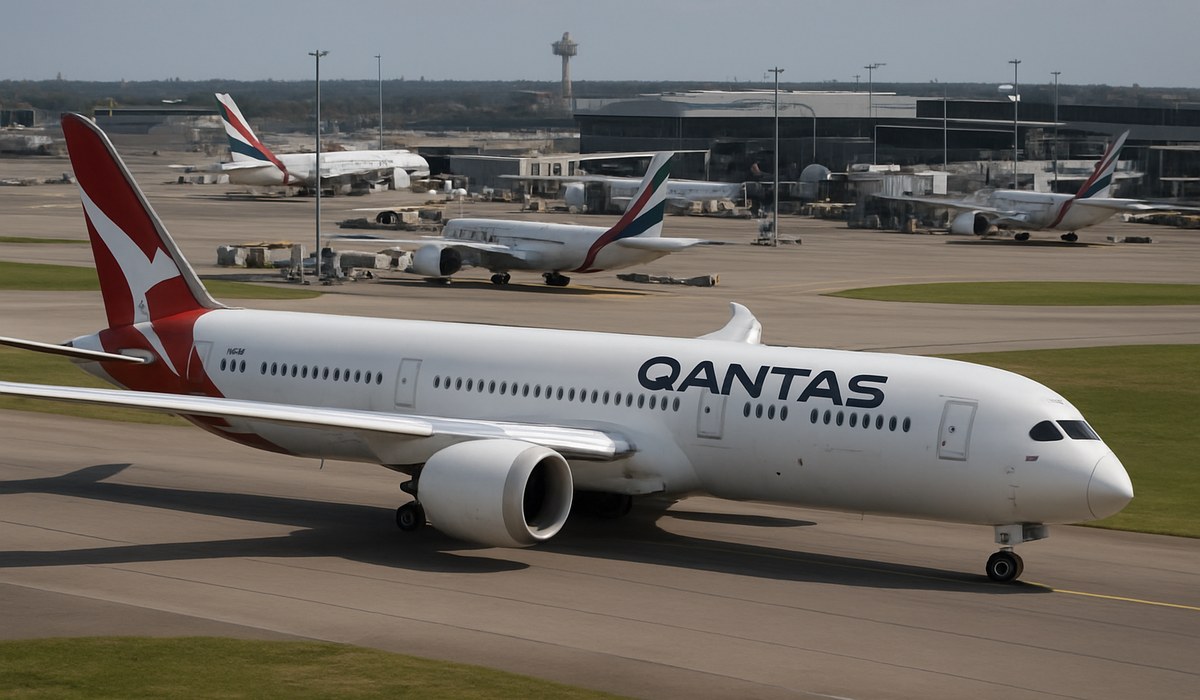
Image generated by AI
Qantas Expands European Network as Global Flight Disruptions Intensify Across Multiple Regions
Australian carrier Qantas Airways announced significant increases to its European flight schedule on March 28, 2026, capitalizing on surging passenger demand even as multiple countries grapple with widespread air traffic disruptions. The expansion marks a bold strategic move as carriers worldwide navigate operational challenges, geopolitical tensions, and unprecedented airfare volatility affecting travelers across the Middle East, Europe, and beyond.
The Australian flag carrier's decision to increase European services comes amid a complex global aviation landscape where the United Kingdom, United Arab Emirates, Qatar, Iran, Italy, and France simultaneously report major flight disruptions affecting thousands of daily passengers. Industry analysts suggest Qantas's expansion strategy reflects confidence in post-disruption recovery demand and the airline's capacity to operate alternative routing protocols.
Root Causes of Global Flight Disruptions in March 2026
Multiple factors are converging to create unprecedented strain on international aviation networks. Regional geopolitical tensions affecting Middle Eastern airspace continue to necessitate costly flight reroutes over Africa and Asia, adding 2–4 hours to typical journey times. Additionally, increased military activity near Iran has prompted numerous carriers to suspend or significantly reduce operations through traditionally busy corridors.
European nations including Italy and France are simultaneously managing capacity constraints linked to airport infrastructure upgrades and staffing shortages following labor actions. The United Kingdom reports disruptions stemming from air traffic control system modernization causing cascading delays at London Heathrow (LHR), London Gatwick (LGW), and Manchester (MAN).
Qatar Airways and UAE-based carriers Emirates and Flydubai have issued repeated advisories regarding unpredictable airspace closures, forcing real-time flight replanning and passenger rebooking complications.
Airlines Increasing Capacity and Rerouting Operations
Qantas Airways Expansion Details:
- Adding four additional Boeing 787-9 Dreamliner rotations on Australia-London (SYD-LHR) and Australia-Paris (SYD-CDG) routes
- Deploying larger Airbus A380 aircraft on high-demand European services
- Implementing enhanced crew scheduling to accommodate extended routing via southern Africa instead of traditional Middle Eastern corridors
- Increasing flight frequency on existing Sydney-Rome (SYD-FCO) services by 40%
Competitor Actions: Regional carriers, including Qatar Airways and Middle Eastern operators, are simultaneously expanding capacity while managing airspace restrictions. Most are increasing aircraft utilization rates and extending flight durations to accommodate mandatory reroutes avoiding restricted Iranian airspace.
Affected Routes and Flight Operations
The following major international routes experience moderate to severe disruptions:
| Route | Affected Airlines | Disruption Type | Expected Duration |
|---|---|---|---|
| London-Middle East | BA, EK, QR, LH | 90–180 min delays | Through Q2 2026 |
| Paris-Gulf | AF, EK, QR | Reroutes via Africa | Ongoing |
| Rome-Asia Pacific | IB, LH, QA | Extended flight times | 4–8 weeks |
| UAE-Europe | EK, FZ, QR | Capacity constraints | Through March 2026 |
| UK domestic/EU feeder | BA, EZY, U2, RY | Secondary delays | 2–3 weeks |
Real-Time Flight Tracking and Status Updates
Travelers should monitor live flight information through:
- FlightAware – Real-time tracking with 15-minute update intervals
- Airline apps – Direct push notifications for schedule changes (Qantas, Emirates, Qatar Airways, Air France, Alitalia, British Airways)
- Official airport websites – LHR, CDG, FCO, DXB, DOH all publish hourly updates
- IATA Travel Hub – IATA provides industry-wide disruption bulletins updated every 6 hours
Passenger Rights and Compensation Framework
Under EU Regulation 261/2004, UK Civil Aviation Authority guidelines, and UAE/Qatar consumer protection frameworks, affected passengers are entitled to:
Compensation for Delays ≥3 hours:
- €250–€600 depending on flight distance and destination
- Applies to EU flights and flights departing EU airports
Compensation for Cancellations:
- Full ticket refund or rebooking on alternative flights at no additional cost
- Hotel accommodation and meal vouchers if overnight stay required
- Ground transportation to/from hotel
Important: Airlines must provide written compensation notices within 30 days. US Department of Transportation outlines parallel protections for transatlantic passengers.
Filing claims: Contact airline customer relations with flight documentation, booking confirmation, and proof of expenses. EU-based claims processors typically resolve within 8–12 weeks.
Traveler Action Checklist
Follow these steps to minimize disruption impact:
- Check flight status 24–48 hours before departure via airline app or FlightAware; enable push notifications immediately
- Verify passport validity and visa requirements for alternative European destinations (disruptions may force routing changes)
- Purchase travel insurance with flight disruption coverage if booking new tickets; ensure it covers Iran-related airspace restrictions
- Pack medications, valuables, and essentials in carry-on luggage to protect against baggage routing complications
- Document all expenses (meals, hotels, ground transportation) incurred due to delays exceeding 3 hours
- Request written confirmation from airline staff regarding schedule changes; screenshot digital correspondence
- Register for airline frequent flyer protections offering priority rebooking on full flights
- Contact US DOT or local aviation authority if compensation claims are denied after 30 days
- Book connecting flights with minimum 4-hour layovers to accommodate rerouting delays
- Monitor embassy travel advisories for Iran, Italy, France, and UK regarding airspace closure updates
Recovery Timeline and Industry Outlook
Qantas expects full European schedule normalization by late May 2026, assuming no escalation in Middle Eastern geopolitical tensions. The airline's capacity increases signal confidence that global aviation will absorb excess demand once rerouting requirements stabilize.
European airports anticipate:
- Mid-April 2026: 70% schedule capacity restoration at London and Paris hubs
- Early May 2026: Full capacity resumption at Italian airports (Rome, Milan, Venice)
- Late May 2026: Unrestricted airspace operations via traditional Middle Eastern corridors
Industry sources indicate this disruption cycle may reset passenger expectations regarding ticket prices. Fares are expected to remain 15–25% above 2025 averages through Q2 2026 before normalizing in summer travel season.
Frequently Asked Questions
Q: Will my Qantas booking be automatically rebooked on expanded European services? A: New Qantas capacity primarily accommodates waitlist passengers and new bookings. Existing ticket holders are rebooked on original flight dates if available; otherwise, you're offered alternative flights with no fare difference.
Q: Are flights through Iran still banned? A: No airlines operating commercial passenger services currently route through Iranian airspace. All major carriers use alternative corridors via southern Africa or Asia.
Q: How do I claim compensation for a 5-hour delay? A: File claims with the airline within 6 months. Provide booking reference, flight itinerary, and proof of delay (boarding pass, airline communication). EU flights qualify for €400–€600 depending on flight distance.
Q: Are connecting flights in France and Italy experiencing delays? A: Yes, Paris (CDG, ORY) and Rome (FCO) are reporting 45–90 minute secondary delays. Build in additional connection time (minimum 3 hours international-to-international).
Q: Will ticket prices decrease once disruptions end? A: Historically, fares normalize 4–6 weeks after major disruptions. Current premium pricing reflects fuel surcharges and rerouting costs, not speculation.
Last Updated: March 28, 2026
Data sources: Qantas Airways official statements, FlightAware network analysis, IATA disruption reports, EU aviation authority bulletins
Disclaimer
This article is for informational and educational purposes only. It does not constitute legal, financial, or professional advice. While we strive to provide accurate and up-to-date information, travel policies, regulations, and conditions change rapidly. Always verify information with official sources before making travel decisions. Nomad Lawyer makes no representations about the accuracy, reliability, completeness, or suitability of the information provided. Readers should consult qualified professionals for advice specific to their circumstances. The views expressed in this article are those of the author and do not necessarily reflect the views of Nomad Lawyer.
Raushan Kumar
Founder & Lead Developer
Full-stack developer with 11+ years of experience and a passionate traveller. Raushan built Nomad Lawyer from the ground up with a vision to create the best travel and law experience on the web.
Learn more about our team →