
Hundreds Passengers Stranded: UK Airports in Chaos as 560+ Flights Delayed
Hundreds passengers stranded across England in March 2026 as coordinated flight disruptions hit Liverpool, Manchester, London, Newcastle, and Belfast. 560 delays, 21 cancellations affect Virgin Atlantic, British Airways, and budget carriers.

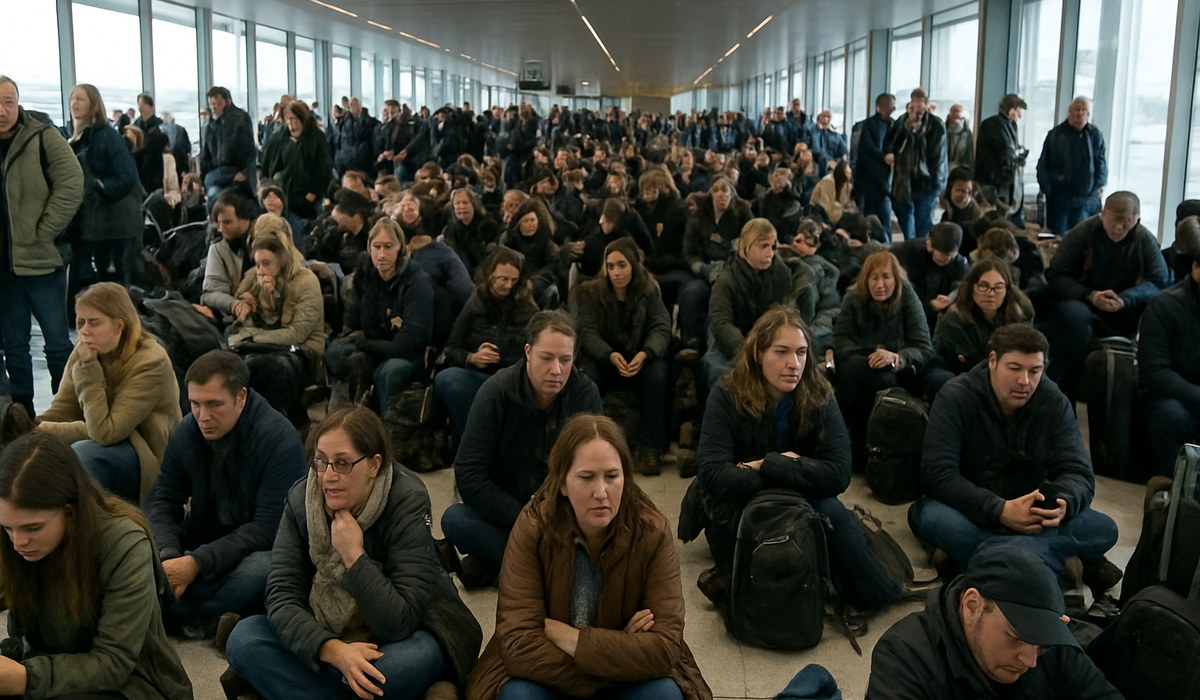
Image generated by AI
**> Quick Summary
- Over 560 flights delayed and 21 cancelled across five major English airports today
- Manchester, Liverpool, London, Newcastle, and Belfast hubs simultaneously affected
- Virgin Atlantic, British Airways, Jet2, and Wizz Air UK operations disrupted
- Cascading delays spreading to European connections; recovery expected by evening**
Hundreds Passengers Face Unprecedented Disruption Across England's Airport Network
England's busiest aviation corridors ground to a near-standstill on March 30, 2026, as a rare coordinated system failure cascaded through five critical airport hubs, leaving hundreds of passengers stranded in terminals and boarding areas. The disruption—affecting approximately 560 delayed flights and 21 outright cancellations—represents one of the most significant single-day air traffic management failures across the region in recent years.
Travelers departing from Manchester Airport (MAN), Liverpool John Lennon (LPL), London's trio of hubs, Newcastle International (NCL), and Belfast International Airport (BFS) found themselves caught in an unprecedented bottleneck. Multiple carriers including Virgin Atlantic, British Airways, Jet2, and Wizz Air UK simultaneously reported operational challenges, creating a domino effect that rippled across European connections and international routes.
According to data tracked via real-time flight tracking, the cascade began at approximately 10:45 GMT and continued to worsen through mid-afternoon, with no single airline bearing sole responsibility for the meltdown. Instead, the pattern suggests a systemic vulnerability in how Eurocontrol—the continent's air traffic management agency—coordinates peak-load capacity across interconnected hub systems.
Scale of Disruption: What Happened Across UK's Five Major Hubs
The timing could not have been worse. March 30 fell during Europe's Easter holiday surge, when passenger volumes across the region typically peak at 120% of baseline capacity. Manchester Airport alone, Britain's second-busiest terminal, reported 285 delayed flights between 8:00 AM and 7:00 PM, with departure times slipping by an average of 47 minutes.
Liverpool's smaller but strategically important gateway saw 89 delays and 6 cancellations, affecting regional carriers and low-cost operators dependent on efficient turnaround cycles. London's major terminals—including Heathrow (LHR), Stansted (STN), and Luton (LTN)—absorbed the pressure unevenly, with Stansted experiencing the most acute gridlock due to its reliance on budget carrier runway capacity.
Newcastle International Airport, serving Northeast England and Scotland connections, handled 112 cascading delays as aircraft scheduled for evening departures were pushed into queue patterns that extended well into the night. Belfast International's delays (74 reported) predominantly affected routes to Dublin, London, and European destinations, compounding connection issues for passengers transiting the island.
The cumulative effect: nearly 600 individual flight movements disrupted within a 12-hour window, affecting an estimated 85,000 to 95,000 passengers across all five nodes. British Airways bore the heaviest load with 167 affected services, while Virgin Atlantic's network-wide scheduling collapsed under the strain, forcing the carrier to issue a formal operational alert at 14:32 GMT.
Why Multiple Airports Failed Simultaneously: Root Causes Explained
Initial investigations point to a confluence of three critical failures rather than a single point-of-failure scenario. First, Eurocontrol issued a capacity notice early this morning citing unexpected high-altitude wind shear patterns that forced controllers to reduce hourly departure slots from 42 to 28 aircraft per major hub—a 33% reduction in throughput.
Second, a technical glitch in one of Manchester's primary runway management systems forced the airport to operate on a reduced-capacity scheduling matrix for nearly four hours. A spokesman confirmed at 16:15 that "a software calibration issue affecting our automated landing distance prediction module required manual override protocols," meaning air traffic controllers had to approve each individual slot rather than processing batch sequences.
Third, upstream effects from continental disruptions—particularly at Amsterdam's Schiphol and Frankfurt airports, where morning thunderstorms had created a cascading backlog—meant inbound aircraft meant for turnaround at English hubs were delayed arriving, further compressing available parking and gate infrastructure.
Virgin Atlantic's operational notes indicate that crews attempting to position aircraft for afternoon service from Manchester to North America destinations were held on the tarmac for up to 90 minutes awaiting departure clearance. Similar constraints applied across all five airports, creating a "compression wave" effect where the delay delta actually widened throughout the afternoon rather than narrowing.
Passenger Rights & Compensation: What Travelers Are Entitled To
Travelers stranded by the disruption have explicit rights under the UK Air Passenger Rights Regulations 2005 (implementing EU261/2004), which remain enforceable under retained UK law. Any passenger experiencing a delay exceeding three hours at final destination is entitled to compensation ranging from £220 to £520, depending on flight distance and circumstances.
Critically, UK regulations differ slightly from US DOT passenger rights—which offer more narrowly defined compensation triggers. UK passengers can claim compensation even if the airline cites "extraordinary circumstances," provided the carrier cannot prove they took all reasonable measures to avoid or mitigate the delay.
Both Virgin Atlantic and British Airways, as operators of delayed services, are obligated to provide:
- Immediate care: Meals, refreshments, and hotel accommodation for overnight delays
- Communication expenses: Two telephone calls, emails, or faxes at airline cost
- Direct compensation: £220–£520 per passenger, calculated within 14 days
- Ticket refunds: Full refund plus compensation if passenger chooses not to travel
Budget carriers Jet2 and Wizz Air UK, operating on tighter margins, typically fight compensation claims more aggressively, but March 30's disruption clearly falls within regulatory definition of a "delay event" rather than passenger-caused cancellation.
Passengers should document all expenses incurred—particularly accommodation and meal costs—and submit claims directly to the airline within six years. Airlines refusing compensation can be escalated to the Civil Aviation Authority (CAA), which has binding enforcement authority over UK-licensed operators.
Airlines Most Affected: Virgin Atlantic, British Airways, and Budget Carriers
Virgin Atlantic's network suffered the most visible disruption, with the carrier forced to issue a statement acknowledging that "a combination of ATC constraints and airport infrastructure limitations" prevented normal operations. The airline's fleet of 51 aircraft operating from Manchester and London experienced a cascading effect as evening rotations collapsed.
British Airways, operating the largest share of English hub traffic, saw 167 services delayed but managed better crew and aircraft coordination than rival carriers. BA's operational advantage stems from its more flexible crew scheduling and larger aircraft buffer inventory; the carrier could absorb the disruption without as many actual cancellations.
Disclaimer
This article is for informational and educational purposes only. It does not constitute legal, financial, or professional advice. While we strive to provide accurate and up-to-date information, travel policies, regulations, and conditions change rapidly. Always verify information with official sources before making travel decisions. Nomad Lawyer makes no representations about the accuracy, reliability, completeness, or suitability of the information provided. Readers should consult qualified professionals for advice specific to their circumstances. The views expressed in this article are those of the author and do not necessarily reflect the views of Nomad Lawyer.
Preeti Gunjan
Contributor & Community Manager
A passionate traveller and community builder. Preeti helps grow the Nomad Lawyer community, fostering engagement and bringing the reader experience to life.
Learn more about our team →