
Hospitality Japan Conference 2026 to Address JPY 630 Billion Hotel Transaction Surge and Yield Compression
The 5th Hospitality Japan Conference will convene in Tokyo on October 6-7, 2026, to analyze record-breaking hotel transactions and the impact of Bank of Japan interest rate normalization on real estate.

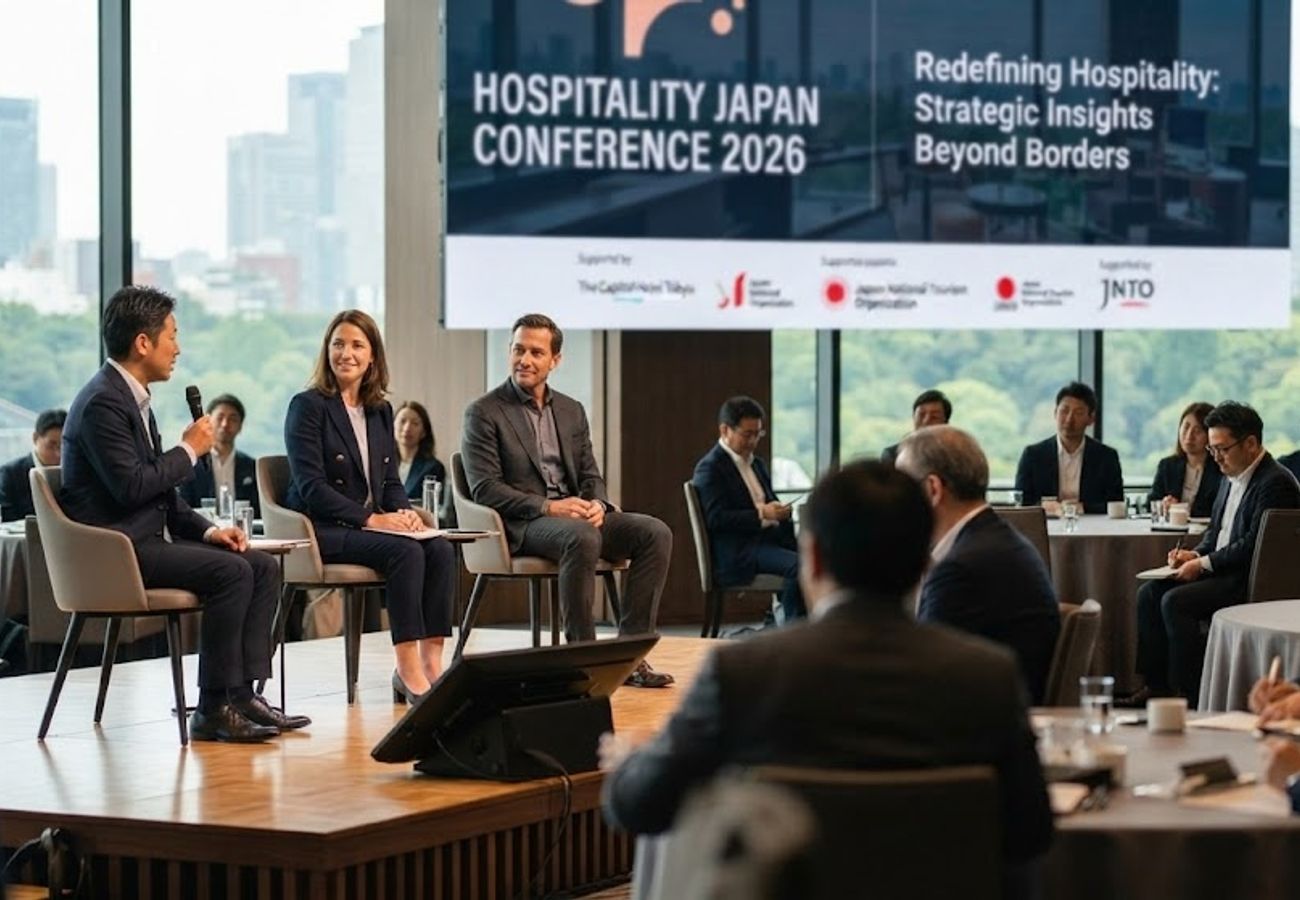
Image generated by AI
The 5th Hospitality Japan Conference will convene in Tokyo on October 6-7, 2026, to analyze record-breaking hotel transactions and the impact of Bank of Japan interest rate normalization on real estate.
Institutional investors are aggressively pivoting toward Japanese urban real estate following record-breaking international tourist arrivals reported by the Japan National Tourism Organization. This surge in demand has directly inflated commercial land valuations, according to data from the Ministry of Land, Infrastructure, Transport and Tourism.
The upcoming summit, hosted at The Capitol Hotel Tokyu, operates under the theme “Redefining Hospitality: Strategic Insights Beyond Borders in Japan.” The agenda moves away from theoretical economic modeling to focus on real-world execution, calculated risk, and the establishment of new performance benchmarks for the APAC region.
Core Event Framework: October 6-7, 2026
The conference is split into two distinct operational pillars:
- Day 1: Capital & Design – Focusing on the Hotel Investment Summit and Hotel Design Summit.
- Day 2: Revenue & Margins – Focusing on the Hotel Revenue Summit and strategies for managing 60 million visitors.
Capital Strategy and Market Volatility
The Hotel Investment Summit Japan will address a tightening market characterized by a shift in monetary policy. The Bank of Japan has initiated policy interest rate normalization, targeting a range between 1.0% and 1.25%. This shift coincides with a sharp compression of net yields in central Tokyo, now sitting between 1.0% and 1.8%.
Asset owners are currently facing a "pincer movement" of rising debt costs and escalating construction expenditures, which are climbing by 5.0% to 5.6% annually. This environment is forcing a transition toward refined credit-rated bond pricing and alternative capital structures to maintain leveraged returns.
Market Metrics and Financial Indicators
The following data points define the current investment climate in the Japanese hospitality sector:
| Financial Indicator | Market Metric Value | Operational Impact |
|---|---|---|
| Hotel Transaction Volume | JPY 630 Billion | Unprecedented liquidity in APAC region |
| BOJ Policy Rate Benchmark | 1.0% – 1.25% | Higher baseline debt financing costs |
| Central Tokyo Net Yields | 1.0% – 1.8% | Yield compression driving regional focus |
| Annual Construction Costs | +5.0% to +5.6% | Elevated capital expenditure constraints |
Diversification Beyond Tokyo
Due to extreme land scarcity in the capital, institutional capital is migrating toward "secondary whitespace markets." Our analysis of current investment trends indicates a strategic shift toward:
- Regional Hubs: Increased footprint expansion into Nagoya and Tohoku.
- Luxury Resorts: Asymmetric return profiles in Niseko and Okinawa, leveraging seasonal average daily rate (ADR) surges.
- Joint Ventures: A continued preference for cross-border investors to partner with local asset developers to mitigate operational risk.
Contractual and Architectural Evolution
The conference will audit the erosion of hotel management agreement fees. Many owners are now renegotiating terms with global brand networks or pursuing early contract terminations to secure greater operational flexibility.
Simultaneously, the Hotel Design Summit Japan is reframing architecture as a financial driver. The integration of "Spatial Identity" is being used to reduce reliance on a scarce labor force:
- Smart Automation: Directly targeting labor cost reduction.
- Cultural Integration: Using hyperlocal authenticity to drive premium pricing.
- Sustainable Timber: Aligning with ESG compliance to increase overall asset value.
- Adaptive Reuse: Utilizing historical structures to accelerate time-to-market.
Revenue Optimization and Margin Protection
With international arrivals approaching 60 million, the Hotel Revenue Summit will address the threat of mounting payroll costs. To protect net profitability, commercial directors are implementing a "Margin Protection Pipeline":
- Direct Channels: Reducing third-party OTA commissions.
- Dynamic Pricing: Utilizing AI and machine learning for localized demand forecasting.
- Ancillary Streams: Expanding high-margin F&B, spa, and event facilities.
The intersection of rising debt and yield compression has made asset-level operational efficiency the only viable path to profitability in 2026.
Related Travel Guides
Disclaimer
This article is for informational and educational purposes only. It does not constitute legal, financial, or professional advice. While we strive to provide accurate and up-to-date information, travel policies, regulations, and conditions change rapidly. Always verify information with official sources before making travel decisions. Nomad Lawyer makes no representations about the accuracy, reliability, completeness, or suitability of the information provided. Readers should consult qualified professionals for advice specific to their circumstances. The views expressed in this article are those of the author and do not necessarily reflect the views of Nomad Lawyer.
Raushan Kumar
Founder & Lead Developer
Full-stack developer with 11+ years of experience and a passionate traveller. Raushan built Nomad Lawyer from the ground up with a vision to create the best travel and law experience on the web.
Learn more about our team →