
Aviation Updates: Horizon Air Flight Attendants Vote 99.8 Percent in Favour of Strike Authorisation as AFA-CWA Union Representing 650 Cabin Crew Members Escalates Contract Dispute With Alaska Air Group After More Than a Year of Federal Mediation Under the Railway Labor Act
The Association of Flight Attendants–CWA (AFA-CWA), representing approximately 650 Horizon Air cabin crew members, announced that 99.8% of participating members voted in favour of strike authorisation — escalating a labour dispute that entered federal mediation in January 2025 — with no strike currently authorised to begin as the Railway Labor Act requires completion of the National Mediation Board process and a mandatory 30-day cooling-off period before any lawful industrial action can occur, leaving Alaska Airlines regional services currently operating on normal schedules.

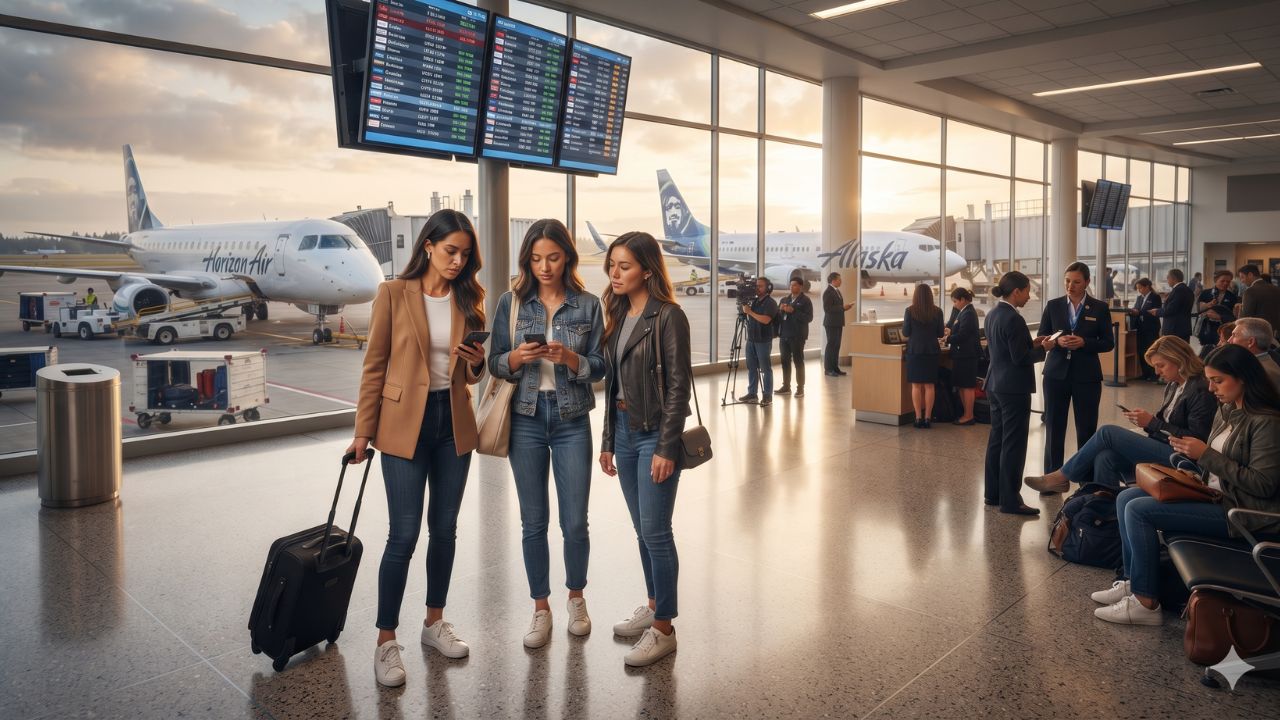
Image generated by AI
Aviation Updates: Horizon Air Flight Attendants Vote 99.8 Percent in Favour of Strike Authorisation as AFA-CWA Union Representing 650 Cabin Crew Members Escalates Contract Dispute With Alaska Air Group After More Than a Year of Federal Mediation Under the Railway Labor Act
A strike authorisation vote in the airline industry is not a strike. But it is the most unambiguous signal that a workforce can send about its collective determination — and a 99.8% result leaves very little interpretive space. The question now is whether Alaska Air Group and Horizon Air's management take that signal seriously enough to resolve a dispute that has been moving through federal mediation for more than 18 months.
Major airline news from the United States regional aviation market confirms that the Association of Flight Attendants–CWA (AFA-CWA) — the union representing approximately 650 Horizon Air cabin crew members — has announced that 99.8% of participating members voted in favour of authorising a strike, delivering one of the most emphatic labour mandates in recent US aviation history. The near-unanimous result escalates a contract dispute that has been under federal mediation since January 2025, when the union formally requested the intervention of the National Mediation Board after collective bargaining negotiations stalled over wages, benefits, working conditions, and compensation policy — including the specific and long-contested question of payment for time spent on duty during passenger boarding.
The aviation updates surrounding this vote require immediate contextualisation for passengers with Horizon Air or Alaska Airlines bookings: no strike has been called, no flights have been cancelled, and no schedule reductions have been announced. The Railway Labor Act — the federal legislation that governs labour relations in the US airline industry — establishes a structured, multi-stage legal process that must be completed in its entirety before any lawful industrial action can begin. Horizon Air regional services continue operating on their normal published schedules, and passengers should expect no immediate operational disruption as a direct consequence of the strike authorisation vote. What the vote does change is the negotiating dynamic: union leadership now holds an explicit, overwhelming mandate to call a strike if the mediation process reaches a legal impasse — and the 99.8% result makes clear that this mandate reflects the near-total unity of the 650 cabin crew members it represents.
Expanded Overview: What a 99.8% Strike Authorisation Vote Actually Means
In the context of US airline labour relations, a strike authorisation vote is a procedural milestone rather than an operational trigger. It does not instruct union leadership to call a strike; it grants union leadership the authority to call a strike if specific legal conditions are subsequently met. The distinction is significant for passengers, investors, and operational planners trying to assess the near-term risk to Horizon Air's schedule stability.
The Railway Labor Act (RLA) — which governs US airline and railroad labour relations and was specifically designed to prevent the kind of immediate work stoppages that unconstrained labour disputes would generate in transportation industries — establishes the following sequence before any lawful airline strike can occur:
- Collective bargaining — the initial contract negotiation phase between the airline and the union
- Federal mediation — if negotiations stall, either party may request mediation by the National Mediation Board (NMB), which is what Horizon Air flight attendants did in January 2025
- Proffer of arbitration — the NMB may propose binding arbitration; if either party declines, the NMB releases the parties from mediation
- 30-day cooling-off period — after release from mediation, both parties enter a mandatory 30-day period during which strikes and lockouts are prohibited
- Presidential Emergency Board — in cases where the President determines a strike would substantially interrupt interstate commerce, a Presidential Emergency Board may be appointed, extending the prohibition further
- Lawful strike — only after all preceding steps are complete may a lawful strike begin
The current position in this sequence places Horizon Air's dispute within the federal mediation phase — with the National Mediation Board continuing to oversee negotiations. A lawful strike remains multiple legal steps and potentially many months away from today's vote, assuming the process proceeds at a normal pace and no presidential intervention occurs.
Section-Wise Breakdown: The Key Dimensions of the Dispute
The Union — AFA-CWA and the 650 Cabin Crew Members
The Association of Flight Attendants–CWA (AFA-CWA) is the largest flight attendant union in the world and one of the most experienced aviation labour organizations in the United States, representing cabin crew at numerous US carriers. At Horizon Air, AFA-CWA represents approximately 650 flight attendants — the full complement of cabin crew employed by the Alaska Air Group regional subsidiary.
The 99.8% strike authorization result — representing the overwhelming majority of the 650 members who participated in the vote — is a benchmark level of union solidarity that signals to both Horizon Air management and the National Mediation Board that the workforce is unified, that the underlying grievances are substantive, and that union leadership has an effectively unconstrained mandate to escalate the dispute if negotiations fail to produce an acceptable outcome.
The Contract Demands — What Cabin Crew Are Seeking
The union's stated demands centre on four primary areas:
- Higher salaries — bringing Horizon Air flight attendant compensation in line with comparable regional carrier standards in a US aviation labour market where competition for qualified cabin crew has significantly intensified since the pandemic recovery
- Stronger workplace protections — updated contractual provisions governing scheduling, reserve duty, fatigue management, and working environment standards
- Payment for all working time — including time spent on duty during passenger boarding — a specific and widely contested compensation issue in the regional airline sector where boarding pay is often excluded from hourly compensation calculations despite the operational responsibilities it entails
- Improved employee benefits — healthcare, retirement, and related compensation package elements that the union argues have not kept pace with industry standards or with the post-pandemic inflation environment
Horizon Air's Operational Role — Why This Matters for Alaska Airlines Travelers
Horizon Air is not a standalone carrier in any practical sense for most passengers who fly it. Operating under the Alaska Airlines brand on its regional routes, Horizon connects smaller Pacific Northwest communities — including Boise, Eugene, Medford, Pullman, and a range of other secondary markets — with larger Alaska Airlines hubs at Seattle, Portland, and Anchorage, feeding passengers into Alaska's broader domestic and international network.
For a passenger whose itinerary involves a regional Horizon-operated sector connecting to a long-haul Alaska Airlines service — to Hawaii, to the East Coast, or to an international destination through a partner carrier — operational instability at Horizon does not merely affect the regional leg. It affects the entire downstream itinerary, including connections that may have been booked on separate tickets with no contractual protection against upstream disruption. This is why Alaska Air Group's interest in reaching a negotiated settlement before any operational disruption occurs extends beyond the Horizon Air brand alone: it is a network-wide reliability question.
Verified Labour Dispute Data Matrix
Horizon Air Flight Attendant Strike Authorisation — Key Statistics
| Category | Details |
|---|---|
| Flight Attendants Represented | Approximately 650 |
| Strike Authorisation Vote | 99.8% in favour |
| Federal Mediation Requested | January 2025 |
| Current Strike Status | Not authorised to begin |
| Governing Legislation | Railway Labor Act |
Dispute Chronological Tracker
| Milestone | Details |
|---|---|
| January 2025 | Horizon Air flight attendants requested federal mediation after contract negotiations stalled |
| June 2026 | Union members voted 99.8% in favour of authorising a strike |
| Next Stage | National Mediation Board continues overseeing negotiations |
| Future | A 30-day cooling-off period would be required before any lawful strike could occur if mediation reaches an impasse |
Data sourced from AFA-CWA official announcement.
Passenger Impact: What Travelers Need to Know Right Now
For passengers with Horizon Air or Alaska Airlines bookings across the coming weeks and months, the practical guidance is straightforward but requires active monitoring:
Immediately: No action required. Horizon Air flights are operating normally on published schedules. No cancellations or schedule reductions have been announced.
Short-term: Monitor Alaska Airlines' official communications for any updates on the mediation process. If the National Mediation Board proceedings approach the release-from-mediation phase, Alaska Airlines will typically communicate proactively with passengers on potentially affected routes.
If disruption eventually occurs: Passengers booked on Horizon-operated regional segments as part of an Alaska Airlines itinerary should review Alaska Airlines' disruption rebooking policies. Passengers with regional sectors booked on separate tickets should consider travel insurance coverage that includes airline labour disruption as a covered cause of trip interruption.
For time-sensitive travel: Passengers with critical connection windows through Horizon Air's regional network — particularly those connecting to international flights with minimal flexibility — may wish to consider alternative routing through non-Horizon hub connections if the mediation process visibly deteriorates in the coming months.
Industry Analysis: The Post-Pandemic Labour Reckoning Reaches Regional Aviation
The Horizon Air dispute is one expression of a broader labour market realignment that has been reshaping US aviation since the recovery of travel demand in 2022–2023. The pandemic created a paradoxical labour dynamic: airlines reduced headcount aggressively during the 2020–2021 demand collapse, then faced acute skilled labour shortages as demand recovered faster than replacement hiring could proceed. The result was a nationwide upward revaluation of aviation labour — pilots received industry-leading pay packages at virtually every major US carrier, mechanics and ground crew negotiated substantial increases, and flight attendants across both mainline and regional carriers pursued contracts that reflected both the improved market value of their labour and the inflation-driven erosion of real wages that had occurred during the pandemic period.
Regional airlines like Horizon Air operate within a structural cost constraint that makes these labour market dynamics particularly challenging: they are compensated by their parent carriers through capacity purchase agreements that specify unit rates, and their ability to pass labour cost increases through to ticket prices is indirect and limited. The tension between the labour market reality that Horizon Air flight attendants are navigating and the structural economics of the Alaska Air Group capacity purchase agreement is a genuine and difficult problem — and the 99.8% strike authorisation vote is, in part, a signal that the workforce no longer accepts the regional carrier's structural cost constraint as a reason to accept below-market compensation.
Conclusion: The Next Phase of Mediation Is Now Decisive
The 99.8% Horizon Air strike authorisation vote is the most powerful signal yet that AFA-CWA's 650 cabin crew members are unified, determined, and prepared to pursue every legal avenue available under the Railway Labor Act to achieve a contract that reflects their demands on wages, working conditions, and full compensation for all duty time. No immediate disruption is imminent. But the pressure on the negotiating teams — and on the National Mediation Board overseeing the process — has increased dramatically. The next phase of federal mediation will be decisive.
Key Takeaways
- Vote Result: 99.8% of participating AFA-CWA members voted to authorise a strike — representing ~650 Horizon Air flight attendants
- No Strike Yet: Strike not authorised to begin — the Railway Labor Act requires federal mediation completion and a 30-day cooling-off period before any lawful action
- Mediation Since: Federal mediation requested by the union in January 2025 — process ongoing under National Mediation Board
- Key Demands: Higher salaries, stronger workplace protections, pay for boarding time, improved benefits
- Operational Impact Now: Zero — Horizon Air continues operating all published schedules normally
- For Travelers: Monitor Alaska Airlines communications; no cancellations or schedule changes currently linked to the vote
- Alaska Network Risk: Horizon Air feeds critical regional traffic to Alaska Airlines' hub network — prolonged disruption would affect connecting itineraries beyond the regional sectors themselves
Related Travel Guides
Iberia Voluntary Redundancy 996 Employees Madrid Transformation 2026
Montreal Trudeau Jazz Air Canada 10 Cancellations 73 Delays Travel Chaos 2026
Global Flight Cancellation and Compensation Guide 2026
Disclaimer: This article is strictly for informational purposes only. All union membership figures, vote percentages, mediation timeline data, and Railway Labor Act procedural details are sourced from AFA-CWA's official announcement and publicly available regulatory information. No strike has been called or authorized to begin. Passengers are advised to monitor Alaska Airlines' official communications for operational updates and to contact Alaska Airlines or Horizon Air directly for specific booking enquiries.
Disclaimer
This article is for informational and educational purposes only. It does not constitute legal, financial, or professional advice. While we strive to provide accurate and up-to-date information, travel policies, regulations, and conditions change rapidly. Always verify information with official sources before making travel decisions. Nomad Lawyer makes no representations about the accuracy, reliability, completeness, or suitability of the information provided. Readers should consult qualified professionals for advice specific to their circumstances. The views expressed in this article are those of the author and do not necessarily reflect the views of Nomad Lawyer.
Raushan Kumar
Founder & Lead Developer
Full-stack developer with 11+ years of experience and a passionate traveller. Raushan built Nomad Lawyer from the ground up with a vision to create the best travel and law experience on the web.
Learn more about our team →