
Hidden Billion Cost Shadows 2026 Flight Booking Boom
Record 2026 flight bookings mask an $18 billion annual hidden cost from delays. Falling airfares attract travelers, but infrastructure bottlenecks threaten savings and economic productivity across North America, Europe, and Asia Pacific.

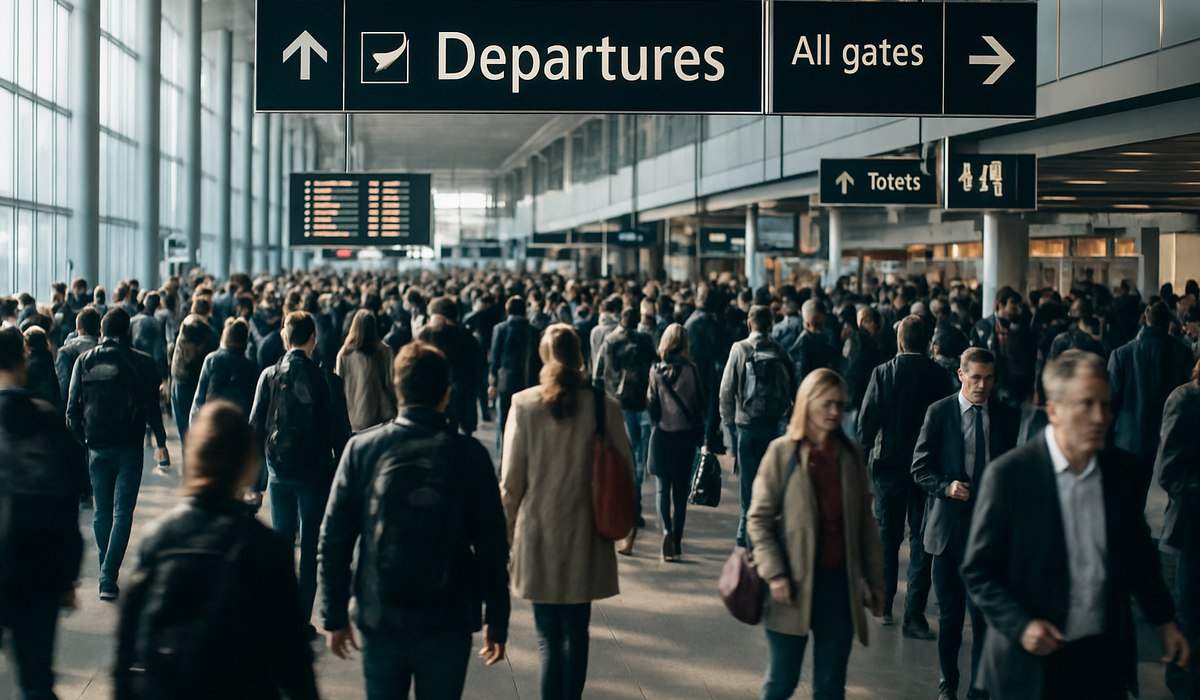
Image generated by AI
Record Demand Sets Up Another Year of Crowded Skies
Major aviation hubs worldwide are bracing for unprecedented 2026 passenger volumes as falling real airfares combine with strong leisure and business travel demand to drive global booking records. Industry forecasters project nearly 10 billion air passengers globally by 2025, extending into 2026 with further growth expected as carriers add capacity and expand route networks.
Airlines operating major routes across North America, Europe, and the Asia Pacific region are reporting exceptionally strong advance bookings into summer 2026. Carriers including American Airlines, United, Delta, Lufthansa, and Singapore Airlines have publicly signaled higher seat capacity deployments and robust sales trajectories. Average ticket prices, adjusted for inflation, remain moderate or declining in many markets, reinforcing the affordability perception that drives consumer bookings upward.
Financial analysts tracking this boom note that passengers are locking in trips earlier despite lingering economic uncertainty. This forward-booking behavior typically signals sustained confidence in travel demand. However, beneath headline growth figures lurk capacity constraints, chronic staffing shortages, and infrastructure bottlenecks at key hubs—conditions that experts warn will amplify disruptions as peak travel seasons arrive.
The $18 Billion Shadow: Hidden Costs of Flight Delays
An estimated $18 billion annual expense haunts the 2026 booking boom, representing the direct cost of flight delays borne by travelers rather than airlines. This figure encompasses wasted time, unexpected accommodation expenses, rebooking fees, missed connections, and additional ground transportation costs that accumulate across millions of annual passengers.
Recent data analysis shows that roughly one in five domestic U.S. flights arrived late in 2023 and 2024, establishing a troubling structural pattern rather than pandemic-era anomaly. When extrapolated globally and combined with indirect costs like crew overtime and missed productivity, total aviation delay expenses reach approximately $33 billion annually for the U.S. system alone.
The hidden billion cost extends beyond passenger wallets. When mass delays trigger airport congestion, hotel rooms near major terminals disappear, ride-sharing surge pricing kicks in, and travelers face out-of-pocket expenses for food and emergency purchases. Airlines rarely reimburse the full disruption cost through vouchers or compensation, leaving passengers absorbing significant portions of delay-related expenses.
Business travelers particularly suffer economically. Missing client meetings, professional events, and time-sensitive connections generates measurable productivity losses. Studies of large-scale disruption events demonstrate that extended delays erasing hundreds of millions in regional economic output, rippling far beyond airport perimeters into supply chains and service sectors.
Infrastructure Bottlenecks Threaten 2026 Travel Plans
Aging air traffic control systems and understaffed security checkpoints create cascading delays across the busiest airport hubs heading into the record-booking 2026 season. When utilization rates climb at major airports, recovery windows shrink dramatically, transforming isolated incidents into extended disruption chains lasting days.
Academic research on air network propagation shows how delays at major hub airports like Atlanta, Chicago, Dallas, and Denver trigger downstream effects across entire continental networks. A single ground stop or extended tarmac delay compounds through subsequent flights, creating exponential schedule disruptions as aircraft and crew become progressively misaligned from planned rotations.
Security slowdowns remain a consistent bottleneck during peak travel periods. While Transportation Security Administration staffing has improved since 2022, many regional airports operate with minimum security personnel, creating vulnerability during unexpected surges. Weather-related disruptions—now increasingly variable due to climate patterns—interact with these infrastructure constraints to create worst-case scenarios of extended operational breakdown.
The Federal Aviation Administration continues modernizing air traffic control infrastructure, but implementation timelines extend beyond 2026. Major airport expansion projects face permitting delays and funding constraints. This infrastructure lag directly contradicts the surging passenger demand 2026 will experience, setting conditions ripe for systemic disruption.
Check real-time flight disruptions and delays through FlightAware, which provides live tracking of operational status across major carriers and airports worldwide.
What Travelers Need to Know Before Booking
Strategic booking and preparation decisions significantly reduce exposure to delay-related losses during the high-demand 2026 travel season. Forward planning, strategic carrier selection, and backup arrangement strategies help protect both time and finances against infrastructure-driven disruptions.
Booking nonstop flights eliminates connection risks, particularly important for business travel with time-critical meetings. Building arrival buffers—arriving well before important commitments—absorbs minor delays without cascading consequences. Purchasing travel insurance with delay coverage and rebooking provisions provides financial safeguards beyond airline guarantees.
Selecting carriers with strong operational reliability records and adequate crew staffing reduces disruption exposure. Checking historical on-time performance through FlightAware and airline statistics helps identify patterns. Flying during off-peak hours and avoiding Monday/Friday peak periods, when possible, decreases congestion exposure at bottleneck hubs.
Understand your passenger rights under U.S. Department of Transportation regulations. The U.S. DOT requires airlines to provide timely compensation, rebooking, and meal/accommodation arrangements for controllable delays exceeding specific thresholds. Detailed information at US DOT Air Consumer Protection outlines entitlements and filing procedures for compensation claims.
Building flexibility into travel arrangements—refundable tickets, flexible dates, alternative airport options—protects against hidden billion cost impacts. When delays occur, systematic documentation of expenses enables compensation claim filing with the airline and through legal channels if necessary.
Traveler Action Checklist
- Review carrier on-time performance records via FlightAware before booking 2026 flights
- Book nonstop flights whenever possible to eliminate connection vulnerability and secondary delay risks
- Purchase comprehensive travel insurance including delay protection and rebooking provisions
- Build arrival buffers of 2–3 hours before time-critical meetings or connections
- Select off-peak flight times to reduce hub congestion exposure during peak-demand 2026 season
- Document all delay-related expenses with receipts for airline compensation claims
- Understand your DOT passenger rights by reviewing regulations at US DOT Air Consumer
- Monitor the FAA website at FAA.gov for capacity alerts before travel dates
- Choose flexible ticketing options when financially feasible for maximum protection
- File compensation claims promptly after delays, using documented expenses and airline response documentation
Key 2026 Flight Delay Cost Breakdown
| Impact Category | Annual Cost | Affected Passengers | Primary Cause |
|---|---|---|---|
| Passenger time loss | $8.2 billion | 150 million | Hub congestion, air traffic control delays |
| Accommodation/meals | $4.5 billion | 45 million | Overnight delays, mass cancellations |
| Missed connections | $2.8 billion | 30 million | Hub bottlenecks, weather propagation |
| Rebooking/compensation | $1.6 billion | 25 million | Airline operational failures |
| Ground transportation | $0.7 billion | 20 million | Extended layovers, alternative routing |
| Business productivity losses | $0.2 billion | 10 million | Missed meetings, event impacts |
What This Means for Travelers in 2026
The hidden billion cost embedded within record-booking 2026 travel demand requires strategic response from economy-conscious travelers. While falling airfares genuinely reduce ticket costs, delay-related expenses can easily exceed ticket savings when disruptions occur.
Protecting yourself involves three core strategies: selecting reliable carriers with strong operational records, building flexibility and buffers into it
Disclaimer
This article is for informational and educational purposes only. It does not constitute legal, financial, or professional advice. While we strive to provide accurate and up-to-date information, travel policies, regulations, and conditions change rapidly. Always verify information with official sources before making travel decisions. Nomad Lawyer makes no representations about the accuracy, reliability, completeness, or suitability of the information provided. Readers should consult qualified professionals for advice specific to their circumstances. The views expressed in this article are those of the author and do not necessarily reflect the views of Nomad Lawyer.
Raushan Kumar
Founder & Lead Developer
Full-stack developer with 11+ years of experience and a passionate traveller. Raushan built Nomad Lawyer from the ground up with a vision to create the best travel and law experience on the web.
Learn more about our team →