
Heathrow and Gatwick Airports Hit by Powerful Thunderstorms Causing Severe Flight Delays, Operational Disruptions and Large Scale Passenger Stranding Across UK Aviation Network
Severe thunderstorms at Heathrow and Gatwick airports caused hundreds of flight cancellations and delays, stranding thou

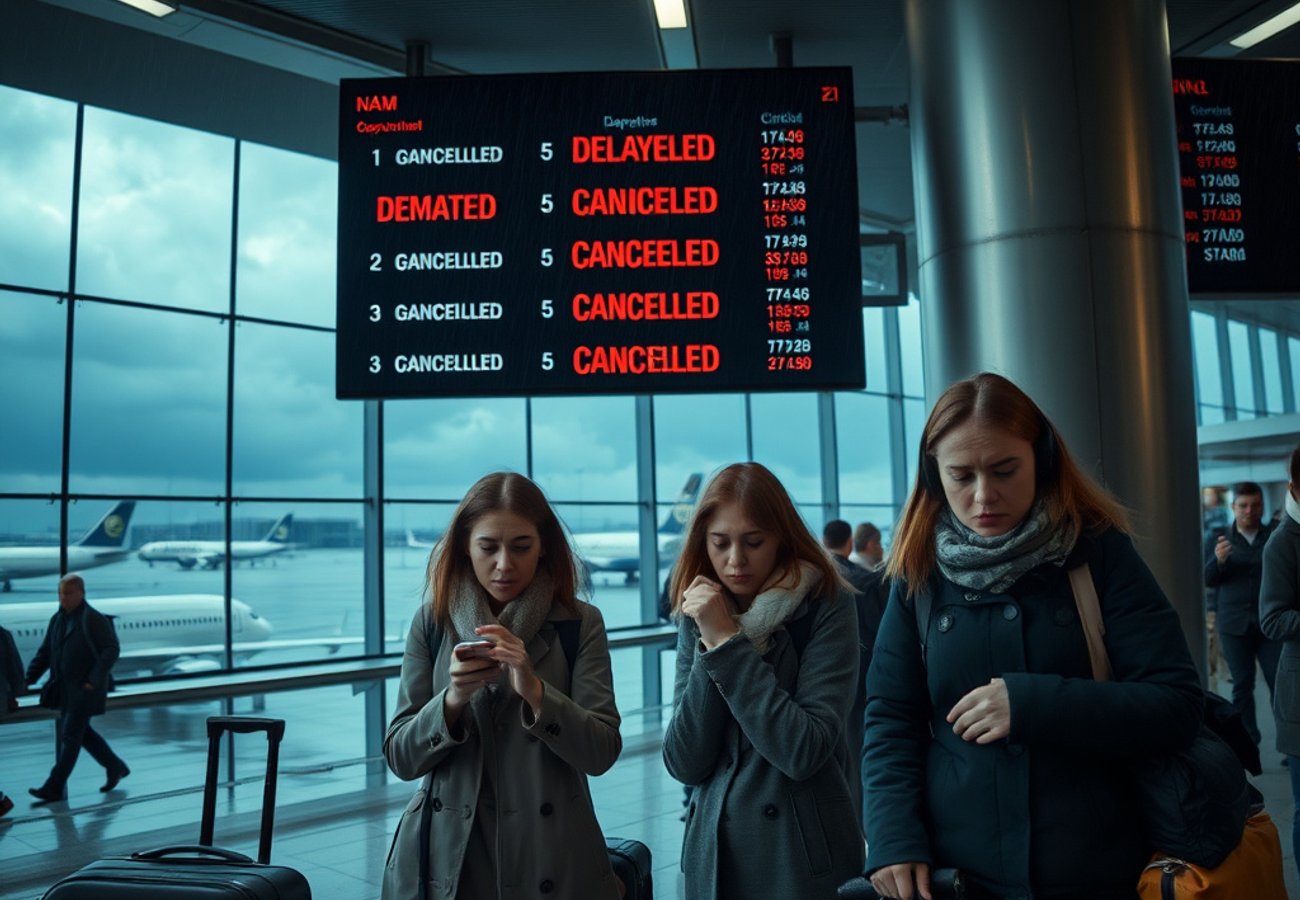
Image generated by AI
[London, June 28, 2026] — Severe thunderstorms have paralyzed air travel across the United Kingdom's primary aviation gateways, with Heathrow and Gatwick airports reporting hundreds of cancelled and delayed flights. The atmospheric volatility, which followed a period of intense heat, has left thousands of passengers stranded as air traffic control implemented emergency safety measures to manage lightning and heavy precipitation.
The sudden weather shift created an immediate operational crisis, triggering a ripple effect that extended from London's hubs to regional airports and international flight paths. According to industry reports, the combination of lightning strikes and torrential rain forced aviation authorities to impose strict flow restrictions, drastically reducing the number of aircraft permitted to take off or land per hour.
Rapid Weather Shift Triggers London Aviation Collapse
The crisis began when a prolonged heatwave across southern England gave way to unstable atmospheric conditions, leading to the rapid formation of powerful storm cells. While the Met Office had issued prior warnings, the actual intensity of the weather event quickly exceeded the safety thresholds required for standard aircraft movements.
To mitigate risk, air traffic controllers introduced rigorous flow restrictions at both Heathrow and Gatwick. These measures resulted in widespread runway congestion, with many aircraft forced into extended holding patterns while others missed their designated departure slots. Flight tracking data indicates that more than 1,000 flights across the UK network were impacted, with delays ranging from a single hour to over six hours depending on the specific route and aircraft availability.
Heathrow Airport Faces Critical Operational Strain
Heathrow Airport, one of the world's busiest hubs, bore the brunt of the disruption. The reduction in available airspace capacity led to a cascading failure of schedules, where a single delay early in the day triggered subsequent disruptions for flights scheduled hours later.
The impact was particularly severe for long-haul operations serving North America, Asia, and the Middle East. Aircraft turnaround times spiked as arriving planes were unable to access their assigned stands due to ground safety protocols. During periods of peak lightning activity, safety regulations prevented passengers from disembarking, leaving many trapped inside aircraft parked on taxiways for extended periods.
Furthermore, the disruption was compounded by crew duty limits. As delays stretched into several hours, many flight crews reached their legal maximum working hours, forcing airlines to cancel services entirely as they lacked available replacement staff to operate the flights.
Gatwick Airport Struggles with Single-Runway Constraints
Gatwick Airport faced parallel challenges, though its operational structure added a layer of complexity. Because Gatwick relies on a single-runway system, the competition for limited landing and takeoff slots became intensified during the storm.
Heavy rainfall and plummeting visibility forced the temporary suspension of various ground operations. This led to "stacking," where aircraft circled in holding patterns awaiting clearance to land. Short-haul flights to European destinations were the most heavily impacted, causing a schedule collapse that persisted well into the evening. Because Gatwick's business model depends on high-frequency, rapid-turnaround rotations, the initial wave of weather-related delays quickly destabilized the entire daily flight program.
Air Traffic Control Implements Safety Restrictions
The UK's air traffic management system prioritized safety over throughput, implementing controlled flow restrictions that slashed hourly capacity across London's airspace. Officials confirmed that lightning activity posed a direct threat to ground handling personnel and made aircraft refueling operations too dangerous to continue.
These precautionary measures slowed departure sequencing and increased the spacing between arriving aircraft. While these steps were necessary to prevent accidents, they created a massive backlog of flights. The disruption extended to transit passengers using London as a global connection point, with many missing their connecting flights due to the instability of the primary legs of their journeys.
Passenger Hardship and Terminal Congestion
The human cost of the disruption was evident across multiple terminals, where congestion surged as passengers flocked to customer service desks for rebooking. Many travelers experienced significant distress, spending hours inside aircraft on the tarmac before receiving clearance to move.
Airlines attempted to mitigate the chaos by activating emergency rebooking systems and providing hotel vouchers for those facing overnight delays. However, the sheer volume of affected travelers meant that hotel and flight availability was limited, leaving many with few immediate options. Communication gaps were also reported, as the rapidly changing weather conditions made it difficult for airport authorities to provide real-time, accurate departure updates.
Regional and European Network Ripple Effects
The storm's influence was not confined to London. Aviation monitoring indicates that regional hubs, including Edinburgh and Leeds Bradford, suffered secondary disruptions. This occurred because aircraft intended for those regional routes were stuck in London or delayed in their initial rotations.
The interconnected nature of European aviation meant that scheduling inefficiencies spread across the continent. Carriers operating multiple daily frequencies through London found their entire fleet rotations thrown off balance. Consequently, flights in cities that experienced perfectly clear weather were still cancelled or delayed because the physical aircraft and crews were stranded in the UK.
Recovery Outlook and Weather Stabilization
The timeline for a full operational recovery at Heathrow and Gatwick remains tied to the stabilization of the weather. While forecasts suggest the storm system is moving away, the "recovery phase" is slow. Airlines must now engage in the complex process of repositioning aircraft and crews to their correct bases to resume normal schedules.
Air traffic authorities continue to monitor the atmosphere to ensure a safe return to full capacity. Passengers are strongly advised to verify the status of their flights via digital channels before traveling to the airport to avoid further congestion in the terminals.
Why This Matters: The Fragility of High-Density Hubs
The events of June 28 highlight a critical vulnerability in the modern aviation infrastructure: the lack of resilience in high-density, "just-in-time" flight networks. Heathrow and Gatwick operate at near-maximum capacity even in ideal conditions. When a weather event reduces that capacity by even 20%, the system does not simply slow down—it bottlenecks.
This incident demonstrates that as climate volatility increases, the frequency of "sudden-onset" weather events may outpace the ability of current air traffic management systems to adapt. The reliance on a few primary hubs for global connectivity means that a localized storm in Southern England can effectively disrupt travel for passengers in New York, Dubai, or Singapore. For the industry, this underscores an urgent need for more flexible scheduling, better real-time data integration for passengers, and perhaps a strategic rethink of how hub-and-spoke models handle extreme weather shocks.
Related Travel Guides
Disclaimer
This article is for informational and educational purposes only. It does not constitute legal, financial, or professional advice. While we strive to provide accurate and up-to-date information, travel policies, regulations, and conditions change rapidly. Always verify information with official sources before making travel decisions. Nomad Lawyer makes no representations about the accuracy, reliability, completeness, or suitability of the information provided. Readers should consult qualified professionals for advice specific to their circumstances. The views expressed in this article are those of the author and do not necessarily reflect the views of Nomad Lawyer.
Raushan Kumar
Founder & Lead Developer
Full-stack developer with 11+ years of experience and a passionate traveller. Raushan built Nomad Lawyer from the ground up with a vision to create the best travel and law experience on the web.
Learn more about our team →