
Aviation Updates: Gulf Carriers Enforce Drastic Lithium Battery Bans to Prevent Mid-Air Fires and Summer Travel Chaos
Qatar Airways, Emirates, Etihad, Saudia, and Oman Air launch an aggressive crackdown on power banks and smart luggage to avert catastrophic cabin fires during the 2026 peak season.

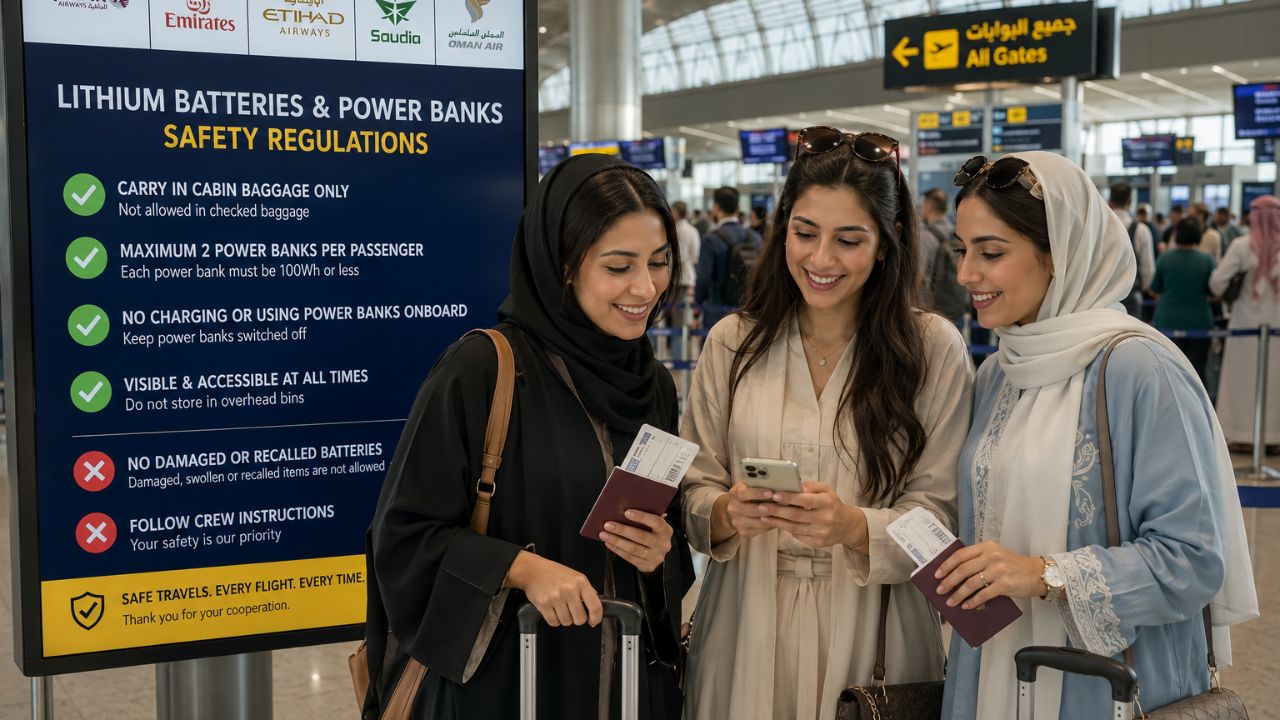
Image generated by AI
Aviation Updates: Gulf Carriers Enforce Drastic Lithium Battery Bans to Prevent Mid-Air Fires and Summer Travel Chaos
As catastrophic mid-air thermal runaway incidents violently surge across the globe, the Middle East's premier aviation mega-carriers have aggressively united to enforce zero-tolerance lithium battery restrictions, prioritizing absolute airspace survival over passenger convenience ahead of the explosive 2026 summer rush.
Image generated by AI
As urgent airline news networks and critical aviation updates relentlessly broadcast the terrifying reality of in-flight chemical fires, a massive regulatory crackdown has just been activated across the Middle East. Ahead of the highly anticipated 2026 summer peak travel season, a fierce, non-negotiable alliance has been formed by Qatar Airways, Emirates, Etihad Airways, Saudia, and Oman Air. Driven by an alarming global spike in mid-air thermal runaway incidents, these premier carriers are now strictly enforcing incredibly comprehensive, highly aggressive policies regarding all lithium battery and power bank transportation. Mandated directly by regional civil aviation bodies, prominently including the Qatar Civil Aviation Authority, and strictly complying with updated ICAO and IATA Dangerous Goods Regulations, this harmonized front is designed to protect commercial flights from catastrophic fires that are nearly impossible to suppress at cruising altitude. While these rigid enforcement measures will inevitably trigger localized airport disruptions at boarding gates, the massive Gulf carriers refuse to compromise; neutralizing the devastating risks associated with volatile energy storage cells is the only way to prevent terrifying emergency diversions and massive, system-wide flight cancellations that would plunge millions of transit passengers into absolute travel chaos.
Expanded Overview: The Terrifying Mechanics of Thermal Runaway
When analyzing the massive operational panic sweeping global aviation authorities, the scientific mechanics of thermal runaway explain exactly why these new mandates are so incredibly severe.
When internal faults occur within a damaged lithium-ion energy cell, a violent chain reaction of rapidly increasing temperatures instantly triggers within the chemical structure. If a modern battery pack fails, it releases highly toxic fumes and generates intense, self-sustaining flames that cannot be easily extinguished by traditional fire-fighting methods or standard water extinguishers. Within the highly pressurized, enclosed environment of a passenger jet, this spontaneous combustion presents a catastrophic danger. International aviation safety inspectors have brutally confirmed that even a single malfunctioning device can ignite an uncontrollable blaze, violently jeopardizing the lives of hundreds of individuals on board. Over the past few years, overheating electronic devices have forced numerous terrifying emergency landings. To combat this, flight crews are now completing extensive training programs and carrying specialized fire containment bags to quickly isolate failing devices before they destroy the aircraft.
Section-Wise Breakdown: The Unified Baggage Prohibition
The foundational baseline of this massive regulatory shift perfectly aligns with strict mandates issued by the International Civil Aviation Organization (ICAO).
An absolute, unbreakable prohibition has been placed on the packing of any portable charging devices within checked luggage across all five prominent Gulf airlines. It is federally mandated that the lower cargo hold of the aircraft must remain completely free of unmonitored lithium-ion energy cells. In the horrific event of a fire violently breaking out in the physically inaccessible cargo area, the aircraft, crew, and passengers would face certain catastrophe. Therefore, all portable battery packs must be transported exclusively within the passenger cabin, where highly trained flight attendants can instantly detect anomalous heat generation through visual and olfactory monitoring. When luggage passes through automated security scanners, advanced imaging technology heavily scrutinizes checked bags; any illicit power packs discovered are swiftly confiscated by baggage handlers, causing frequent delays and necessary security interventions.
Section-Wise Breakdown: The Qatar Airways Directive
While the baseline rules are unified, individual carriers are aggressively imposing their own hyper-specific operational limits.
Following strict alignment with the latest directives issued by the Qatar Civil Aviation Authority on 17 June 2026, Qatar Airways is violently cracking down on cabin stowage. Under these highly specific guidelines, the airline strictly enforces a maximum limit of two portable charging devices per passenger, with each unit absolutely not exceeding a maximum energy capacity of 100Wh (approximately 27,000mAh). Furthermore, Qatar Airways has mandated a highly rigid storage protocol: permitted charging units must remain highly visible and easily accessible to the cabin crew at all times. The stowage of these volatile items inside overhead bins or deep within tightly packed carry-on baggage is explicitly forbidden. This strict visibility mandate ensures flight crews can instantly recognize preliminary signs of smoke before a larger crisis is violently triggered.
Section-Wise Breakdown: The Emirates Absolute Restriction
Conversely, the Dubai-based mega-carrier has implemented a notably more stringent, deeply severe approach for the 2026 high-season rush.
Emirates is actively enforcing a baseline policy of maximum restraint across its massive global route network, enacting an absolute ban on the in-flight utilization of any portable charging unit. It is strictly decreed that only one single power bank per person is allowed inside hand luggage, and its capacity must be rated under 100Wh. Throughout the entire duration of the intercontinental journey, this device must be completely turned off and rendered entirely inactive. Emirates forcefully demands that the item be stored exclusively within the seat pocket provided in front of the passenger or securely placed underneath the seat, ensuring the highly volatile device remains isolated, unutilized, and constantly within the peripheral vision of patrolling airline staff.
Section-Wise Breakdown: The Etihad, Saudia, and Oman Air Label Mandate
A highly rigorous, harmonized procedural protocol is actively causing boarding gate friction across the networks of Etihad Airways, Saudia, and Oman Air.
These three airlines strictly implement a maximum allowance of two devices per traveler, but enforcement is brutal. Trained customer service agents are currently conducting rigorous visual inspections of all electronic accessories directly at the boarding gates. The airlines have issued severe warnings: any portable battery pack with unclear, severely scratched, or entirely missing watt-hour capacity labels will be aggressively confiscated by ground staff immediately prior to boarding. Because the exact energy capacity must be clearly verifiable without any ambiguity, unverified energy storage devices are permanently removed from the flight manifest. While enforcing this strict label requirement causes minor delays, these carriers refuse to compromise flight safety for passenger leniency.
Flight Details: Gulf Carrier Lithium Battery Policy Matrix
The exact operational telemetry outlining these highly restrictive new compliance mandates, detailing specific capacity limits and stowage protocols, has been consolidated into the mandatory matrix below.
Gulf Carrier Lithium Battery & Power Bank Policy Matrix (2026)
| Airline | Maximum Device Allowance | Capacity Limit | Specific Stowage & Usage Rules |
|---|---|---|---|
| Qatar Airways | 2 devices per passenger | 100Wh (27,000mAh) per unit | Highly visible, no overhead bin stowage. In-flight usage banned. |
| Emirates | 1 device per passenger | Under 100Wh | Must be turned off, stored in seat pocket/under seat. In-flight usage banned. |
| Etihad Airways | 2 devices per passenger | Verifiable via clear label | Clear labels mandatory. Confiscation if scratched. In-flight usage banned. |
| Saudia | 2 devices per passenger | Verifiable via clear label | Clear labels mandatory. Confiscation if scratched. In-flight usage banned. |
| Oman Air | 2 devices per passenger | Verifiable via clear label | Clear labels mandatory. Confiscation if scratched. In-flight usage banned. |
Passenger Impact: Strict In-Cabin Operational Bans
Beyond simply restricting the physical number of devices, comprehensive behavioral bans are now violently enforced regarding the operation of these electronic items while the aircraft is airborne.
The active charging of any portable battery bank using the aircraft's in-seat USB ports or AC power outlets is strictly prohibited by all five airlines to protect delicate flight deck electrical systems. Furthermore, using a power bank to replenish mobile phones, laptops, or tablets while in active operation is completely banned for the entire duration of the flight. Constant cabin walk-throughs guarantee these bans are strictly monitored. To comply, passengers are formally instructed by the International Air Transport Association to ensure all personal electronic devices are fully charged at terminal waiting areas prior to boarding, drastically lowering the overall fire risk within the cabin.
Industry Analysis: Regulating Damaged Goods and Smart Luggage
Aviation security personnel are maintaining an absolute zero-tolerance policy regarding compromised electronic equipment.
Devices visibly showing signs of active swelling, excessive external wear, severe physical damage, or those officially recalled by international manufacturers are entirely barred from transport; confiscation or boarding denial is immediate. Furthermore, technologically advanced "smart luggage" is heavily regulated. These suitcases are only permitted in the checked cargo hold if the internal lithium battery is completely removed beforehand. If brought into the cabin, the battery capacity must be under the 100Wh limit and must remain physically disconnected from the suitcase for the entire flight. Similarly, electronic cigarettes and personal vaporizers are strictly prohibited in checked baggage; while allowed in the cabin, active usage and charging are completely banned. Finally, standard laptops and tablets are allowed in checked baggage only if they are fully powered off (not in sleep or standby modes), though airlines highly recommend keeping them in the main cabin.
Conclusion: Compliance or Confiscation
Ultimately, the responsibility for absolute compliance with these highly aggressive new Gulf carrier mandates rests entirely upon the individual traveler. Passengers must carefully audit all personal baggage before even commencing their journey to the airport. A smooth, uninterrupted transit experience is practically guaranteed for those who rigorously follow the rules. Conversely, those who fail to adhere to these non-negotiable mandates face severe travel disruptions, brutal boarding denials, missed flight connections, and the permanent loss of expensive electronic accessories. As the 2026 summer travel season explodes, this harmonized front by Qatar Airways, Emirates, Etihad, Saudia, and Oman Air proves that the absolute security of the aircraft and the preservation of human life will always be violently prioritized over the convenience of a charged smartphone.
Key Takeaways
- Unified Gulf Ban: Qatar Airways, Emirates, Etihad, Saudia, and Oman Air have heavily synchronized strict lithium battery and power bank policies for the 2026 summer peak.
- Checked Luggage Prohibition: All portable charging devices and e-cigarettes are strictly forbidden from entering the inaccessible lower cargo hold.
- Emirates Maximum Restriction: Emirates explicitly limits passengers to one single power bank under 100Wh, which must remain totally turned off and stored in the seat pocket.
- Gate Confiscations: Etihad, Saudia, and Oman Air will aggressively confiscate any power bank with scratched, unclear, or missing watt-hour capacity labels prior to boarding.
- In-Flight Usage Banned: Using power banks to charge devices or plugging power banks into aircraft USB/AC outlets is strictly prohibited across all five carriers.
FAQ: Gulf Carrier Lithium Battery Regulations 2026
Can I pack a power bank in my checked luggage when flying a Gulf carrier? No. It is an absolute federal mandate that all portable charging devices and lithium-ion power banks are strictly prohibited from checked luggage to prevent catastrophic cargo fires.
What is the specific Qatar Airways policy regarding power bank stowage? Following the 17 June 2026 directive, Qatar Airways mandates that passengers carry a maximum of two devices (up to 100Wh each), which must remain highly visible and cannot be stowed in overhead bins.
Will Etihad Airways confiscate my power bank if the label is faded? Yes. Etihad Airways, Saudia, and Oman Air enforce a zero-tolerance label mandate; any device with an unclear, severely scratched, or missing watt-hour capacity label will be aggressively confiscated at the boarding gate.
Related Travel Guides
Air France A350 Paris Saint Martin Route Travel Chaos 2026
United Airlines UA858 Shanghai San Francisco Diverts Tokyo Travel Chaos 2026
Middle East Regional Flight Disruption Survival Guide 2026
Disclaimer: This article is strictly for informational purposes. The aviation safety data, specific airline baggage policies (prohibition of power banks in checked luggage), specific carrier limits (Qatar Airways 2 devices/100Wh, Emirates 1 device/100Wh), and gate confiscation protocols (label verification by Etihad, Saudia, and Oman Air) are based on the latest directives from the Qatar Civil Aviation Authority (issued 17 June 2026) and the International Air Transport Association (IATA) available at the time of publication. International aviation safety regulations regarding dangerous goods, lithium-ion battery transportation limits, and specific airline in-flight operational bans are highly dynamic and subject to immediate, unannounced modification based on global security assessments. Passengers must explicitly verify exact electronic device allowances, watt-hour limits, and prohibited items lists directly with their operating carrier prior to packing luggage and arriving at the airport terminal.
Disclaimer
This article is for informational and educational purposes only. It does not constitute legal, financial, or professional advice. While we strive to provide accurate and up-to-date information, travel policies, regulations, and conditions change rapidly. Always verify information with official sources before making travel decisions. Nomad Lawyer makes no representations about the accuracy, reliability, completeness, or suitability of the information provided. Readers should consult qualified professionals for advice specific to their circumstances. The views expressed in this article are those of the author and do not necessarily reflect the views of Nomad Lawyer.
Kunal K Choudhary
Co-Founder & Contributor
A passionate traveller and tech enthusiast. Kunal contributes to the vision and growth of Nomad Lawyer, bringing fresh perspectives and driving the community forward.
Learn more about our team →