
Emirates and Qatar Airways Trigger Massive Gulf Aviation Surge Despite Brutal 48% Passenger Demand Collapse, Threatening $4 Billion Regional Industry Implosion: Latest Airline News
A deeply contradictory aviation surge is engulfing the Middle East as global airlines furiously reinstate capacity despite a devastating collapse in international passenger demand and severe regional instability.

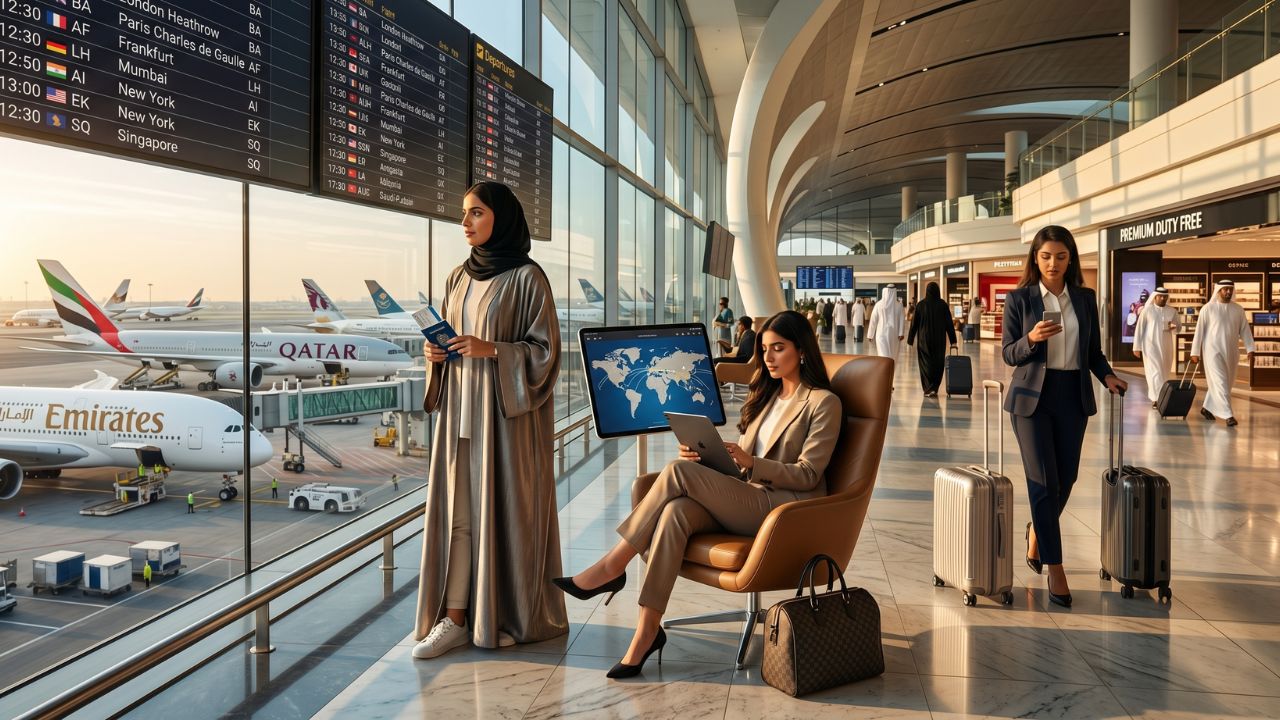
Image generated by AI
In a deeply contradictory and highly volatile market maneuver, the Middle Eastern aviation sector is officially executing a massive June 2026 flight surge across the UAE, Saudi Arabia, and Qatar, aggressively spearheaded by Emirates, Qatar Airways, and Etihad Airways. Despite a catastrophic 48% collapse in regional passenger demand, international heavyweight carriers including British Airways, Lufthansa, Air India, Turkish Airlines, Air France, and American Airlines are furiously following suit, attempting to reclaim their heavily disrupted transit corridors. This paradoxical strategy—rapidly injecting aircraft capacity into a deeply frightened market—is testing the absolute limits of the Gulf recovery, exposing a brutal disconnect between airline ambition and actual tourist behavior. As regional hubs hemorrhage up to $600 million daily, this devastating collision of massive airport disruptions, sweeping flight cancellations, and economic shock represents the premier headline in today's breaking airline news and global aviation updates.
By introducing direct passenger coordination and dynamic scheduling backups, the regional aviation hubs target growing passenger demand across vital commerce sectors. The choice to coordinate flight departures in phases helps to manage gate capacity, supporting the country's broader regional transportation network.
Context: The Brutal Economics of the Gulf Tourism Shock
The current crisis engulfing the Middle East is not a failure of aviation infrastructure; it is a total collapse of international traveler confidence.
At peak disruption levels in early 2026, the Gulf experienced a staggering 60% spike in booking cancellations. As a direct result, airlines were forced into a massive 38% capacity reduction, while average load factors plummeted to roughly 70%. The financial devastation is profound: under these stressed scenarios, the regional aviation industry is bleeding an estimated $4 billion annually, with daily economic losses across the disruption phases hitting $600 million. In Dubai, a city built entirely on international tourism and high-volume transit, hotel occupancy rates horrifyingly plummeted to 20-25% during the worst weeks of the crisis. Despite these apocalyptic metrics, airlines are now stubbornly attempting to force a recovery by physically reinstating the routes, operating under the highly risky assumption that "if we fly it, they will come."
To view live flight schedules, real-time terminal maps, or check-in rules across the Middle East, travelers can consult the official Dubai International Airport (DXB) or Hamad International Airport directories. For direct booking access, specific baggage rules, and geopolitical travel waivers, passengers can check the official Emirates or Qatar Airways portals. To explore live flight tracking, check delay maps, or monitor exact widebody fleet routing, passengers can consult the official FlightAware tracking service.
Section-Wise Breakdown of the Global Aviation Response
The Big Three Gulf Carriers
The legacy Gulf operators are leading the aggressive capacity injection. Emirates is intensely focused on forcefully recovering its highly lucrative long-haul travel network via its massive Dubai mega-hub. Meanwhile, Qatar Airways is aggressively re-establishing critical transit corridors linking Europe and Asia via Doha, effectively fighting to regain its crown as the world's premier connecting airline. Simultaneously, Etihad Airways is executing a more targeted strategy, relaunching highly specific tourism-focused routes originating from Abu Dhabi.
European Legacy Carriers
The European response is heavily mixed, exposing deep operational hesitation. While British Airways and Lufthansa are initiating the recovery of travel to the Gulf, they are executing partial, scaled-back returns compared to their pre-disruption footprints. Conversely, Air France is exhibiting extreme caution, enacting only a limited recovery and maintaining strict restrictions on select Gulf routes due to the highly volatile geopolitical airspace.
The Asian and American Wildcards
Turkish Airlines and Air India are aggressively capitalizing on the disruption. Both carriers are dynamically adjusting their transit-dominant routes, actively rerouting traffic between Asia and Europe to absorb passengers fleeing the traditional Gulf hubs. Conversely, American Airlines remains highly cautious, slowly developing its transit operations to the Middle East while maintaining the flexibility to pause or restart its Doha connectivity based on real-time threat assessments.
Technical Roster: Gulf Route Recovery and Operational Shifts
To ensure absolute factual accuracy regarding the strategic positioning of global carriers during this massive 2026 capacity surge, the following table details the specific hub cities, current operational status, and primary route impacts for the affected airlines:
| Operating Airline | Primary Hub City | 2026 Operational Status | Key Route Impact & Strategic Focus |
|---|---|---|---|
| Emirates | Dubai | Expanding | Aggressive recovery of Europe-Asia transits |
| Qatar Airways | Doha | Stabilizing | Recovery of global connecting networks |
| Etihad Airways | Abu Dhabi | Recovering | Expansion of highly targeted tourism routes |
| British Airways | London-Gulf | Partial Return | Delay of originally planned route resumptions |
| Lufthansa | Frankfurt | Gradual Rebuild | Reinstating less frequent, scaled-back routes |
| Air India | Delhi/Mumbai | Increasing | Capturing Gulf labor + redirected transit demand |
| Turkish Airlines | Istanbul | Expanding | Aggressive rerouting from Asia to Europe |
| Air France | Paris | Limited Recovery | Strict restriction of select Gulf routes |
| American Airlines | US Hubs | Cautious | Doha connectivity remains in a pause/restart phase |
Passenger Impact: Volatility and the Evaporation of Leisure Travel
For the everyday traveler, this disconnected surge generates extreme ticketing volatility.
Because planes are flying half-empty, passengers are experiencing wild, short-term price fluctuations for both flights and regional hotels. Furthermore, while the number of routes is increasing, the actual frequency of long-haul flights remains heavily depressed, severely limiting schedule flexibility. Consequently, the demographic of the Gulf traveler has radically shifted: highly lucrative, risk-averse leisure tourism has completely evaporated. The only demographic actively utilizing these reinstated routes are hardened corporate business travelers and essential VFR (Visiting Friends and Relatives) traffic who have no choice but to absorb the risk.
Industry Analysis: The Core Conflict of 2026
Aviation industry analysts view the 2026 Gulf aviation surge as a terrifying operational experiment.
The core conflict is obvious: aviation recovery is currently an operational recovery, not a psychological one. Airlines are physically putting $200 million planes back into the sky much faster than frightened tourists are willing to enter their credit card numbers into a booking system. Travelers remain paralyzed by highly uncertain regional airspace stability and the skyrocketing costs associated with carriers having to detour around conflict zones, which burns massive amounts of excess jet fuel. Hub-reliant airlines in Dubai and Doha, alongside low-cost regional operators, are currently absorbing massive financial risks, hoping that overwhelming capacity will eventually force consumer confidence to return.
Actionable Advice for Navigating the Gulf Aviation Surge
If you are compelled to travel through the Middle East during this highly volatile 2026 capacity surge, you must execute this tactical survival checklist:
- Demand Ultimate Flexibility: Never book a basic economy, non-refundable fare through the Gulf right now. Always purchase tickets that guarantee zero-fee cancellations and instant, app-based rerouting capabilities.
- Weaponize Travel Insurance: Standard credit card travel protections are insufficient. You must purchase comprehensive, third-party "Cancel For Any Reason" (CFAR) travel insurance that specifically covers geopolitical airspace disruptions and sudden flight suspensions.
- Expect Spontaneous Re-Routings: Airlines are dynamically shifting flight paths daily to avoid unstable airspace. This means a scheduled 6-hour flight could easily become an 8-hour flight. Prepare for significantly prolonged connection times and never book a layover under three hours.
- Exploit Saudi Domestic Stability: If your primary goal is Middle Eastern tourism, recognize that Saudi Arabia is currently the most resilient market. Because Saudi tourism is heavily anchored by domestic and religious travel, it is vastly less susceptible to the transit shocks destroying Dubai and Doha.
- Monitor the Turkish/Indian Bypass: If you are traveling between Europe and Asia and wish to completely avoid the Gulf, aggressively utilize the expanding networks of Turkish Airlines (via Istanbul) or Air India (via Delhi), which are actively building massive bypass corridors.
FAQ: The 2026 Gulf Aviation Capacity Surge
Why are airlines expanding routes in the Gulf if passenger demand is down?
Airlines like Emirates and Qatar Airways are attempting to forcefully reorganize the global transit system and recapture market share, prioritizing operational presence over immediate passenger loads.
How bad was the actual drop in Gulf passenger demand?
The region suffered a devastating 48% collapse in passenger demand, accompanied by a 60% spike in booking cancellations and billions of dollars in economic losses.
Which Middle Eastern country will recover the fastest?
Analysts predict Saudi Arabia will experience the fastest stabilization due to its massive, highly resilient domestic and religious tourism base, while the UAE and Qatar remain highly vulnerable due to their total reliance on international transit passengers.
The Disconnect Between Metal and Minds
The 2026 Gulf aviation surge brutally exposes the absolute limits of airline network planning. By forcefully injecting massive widebody capacity back into Dubai, Doha, and Abu Dhabi, global carriers are proving they have the logistical hardware to rebuild the world's premier transit corridor. However, the empty seats inside those aircraft tell the true story: infrastructure cannot overwrite psychological fear. Until the Middle East can guarantee sustained geopolitical stability, airlines will continue to bleed billions of dollars, trapped in a highly dangerous game of chicken between empty skies and terrified passengers.
Key Takeaways
- Massive Demand Collapse: The Gulf aviation sector is suffering a catastrophic 48% drop in passenger demand, costing the industry up to $4 billion annually.
- Contradictory Capacity Surge: Despite the financial bleeding, Emirates, Qatar Airways, and Etihad are aggressively reinstating their global transit routes.
- Mixed Global Response: While Turkish Airlines and Air India are aggressively expanding, carriers like Air France and American Airlines remain highly cautious.
- Saudi Resilience: Saudi Arabia's aviation market is vastly outperforming the UAE and Qatar due to its reliance on stable domestic and religious tourism.
- Psychological vs. Operational Recovery: Airlines have successfully restored the physical flight infrastructure, but have entirely failed to restore the necessary psychological confidence of the international tourist.
Related Travel Guides
Etihad Airways Ignites Massive Aviation Shakeup With Free Medical Insurance
Los Angeles Labor Crisis Triggers Massive Flight Disruptions for Global Airlines
Gulf Aviation Surge Capacity and Passenger Demand Collapse Discussion on Reddit
Disclaimer
This article is for informational and educational purposes only. It does not constitute legal, financial, or professional advice. While we strive to provide accurate and up-to-date information, travel policies, regulations, and conditions change rapidly. Always verify information with official sources before making travel decisions. Nomad Lawyer makes no representations about the accuracy, reliability, completeness, or suitability of the information provided. Readers should consult qualified professionals for advice specific to their circumstances. The views expressed in this article are those of the author and do not necessarily reflect the views of Nomad Lawyer.
Kunal K Choudhary
Co-Founder & Contributor
A passionate traveller and tech enthusiast. Kunal contributes to the vision and growth of Nomad Lawyer, bringing fresh perspectives and driving the community forward.
Learn more about our team →