
Travel Chaos Engulfs Guangzhou Baiyun Airport as 283 Flight Disruptions Paralyze Asian Gateways
Breaking airline news: Severe travel chaos strikes Guangzhou Baiyun International Airport, triggering 34 flight cancellations and 249 delays across major Chinese and international carriers.

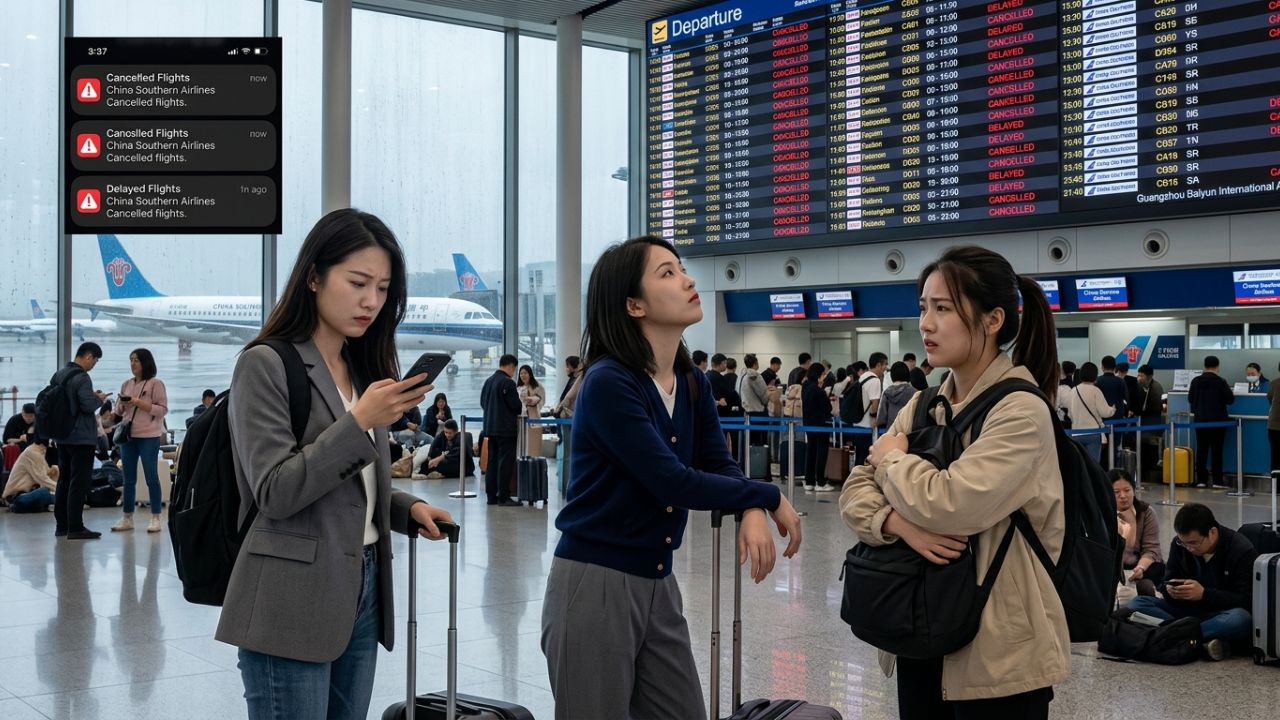
Image representing the intense travel chaos and massive schedule breakdown currently paralyzing Guangzhou Baiyun International Airport.
Travel Chaos Engulfs Guangzhou Baiyun Airport as 283 Flight Disruptions Paralyze Asian Gateways
Schedule Integrity Collapses Across the Southern Aviation Hub
The aviation network of southern China is currently buckling under immense operational strain as severe travel chaos engulfs Guangzhou Baiyun International Airport. Today, June 14, 2026, passengers attempting to navigate through one of Asia's absolute busiest and most critical gateways are facing a catastrophic breakdown in schedule reliability. According to the latest breaking airline news, the airport has officially recorded an agonizing 249 delayed flights and 34 outright flight cancellations across domestic and international services. The sheer, staggering volume of these delayed movements is creating substantial, localized airport disruptions, devastating onward connections, tourism itineraries, and essential business mobility between Beijing, Shanghai, Urumqi, Kuala Lumpur, Seoul, and broader regional Asian gateways.
The current disruption profile indicates that Guangzhou is not suffering from a total grounding event, but rather a grueling deterioration of operational fluidity. Airlines are desperately attempting to keep aircraft moving—with delays accounting for 88% of the total disruption volume—but the cascading nature of these hold-ups means thousands of passengers are currently trapped inside terminals with no definitive departure times. Major operators, including China Southern Airlines, Air China, China Eastern, Hainan Airlines, and China United Airlines, are actively battling to maintain their networks as departure queues and arrival bottlenecks severely degrade regional aviation stability across Guangdong Province and Hong Kong.
The Scale of the Disruption
The most critical aspect of today’s aviation meltdown is the heavy imbalance between cancellations and delays. The data confirms that airlines and air traffic controllers are attempting to preserve capacity at all costs, resulting in rolling delays that bleed throughout the entire daily schedule rather than executing mass flight cancellations.
As Guangzhou’s primary hub carrier, China Southern Airlines is bearing the absolute brunt of the operational strain. The airline recorded 14 cancellations and a massive 82 delays, the highest figures among all airlines operating at the airport. These 82 delayed flights indicate substantial schedule pressure affecting aircraft rotations, crew availability, and connection reliability. Meanwhile, Air China reported 6 cancellations and 32 delays, and China Eastern Airlines recorded 4 cancellations and 37 delays, demonstrating that the nation's largest operators are severely struggling to shield passengers from systemic travel chaos.
Guangzhou Baiyun International Airport Flight Disruption Statistics – June 14, 2026
To provide complete clarity on the severity of this localized airport disruptions, the following operational matrix details the exact disruption breakdown for every carrier operating at Guangzhou today:
Factual Airline-Specific Cancellation and Delay Data
| Airline | Cancelled | Cancellation % | Delayed | Delay % |
|---|---|---|---|---|
| China Southern Airlines | 14 | 2% | 82 | 12% |
| Air China | 6 | 6% | 32 | 33% |
| China Eastern | 4 | 2% | 37 | 25% |
| Juneyao Airlines | 4 | 25% | 2 | 12% |
| China United Airlines | 3 | 75% | 0 | 0% |
| Hainan Airlines | 2 | 2% | 29 | 31% |
| Shanghai Airlines | 1 | 12% | 0 | 0% |
| Beijing Capital Airlines | 0 | 0% | 5 | 31% |
| Zhejiang Loong | 0 | 0% | 6 | 33% |
| Shandong Airlines | 0 | 0% | 2 | 14% |
| West Air | 0 | 0% | 2 | 33% |
| Spring Airlines | 0 | 0% | 3 | 9% |
| Sichuan Airlines | 0 | 0% | 4 | 14% |
| Shenzhen Airlines | 0 | 0% | 12 | 12% |
| Urumqi Air | 0 | 0% | 2 | 100% |
| XiamenAir | 0 | 0% | 8 | 33% |
| Hebei Airlines | 0 | 0% | 2 | 100% |
| 9 Air | 0 | 0% | 16 | 22% |
| Malaysia Airlines | 0 | 0% | 1 | 50% |
| Asiana | 0 | 0% | 2 | 50% |
Section-Wise Breakdown: Why the Network is Failing
The immense travel chaos at Guangzhou is the result of several converging structural and environmental pressures:
Severe Weather Squeeze According to recent aviation updates, severe summer weather remains the primary catalyst for massive aviation disruptions across southern China. Thunderstorm activity, heavy rainfall bands, reduced runway visibility, and strong crosswinds are forcing massive air traffic flow restrictions. Southern China frequently experiences highly unstable weather patterns during this period, making these weather-related operational challenges a paralyzing factor for hub throughput.
Air Traffic Congestion and Rotation Failures Guangzhou Baiyun is among the absolute busiest airports in Asia. When weather restrictions brutally reduce runway capacity, congestion rapidly builds across departure queues, arrival sequencing, and airspace corridors. Because modern airline networks rely on aircraft completing multiple daily segments, a single delayed arrival instantly means subsequent flights depart late, crew schedules become disrupted, and passenger connections are missed. This aircraft rotation failure spreads rapidly throughout the entire Asian route network.
The Strategy of Secondary Carriers While massive carriers like China Southern accepted massive delay volumes to keep passengers moving, several secondary airlines adopted radically different strategies. Juneyao Airlines opted to eliminate selected flights entirely, resulting in a 25% cancellation rate (4 cancellations, 2 delays). More dramatically, China United Airlines suffered a remarkable 75% cancellation rate, indicating a particularly severe and immediate collapse of its Guangzhou operations today.
Passenger Impact: The Hidden Economic Cost
For the passengers trapped inside Guangzhou Baiyun today, the reality is grueling. Because airlines are overwhelmingly choosing to delay rather than cancel flights, thousands of travelers are enduring agonizing, extended terminal waits. This creates immense strain on seating, dining facilities, and customer service desks, leading to severe traveler frustration.
The economic consequences extend far beyond the terminal. Guangzhou serves as a critical entry point for both domestic and international visitors. Missing international connections to Kuala Lumpur or Seoul destroys executive productivity and causes massive corporate travel disruption. Furthermore, because passenger flights frequently transport highly valuable cargo in their belly holds, these severe airport disruptions are currently inflicting heavy pressure on regional supply chains and local tourism operators across Guangdong Province.
Conclusion: A Grueling Recovery Path
The breakdown of schedule reliability at Guangzhou Baiyun International Airport is a severe reminder of the fragility of modern, high-density aviation networks. With 249 flights delayed and 34 flight cancellations executed by major carriers like China Southern, Air China, and China Eastern, the southern Chinese aviation corridor is engulfed in intense travel chaos. While airlines are desperately attempting to maintain network capacity rather than grounding fleets, the compounding effects of severe weather bands, air traffic congestion, and aircraft rotation failures guarantee that full operational recovery will require multiple cycles. Passengers scheduled to fly through Guangzhou must maintain maximum flexibility and prepare for immediate airport disruptions as the system attempts to stabilize over the coming days.
Key Takeaways
- Massive Delays: Guangzhou Baiyun Airport recorded a staggering 249 delayed flights and 34 outright flight cancellations on June 14, 2026.
- Hub Carrier Strain: China Southern Airlines suffered the heaviest burden, recording 14 cancellations and an agonizing 82 delays.
- Systemic Causes: The travel chaos is driven by severe thunderstorms, heavy rainfall, air traffic congestion, and aircraft rotation failures across southern China.
- Secondary Carrier Collapse: China United Airlines recorded a staggering 75% cancellation rate, highlighting severe operational stress.
- Regional Impact: The disruptions are severely impacting onward connections, tourism flows, and business mobility between Beijing, Shanghai, Seoul, Kuala Lumpur, and Hong Kong.
❓ FAQs: Guangzhou Baiyun International Airport Flight Cancellations 2026
1. How many flights were cancelled at Guangzhou Baiyun International Airport today? A total of 34 flights were cancelled on June 14, 2026.
2. How many flights were delayed? The airport recorded 249 delayed flights, creating massive travel chaos for passengers.
3. Which airline had the most cancellations? China Southern Airlines recorded the highest number with 14 flight cancellations.
4. Which airline had the most delays? China Southern Airlines also recorded the highest delay count with an agonizing 82 delayed flights.
5. Which airline had the highest cancellation percentage? China United Airlines reported the highest cancellation rate at a staggering 75%.
6. Are international airlines affected? Yes. Malaysia Airlines and Asiana both reported delayed flights amid the widespread airport disruptions.
7. Is Guangzhou Airport closed? No. The airport remains completely operational despite the significant delays and disruptions.
8. Should passengers still travel to the airport? Passengers should absolutely verify their flight status through official airline channels before departing for the airport and maintain constant communication with their airline to navigate the ongoing travel chaos.
🌍 Related Travel Guides & Flight Resources
- Navigate Airport Disruptions Like a Pro Master the art of surviving unexpected travel chaos with our expert strategies.
- Breaking Airline News & Evasion Routes Stay ahead of the delays with our real-time aviation updates and route intelligence.
- Global Flight Cancellation Defense Grid Essential legal rights and compensation tactics when your flight goes down.
⚖️ Disclaimer
The aviation disruption statistics, flight cancellation data, and airport delay metrics provided in this report are for informational purposes only. Airline flight schedules, operational recovery timelines, and regional air traffic control directives are highly volatile and subject to immediate change based on severe weather systems, crew availability, and sudden macroeconomic shifts. All delay and cancellation data has been officially sourced from Guangzhou Baiyun International Airport authorities and relevant airline operational boards as of June 14, 2026, and remains completely fluid. NomadLawyer does not guarantee the absolute accuracy or current validity of the information provided and assumes no liability for travel disruptions, sudden flight cancellations, altered itineraries, or any financial consequences resulting from the use of this content. Passengers are strongly advised to independently verify all flight statuses directly with their respective airlines prior to proceeding to the airport.
Disclaimer
This article is for informational and educational purposes only. It does not constitute legal, financial, or professional advice. While we strive to provide accurate and up-to-date information, travel policies, regulations, and conditions change rapidly. Always verify information with official sources before making travel decisions. Nomad Lawyer makes no representations about the accuracy, reliability, completeness, or suitability of the information provided. Readers should consult qualified professionals for advice specific to their circumstances. The views expressed in this article are those of the author and do not necessarily reflect the views of Nomad Lawyer.
Kunal K Choudhary
Co-Founder & Contributor
A passionate traveller and tech enthusiast. Kunal contributes to the vision and growth of Nomad Lawyer, bringing fresh perspectives and driving the community forward.
Learn more about our team →