
Absolute Travel Chaos Engulfs Guangzhou Baiyun Airport as 485 Delays and Flight Cancellations Paralyze Air China, China Eastern, and China Southern Operations Across the Asia-Pacific: Latest Airline News
Guangzhou Baiyun International Airport has suffered a massive operational collapse, with 485 delayed flights triggering severe travel chaos, missed connections, and terminal gridlock across Southern China.

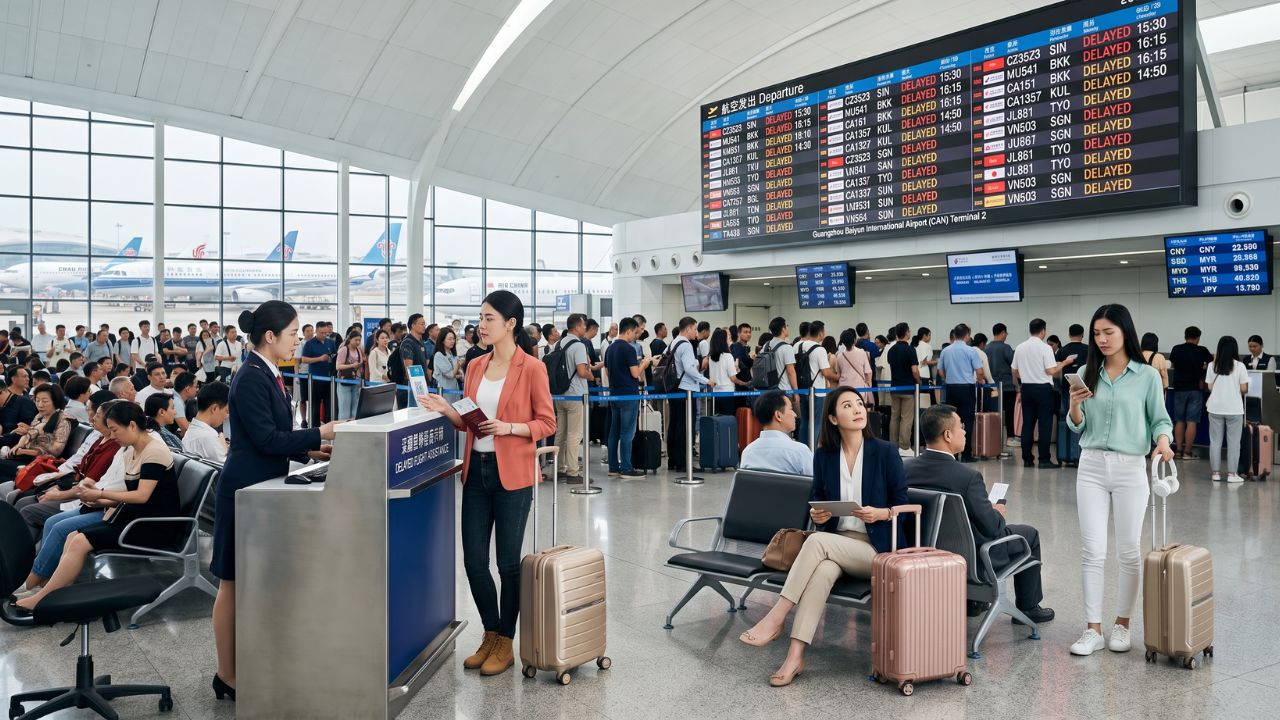
Image generated by AI
In a devastating operational collapse that has instantly ignited massive travel chaos across the entire Asia-Pacific network, Guangzhou Baiyun International Airport is currently enduring one of its busiest and most disruptive days of the summer. Today, June 17, 2026, the critical Southern China transit hub has been paralyzed by a staggering 485 delayed flights and 9 outright flight cancellations. This massive systemic failure has crippled operations for major domestic and international carriers, heavily ensnaring Air China, China Eastern Airlines, Hainan Airlines, and China Southern Airlines. While airlines are desperately attempting to keep aircraft flying, the sheer volume of delayed departures has triggered severe, cascading airport disruptions. Passengers connecting through Guangzhou to destinations across Singapore, Malaysia, Thailand, Vietnam, and Cambodia are currently facing agonizing terminal waits, entirely missed onward connections, and absolute logistical gridlock, making this massive infrastructure breakdown the premier headline in today's breaking airline news and absolutely vital global aviation updates.
By introducing direct passenger coordination and dynamic scheduling backups, the regional aviation hubs target growing passenger demand across vital commerce sectors. The choice to coordinate flight departures in phases helps to manage gate capacity, supporting the country's broader regional transportation network.
Context: The Breaking Point of Southern China's Gateway
For the thousands of global tourists, cross-border business executives, and domestic travelers trapped inside Guangzhou Baiyun today, the operational strain is translating directly into ground-level misery.
Historically, Guangzhou Baiyun serves as the ultra-efficient, primary transfer hub linking China with the broader Asia-Pacific. However, today’s figures reveal a terrifying pattern: the airport is operating under unsustainable heavy pressure. Instead of outright grounding their fleets, carriers have made the strategic, yet agonizing, decision to operate services massively behind schedule. This approach preserves physical connectivity but completely destroys itinerary timelines. China Southern Airlines, utilizing Guangzhou as its primary mega-hub, is single-handedly battling 190 delayed flights. This means that an inbound aircraft arriving late from Beijing instantly forces its next scheduled departure to Bangkok to be delayed, creating a massive, uncontrollable chain reaction across the entire network. This resulting travel chaos forces exhausted passengers to endure severe airport disruptions, overwhelming terminal security checkpoints, lounges, and customer service counters as travelers desperately attempt to salvage their ruined travel plans.
To view live flight schedules, verify your exact delay times, or to track active Chinese airspace restrictions, travelers must consult official aviation directories. For direct rebooking access into less-congested transit corridors, travelers should aggressively check the official airline portals for carriers like China Southern and Air China. To explore live flight tracking and monitor the exact severity of the regional airspace bottlenecks causing the flight cancellations you are trapped in, passengers can consult the official FlightAware tracking service.
Section-Wise Breakdown of the Guangzhou Gridlock
The Major Domestic Carriers: Absorbing the Shock
The "Big Three" Chinese airlines are bearing the absolute brunt of this disruption. China Southern prioritized schedule recovery over removals, resulting in zero cancellations but a devastating 190 delays (26% of its operations). Conversely, Air China registered the highest number of outright flight cancellations (4) alongside 37 delays, indicating massive scheduling challenges. China Eastern Airlines was severely crippled, suffering 3 cancellations and 65 delays—a massive 45% disruption rate that confirms aircraft rotations and crew scheduling completely collapsed under the pressure.
The Medium-Sized Operators: 50% Disruption Rates
Medium-sized operators were unable to escape the terminal gridlock. Hainan Airlines suffered 2 cancellations and 46 delays, meaning exactly half (50%) of its entire schedule was thrown into travel chaos. Similarly, XiamenAir reported a 50% delay rate (13 flights), while Shenzhen Airlines (42 delays), Spring Airlines (14 delays), and Sichuan Airlines (12 delays) saw massive portions of their fleets trapped on the tarmac, proving this is an airport-wide failure, not an isolated airline issue.
The International Ripple Effect
The congestion at Guangzhou Baiyun has aggressively infected regional international connectivity. Because they operate fewer flights, regional carriers suffered terrifying disruption percentages. Hebei Airlines recorded a 100% delay rate. Vietnam Airlines reached an agonizing 75% delay rate, and Tianjin Airlines hit 66%. Flag carriers like Malaysia Airlines, Singapore Airlines, Thai Airways, Scoot, and Cambodia Angkor Air all suffered delays, meaning the travel chaos originating in Guangzhou is currently causing missed connections and airport disruptions across airports in Southeast Asia.
Technical Roster: The Exact Delay and Cancellation Data
To ensure absolute factual accuracy regarding the specific airlines responsible for the current travel chaos, the exact percentages of delayed fleets, and the underlying operational causes of this massive gridlock, the following tables detail the exact integration data for June 17, 2026:
Guangzhou Baiyun Flight Disruption Statistics (Exact Data)
| Airline | Cancelled | Cancelled % | Delayed | Delayed % |
|---|---|---|---|---|
| Air China | 4 | 4% | 37 | 41% |
| China Eastern | 3 | 2% | 65 | 45% |
| Hainan Airlines | 2 | 2% | 46 | 50% |
| Beijing Capital Airlines | 0 | 0% | 7 | 43% |
| Zhejiang Loong | 0 | 0% | 5 | 27% |
| Shandong Airlines | 0 | 0% | 6 | 50% |
| West Air | 0 | 0% | 1 | 16% |
| Spring Airlines | 0 | 0% | 14 | 46% |
| Sichuan Airlines | 0 | 0% | 12 | 44% |
| Shanghai Airlines | 0 | 0% | 4 | 44% |
| China Southern Airlines | 0 | 0% | 190 | 26% |
| Shenzhen Airlines | 0 | 0% | 42 | 41% |
| China United Airlines | 0 | 0% | 2 | 50% |
| Urumqi Air | 0 | 0% | 1 | 50% |
| XiamenAir | 0 | 0% | 13 | 50% |
| Juneyao Airlines | 0 | 0% | 5 | 31% |
| Tianjin Airlines | 0 | 0% | 2 | 66% |
| Hebei Airlines | 0 | 0% | 2 | 100% |
| Vietnam Airlines | 0 | 0% | 3 | 75% |
| 9 Air | 0 | 0% | 20 | 29% |
| Cambodia Angkor Air | 0 | 0% | 2 | 50% |
| Kunming Airlines | 0 | 0% | 1 | 25% |
| Malaysia Airlines | 0 | 0% | 1 | 25% |
| Singapore Airlines | 0 | 0% | 1 | 25% |
| Tibet Airlines | 0 | 0% | 1 | 50% |
| Scoot | 0 | 0% | 1 | 50% |
| Thai Airways | 0 | 0% | 1 | 50% |
Root Causes of the Guangzhou Travel Chaos
| Operational Factor | Impact on Flight Network |
|---|---|
| Adverse Weather Patterns | Heavy rain and thunderstorms in Southern China reduce runway capacity and force aircraft holding patterns. |
| Air Traffic Congestion | High aircraft movement means minor interruptions instantly trigger a massive chain reaction. |
| Aircraft Rotation Failures | Inbound delays force outbound delays; aircraft cannot be serviced, refueled, or boarded on time. |
| ATC Flow Management | Authorities enforce massive spacing restrictions between aircraft to maintain safety, forcing delays over cancellations. |
Passenger Impact: The Nightmare of the Cascading Delay
For the thousands of tourists and business travelers trapped inside Guangzhou Baiyun today, the operational strategy of "delaying rather than canceling" is absolute psychological torture.
The immediate passenger impact is severe terminal gridlock. Because 485 flights are delayed but not officially canceled, passengers cannot leave the airport; they are trapped in crowded departure halls, staring at revised boarding times that continuously slip further into the night. Furthermore, for international travelers flying onward to Singapore, Thailand, or Vietnam, a 3-hour delay departing Guangzhou means a guaranteed missed connection upon arrival. This destroys tightly planned business meetings, cruise departures, and tour group itineraries. The customer service counters at Baiyun are entirely overwhelmed, forcing desperate passengers to rely on overloaded digital airline applications just to secure a hotel voucher or rebook onto a flight the following day.
Industry Analysis: The Cost of Preserving Connectivity
Aviation industry analysts view today's 485 delays at Guangzhou Baiyun as a textbook example of the massive economic and operational cost required to preserve connectivity during an infrastructure failure.
Analysts note that airlines actively chose to absorb the disruptions rather than execute mass flight cancellations. While this keeps the aircraft technically moving, it wreaks havoc on airline balance sheets. Airlines incur massive additional fuel costs keeping aircraft idling on taxiways, crew scheduling becomes illegally complex as pilots max out their legal duty hours, and aircraft utilization plummets. The industry consensus is that while keeping the cancellation figure down to a mere 9 flights is a technical achievement for China Southern and Air China, the resulting travel chaos severely damages passenger confidence in utilizing Guangzhou as a reliable transfer hub for Asia-Pacific travel.
Actionable Advice for Surviving the Guangzhou Gridlock
If you are trapped in Guangzhou Baiyun today, or flying through Southern China in the coming days, execute this strategic survival checklist immediately to navigate the severe travel chaos:
- Abandon Customer Service Desks: Do not wait in the physical line at the airport; the agents are overwhelmed. Use the airline’s mobile app or call their international customer service line (using Wi-Fi calling) to instantly rebook your missed connections before the physical line even moves.
- Never Leave the Gate Area: During cascading delays, airlines will frequently execute sudden, unannounced gate changes or initiate immediate boarding if an ATC slot unexpectedly opens. Stay precisely at your gate and listen to audio announcements.
- Retain All Boarding Passes and Receipts: Because the delay count is so massive, airlines will attempt to deny compensation later. Keep every single receipt for food and emergency airport lodging, and file a formal claim utilizing applicable consumer protection policies the moment you arrive home.
- Pad Your Connection Times: If you are booking future travel through Guangzhou during the summer storm season, never accept a 60-minute layover. Book itineraries with a minimum of a 4-hour buffer to absorb these inevitable, 485-flight delay events.
FAQ: Guangzhou Baiyun Disruption & Travel Chaos 2026
How many flights were canceled and delayed at Guangzhou today?
A massive 485 flights were delayed, while 9 flights were officially canceled, triggering severe travel chaos across the airport.
Which airlines experienced the most severe disruptions?
China Southern recorded an agonizing 190 delayed flights. Air China suffered the most cancellations (4) alongside 37 delays, while Hainan Airlines saw exactly 50% of its flights delayed.
Why did airlines choose to delay flights instead of canceling them?
Airlines prioritized schedule recovery to keep passengers moving, absorbing the impact of weather, air traffic congestion, and ATC spacing restrictions by delaying departures rather than completely removing flights from the network.
The Reality of Terminal Gridlock
The massive operational collapse at Guangzhou Baiyun International Airport today proves definitively that an exceptionally low cancellation rate does not equal a successful travel day. By choosing to push 485 flights back rather than ground them, airlines inadvertently triggered absolute, agonizing travel chaos, trapping thousands of exhausted passengers in terminal purgatory. As massive carriers like China Southern, Air China, and China Eastern desperately struggle to recover their shattered aircraft rotations—triggering severe airport disruptions and missed connections across the entire Asia-Pacific—travelers must accept a critical new reality: avoiding brutal travel anxiety during peak Asian congestion requires actively padding your itineraries, demanding digital rebooking, and bracing for the psychological endurance test of the cascading delay.
Key Takeaways
- Massive Infrastructure Strain: Guangzhou Baiyun International Airport suffered 485 delayed flights and 9 cancellations on June 17, 2026, triggering severe travel chaos.
- Major Carriers Paralyzed: China Southern recorded 190 delays, China Eastern suffered 65 delays (a 45% rate), and Air China recorded the most cancellations (4).
- The International Ripple: The delays heavily impacted international carriers, including Vietnam Airlines (75% delay rate), Singapore Airlines, and Thai Airways, causing missed connections across Southeast Asia.
- Root Causes: The gridlock is driven by southern China's volatile weather, intense ATC flow management restrictions, and severe aircraft rotation failures.
- Passenger Survival: Stranded travelers must utilize mobile apps for immediate rebooking, remain at their gates during cascading delays, and aggressively retain receipts for future compensation claims.
Related Travel Guides
Massive European Infrastructure Collapse Triggers 1,200 Delays
U.S. Airlines Suffer $1 Billion Loss Amid Fuel Chaos
Guangzhou Airport Survival Tactics and Rebooking Hacks on Reddit
Disclaimer
This article is for informational and educational purposes only. It does not constitute legal, financial, or professional advice. While we strive to provide accurate and up-to-date information, travel policies, regulations, and conditions change rapidly. Always verify information with official sources before making travel decisions. Nomad Lawyer makes no representations about the accuracy, reliability, completeness, or suitability of the information provided. Readers should consult qualified professionals for advice specific to their circumstances. The views expressed in this article are those of the author and do not necessarily reflect the views of Nomad Lawyer.
Kunal K Choudhary
Co-Founder & Contributor
A passionate traveller and tech enthusiast. Kunal contributes to the vision and growth of Nomad Lawyer, bringing fresh perspectives and driving the community forward.
Learn more about our team →