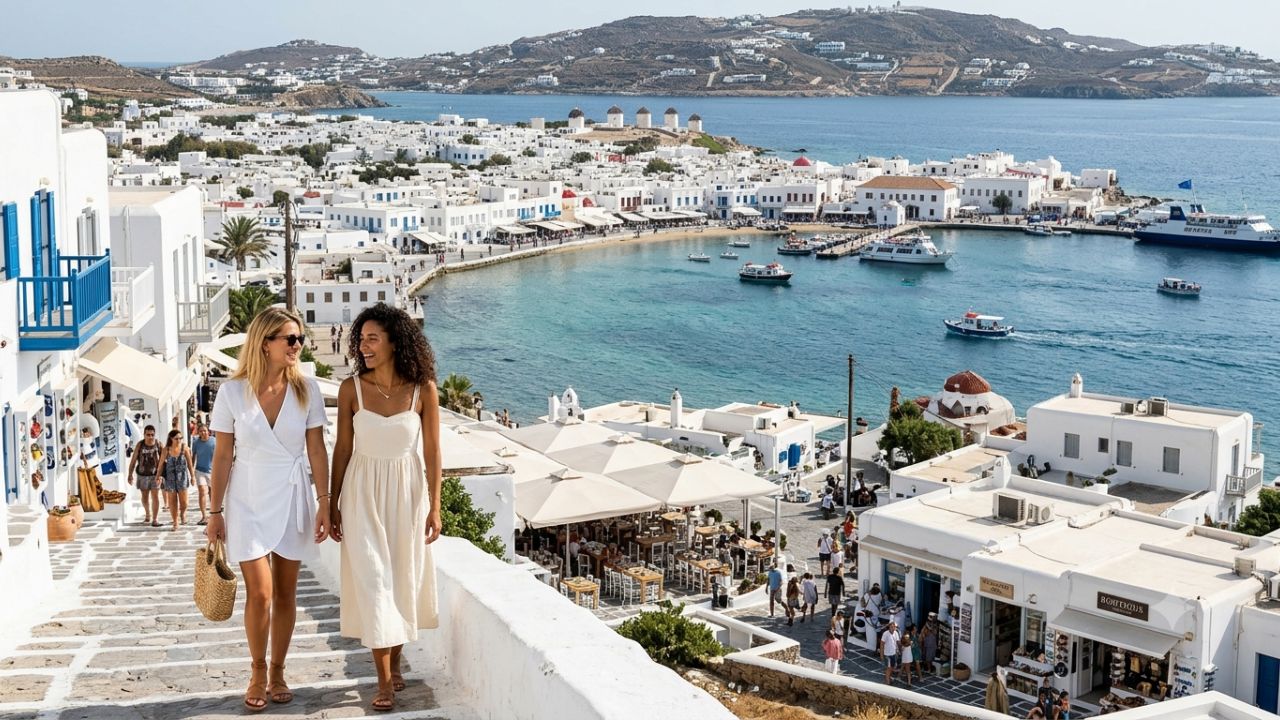
Greece Tourism Generates Record €4.87 Billion in August 2026 Boom: Germany, Italy, and UK Fuel Surge as Short-Stay Rentals Rise

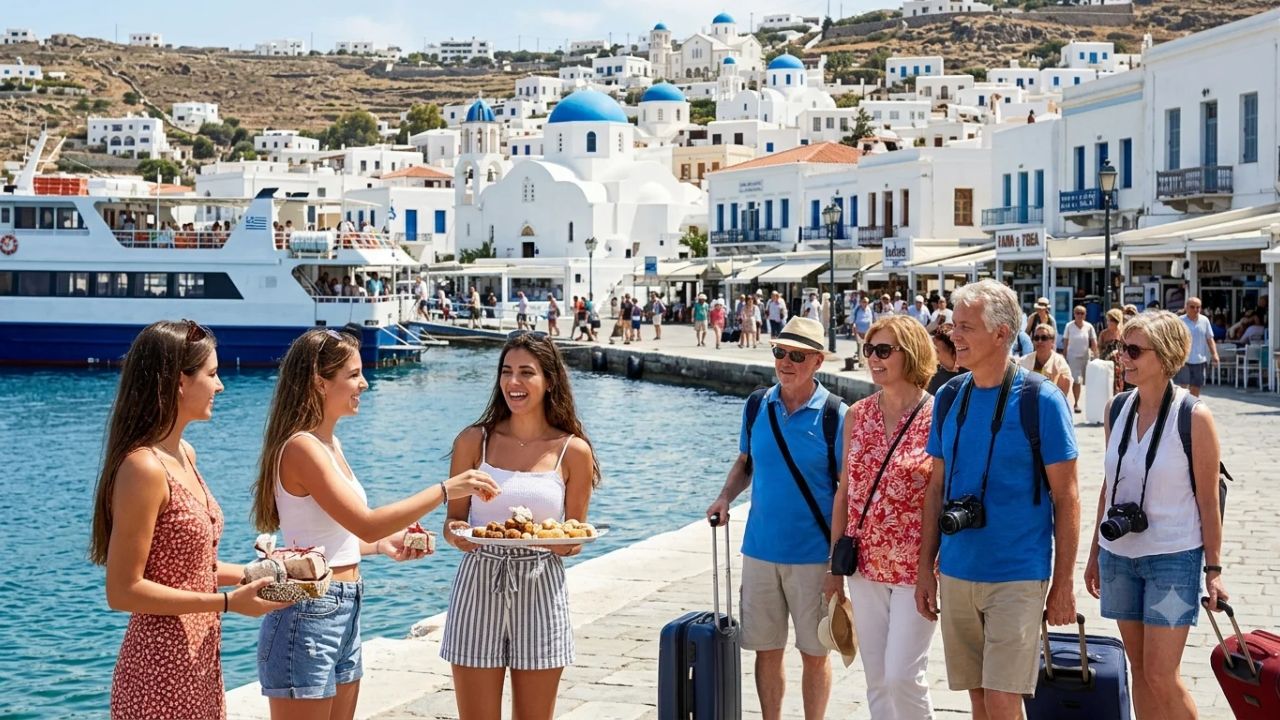
[ATHENS, Oct 22, 2026] — Greece’s travel economy achieved an all-time financial record in August 2026, generating €4.87 billion in travel receipts—a 6.5% year-over-year increase—as international arrivals reached 7,429,931 and total overnight stays exceeded 34.68 million across the mainland and islands.
[!NOTE]
Greece August 2026 Tourism Boom: Key Benchmarks
- Record Financial Output: Travel receipts climbed to €4.87 billion (+6.5% year-over-year), marking the most profitable single month in Greek tourism history.
- 7.43 Million Total Arrivals: Inbound visitor volume reached 7,429,931 (+2.6%), with international travelers accounting for 76.7% of all border crossings.
- Overnight Stay Dominance: Stays reached 34,685,695 nights (+2.1%), with foreign visitors generating 84.0% of all bed-nights.
- Length of Stay Disparity: Foreign visitors averaged 5.1 days per trip—nearly double the 3.2 days recorded by domestic Greek travelers—maintaining an overall national average of 4.7 days.
- Lead Inbound Source Markets:
- Germany: Undisputed volume leader with over 3.03 million visitors (+7.7% YoY) and an average stay of 5.3 days.
- United Kingdom: Heavyweight inbound driver generating over 2.27 million arrivals (+10.5% YoY), supported by direct flights from Jet2 and TUI to secondary islands.
- Italy: Fastest-growing major European market, surging +17.2% to approximately 1.20 million visitors, driven by Adriatic ferry links.
- France: High-yield cultural driver fueling boutique hotels and regional gastronomy across the Aegean and Peloponnese.
- Short-Stay Rental Acceleration: Independent short-stay rentals grew 5.2% in arrivals and 4.6% in overnight stays, outpacing traditional hotels and campsites (+1.5% arrivals, +1.1% stays).
The August performance demonstrates the structural shift underway in Greece’s visitor economy. Rather than concentrating solely in saturated tourist hubs like Santorini and Mykonos, international demand is dispersing toward secondary Aegean and Ionian islands, supported by expanded direct regional flight routes and high-speed Adriatic ferry connections.
          GREECE AUGUST 2026 INBOUND TOURISM FLOWS & GEOGRAPHY

  GERMANY (Volume Leader: #1)            ITALY (Fastest Surge: +17.2%)
  • 3.03+ Million Visitors (+7.7%)       • 1.20 Million Visitors
  • 5.3 Days Average Stay Duration       • Adriatic Sea Ferry Corridors
  • Resort Stays in Crete & Rhodes       • Independent Short-Stay Rentals
  +------------------+                   +------------------+
                     \                                     /
                      \                                   /
                       v                                 v
          +-------------------------------------------------------------+
          |             GREEK NATIONAL TOURISM SYSTEM (CMB)             |
          |       • €4.87 Billion Monthly Travel Receipts (+6.5%)       |
          |       • 7,429,931 Total Arrivals | 34,685,695 Overnights    |
          |       • Foreign Share: 76.7% Arrivals | 84.0% Overnight Bed |
          +-------------------------------------------------------------+
                       /                                 \
                      /                                   \
                     v                                     v
  UNITED KINGDOM (Growth: +10.5%)        FRANCE (High-Yield Cultural)
  • 2.27+ Million British Travelers      • Boutique Hotels & Gastronomy
  • Jet2 / TUI Point-to-Point Charters   • Mainland Heritage & Peloponnese
  • Regional Island Focus (Skiathos/Samos)• Elevated Daily Per-Capita Spend
The August Record: Macroeconomic Breakdown of a €4.87 Billion Milestone
August represents the commercial high-water mark of the Mediterranean holiday season, but the 2026 performance surpassed internal projections across both financial turnover and volume.
Total travel revenues climbed to €4.87 billion, expanding by 6.5% compared to August 2025. This financial momentum was driven by international visitors, who accounted for 76.7% of all arrivals and 84.0% of all overnight stays, spending significantly more per day than domestic holidaymakers.
While domestic Greek travelers recorded an average stay duration of 3.2 days, foreign visitors maintained an average stay of 5.1 days. This extended dwell time drove aggregate overnight stays to 34,685,695, representing a 2.1% year-over-year increase.
| Operational Metric | August 2025 Baseline | August 2026 Performance | Year-over-Year Shift | Foreign Traveler Contribution |
|---|---|---|---|---|
| Travel Revenue | €4.57 Billion | €4.87 Billion | +6.5% Growth | Dominant Revenue Component |
| Total Arrivals | 7,241,648 | 7,429,931 | +2.6% Growth | 76.7% Foreign Share |
| Overnight Stays | 33,972,277 | 34,685,695 | +2.1% Growth | 84.0% Foreign Share |
| Average Stay (Overall) | 4.7 Days | 4.7 Days | 0.0% (Stable) | 5.1 Days (vs 3.2 Days Domestic) |
| Short-Stay Rental Arrivals | Baseline Volume | +5.2% Growth | Outperforming Hotels | +5.5% Foreign Rental Inflow |
| Hotel & Campsite Arrivals | Baseline Volume | +1.5% Growth | Steady Base Volume | +1.9% Foreign Hotel Inflow |
Country-by-Country Inflow: Europe's Top Four Source Markets
Four major European outbound nations—Germany, the United Kingdom, Italy, and France—generated the overwhelming majority of inbound passenger volume and foreign exchange during the August peak.
       TOP SOURCE MARKETS BY ARRIVAL VOLUME & MOMENTUM (AUGUST 2026)

  GERMANY (3.03M Arrivals | +7.7% YoY)
  [████████████████████████████████████████ 3,030,000 Visitors ]

  UNITED KINGDOM (2.27M Arrivals | +10.5% YoY)
  [██████████████████████████████ 2,270,000 Visitors ]

  ITALY (1.20M Arrivals | +17.2% YoY - Fastest Surge)
  [████████████████ 1,200,000 Visitors ]

  FRANCE (High-Yield Cultural Focus across Mainland & Islands)
  [██████████ Strategic Value & High Daily Spend ]
1. Germany: The Volume Anchor and Long-Stay Benchmark
Germany retained its position as Greece's largest tourism source market by total passenger volume:
- Total Visitors: Exceeded 3.03 million arrivals in August, delivering +7.7% year-over-year growth.
- Length of Stay: German travelers recorded an average stay of 5.3 days, ranking among the highest across all inbound markets.
- Regional Deployment: German visitors filled capacity in both traditional four- and five-star coastal resort hotels and family-owned properties across Crete, Rhodes, Kos, and the Peloponnese.
Stable German consumer demand provided Greek hoteliers with predictable occupancy windows, allowing resort operators to sustain high average daily rates (ADR) without offering late-season discounts.
2. United Kingdom: Solid Expansion and Island Diversification
British holidaymakers formed the second-largest inbound contingent, driving strong revenue across Greek island hubs:
- Total Visitors: Exceeded 2.27 million arrivals, marking a +10.5% increase over August 2025.
- Aviation Connectivity: Major tour operators and leisure airlines, including Jet2 and TUI, added direct flight routes connecting regional UK airports (such as Manchester, Birmingham, Bristol, and Newcastle) directly to emerging Greek islands like Skiathos and Samos.
- Relieving Saturated Hotspots: By routing chartered flights directly to secondary islands, UK tour operators helped distribute visitor density away from congested destinations like Santorini, easing municipal infrastructure strain while stimulating local island economies.
3. Italy: The Fastest-Growing European Inbound Market
Italian travelers delivered the highest percentage increase among all major origin nations:
- Arrival Surge: Italian visitor numbers jumped +17.2% year-over-year, reaching approximately 1.20 million tourists.
- Transportation Dynamics: This influx was supported by expanded roll-on/roll-off (Ro-Ro) ferry routes crossing the Adriatic Sea from Italian ports like Bari, Brindisi, and Ancona directly into western Greek ports including Igoumenitsa, Corfu, and Patras.
- Lodging Preferences: Italian travelers showed a pronounced preference for independent short-stay rental apartments and multi-island hopping, driving substantial booking gains for private property owners across the Ionian and Cycladic islands.
4. France: High-Yield Cultural Tourism and Gastronomy
French visitors continued their targeted expansion across Greece's cultural tourism sector:
- Travel Preferences: French holidaymakers prioritized boutique hotels, historical archaeological routes, and gastronomy-focused travel across mainland Greece and less-visited Aegean enclaves.
- High Economic Contribution: French tourists posted elevated per-capita daily expenditure rates, spending heavily on local food services, guided excursions, regional maritime transit, and cultural site tickets.
The Accommodation Shift: Short-Stay Rentals Outpace Traditional Hotels
A defining characteristic of the August 2026 boom was the divergence in growth rates between independent short-stay vacation rentals and traditional hotels or campsites.
While full-service hotels and campsites accommodated the largest absolute volume of guests, short-stay rented rooms registered the fastest rate of expansion across both arrivals and overnight stays.
GREECE ACCOMMODATION PERFORMANCE METRICS (AUGUST 2026)
| Accommodation Tier | Overall Metric | Foreign Guest Shift | Domestic Guest Shift |
|---|---|---|---|
| Short-Stay Rented | Arrivals: +5.2% | Foreigners: +5.5% | Domestic: +4.2% |
| Rooms & Apartments | Overnights: +4.6% | Foreigners: +5.1% | Domestic: +2.2% |
| Avg Stay: 5.2 Days | (Foreign Average) | (Higher Private Rental Pref) | |
| Traditional Hotels | Arrivals: +1.5% | Foreigners: +1.9% | Domestic: +0.5% |
| & Campsites | Overnights: +1.1% | Foreigners: +1.2% | Domestic: +0.8% |
| Avg Stay: 5.1 Days | (Foreign Average) | (Steady Mass-Market Base) |
Explaining the Short-Stay Rental Surge
The 5.2% overall arrival growth in short-stay rented rooms (with foreign demand climbing +5.5%) reflects changing traveler priorities:
- Self-Sufficiency and Flexible Stays: Independent rentals offer kitchen amenities and separate living spaces, appealing to multi-generational European families and remote-working professionals.
- Geographic Dispersion: Unlike large resort hotels that require significant land and capital investment, short-stay rental properties exist in secondary villages, mountain settlements, and quiet island coves where traditional hotel inventory is limited.
- Island-Hopping Alignment: Independent travelers—particularly from Italy and France—use online booking platforms to coordinate multi-island itineraries, booking three-to-four-night stays across multiple destinations rather than committing to a single resort for an entire week.
Meanwhile, traditional hotels and campsites recorded steady performance, with arrivals rising 1.5% and overnight stays growing 1.1%, supported by chartered package holidays from Germany and the UK.
Structural Strategies: Why Greece Successfully Captured Demand
Greece’s ability to convert European travel appetite into €4.87 billion in August revenue was not coincidental. It resulted from coordinated operational planning between civil aviation authorities, regional ferry operators, and municipal tourism boards.
              GREECE TOURISM VALUE MAXIMIZATION MODEL

  REGIONAL AVIATION CORRIDORS             ADRIATIC MARITIME EXPANSION
  • Jet2, TUI Direct Regional Flights     • Daily Bari & Brindisi Ferry Runs
  • Direct Links: Skiathos, Samos, Chios  • Direct Vehicle Transit to Igoumenitsa
  +------------------+                    +------------------+
                     \                                      /
                      \                                    /
                       v                                  v
          +-------------------------------------------------------------+
          |             DECENTRALIZED ISLAND & MAINLAND HUBS            |
          |  • Redirecting Volume Away from Saturated Cyclades          |
          |  • Expanding Short-Stay Capacity in Secondary Municipalities|
          |  • Lengthening Foreign Stays to 5.1 Days (vs 3.2 Domestic)  |
          +-------------------------------------------------------------+
                                       |
                                       v
          +-------------------------------------------------------------+
          |                 MACROECONOMIC REVENUE RESULT                |
          | €4.87 Billion Monthly Receipts • +6.5% YoY Revenue Expansion|
          +-------------------------------------------------------------+
1. Expanding Regional Air Connectivity
Greek airport operator Fraport Greece and civil aviation planners expanded direct seasonal routes linking regional European airports directly to secondary Greek island gateways.
By facilitating point-to-point connections to islands like Skiathos, Samos, Zakynthos, and Kefalonia, airline operators bypassed Athens International Airport and avoided adding traffic to Santorini and Mykonos, where municipal authorities have introduced cruise ship disembarkation fees and visitor management measures.
2. High-Frequency Maritime Connections
Ferry operators deployed additional vessel capacity along Adriatic corridors linking Southern Italy to Western Greece, alongside enhanced inter-island catamaran services across the Dodecanese and North Aegean.
These maritime networks allowed budget-conscious and mobile travelers from Italy and the Balkans to bring private automobiles and campervans directly into Greece, driving economic activity in mainland transit hubs like Epirus and Western Greece.
3. Promoting Cultural and Gastronomic Tourism
Greek tourism marketing emphasized authentic cultural experiences, mountain hiking trails in the Peloponnese, and local culinary traditions. This approach resonated with French and German travelers, encouraging visitor spending in traditional tavernas, olive oil cooperatives, and boutique wineries outside major urban centers.
Environmental Infrastructure and Resource Pressures on Secondary Islands
The rapid geographic redirection of international travelers away from primary hubs like Santorini toward secondary islands has highlighted significant municipal and environmental considerations. While dispersing visitor volume prevents extreme bottlenecks in Oia or Fira, smaller island ecosystems possess fragile utility networks that face acute strain during the August peak.
       SECONDARY ISLAND UTILITY AND RESOURCE MANAGEMENT CYCLE

  INCOMING VISITOR SURGE (August Peak)
  • Direct International Charters to Secondary Gateways
  • Ro-Ro Ferries Delivering Passenger Vehicles
  +-------------------------------------------------------------+
                                 |
                                 v
  MUNICIPAL RESOURCE PRESSURES
  • Desalination Plants Running at Maximum Daily Capacity
  • Peak Electrical Demand on Subsea Interconnection Cables
  • Solid Waste Management and Septic Infrastructure Loading
  +-------------------------------------------------------------+
                                 |
                                 v
  REGULATORY & CLIMATE RESILIENCE MEASURES
  • Climate Resilience Levy Levied on All Commercial Lodgings
  • Reinvestment in Solar-Assisted Desalination Micro-Grids
  • Municipal Caps on Cruise Ship Disembarkations
Desalination Capacity and Energy Demands
Islands throughout the Cyclades and Dodecanese feature arid Mediterranean climates with negligible freshwater reservoirs. To sustain international guest consumption—averaging significantly higher water use per capita than permanent residents—local municipalities rely heavily on reverse-osmosis desalination facilities.
During August 2026, regional water utilities operated desalination units at sustained peak output. To avoid brownouts caused by surging air conditioning loads, the Greek Public Power Corporation (PPC) and independent grid operators accelerated the deployment of subsea high-voltage transmission cables, connecting islands like Skiathos and Samos directly to the mainland power grid.
Additionally, revenues generated by the national Climate Resilience Levy (introduced across all commercial tourist lodgings) provided dedicated capital for municipal governments to install battery storage arrays, expand solar-powered pumping stations, and upgrade wastewater reclamation systems.
Protecting Coastal Waters and Marine Reserves
The surge in private yacht charters and passenger ferries across western Greek waters has prompted maritime authorities to enforce strict anchoring regulations. In protected marine environments surrounding Zakynthos and Kefalonia, designated eco-moorings prevent anchor chains from uprooting vulnerable Posidonia oceanica seagrass meadows, which serve as essential carbon sinks and nurseries for endangered loggerhead sea turtles (Caretta caretta).
The Short-Term Rental Policy Balancing Act: Economic Growth vs. Housing
The rapid 5.2% growth in short-stay rental arrivals in August reflects both economic dynamism and a complex domestic policy landscape. As international travelers increasingly book independent apartments rather than conventional hotels, Greek authorities are managing the balance between investor returns and residential housing availability.
GREECE SHORT-STAY RENTAL ECONOMIC & REGULATORY MATRIX
| Entity / Route | Metrics | Operational Status |
|---|---|---|
| Dimension | Positive Economic Driver | Regulatory & Municipal Consideration |
| Geographic Reach | Channels foreign spend directly | Reduces long-term rental housing for |
| into residential island corners | seasonal teachers, doctors, and staff | |
| Local Supply Chains | Generates direct patronage for | Strains municipal trash collection |
| neighborhood bakeries & markets | and residential parking grids | |
| Fiscal Compliance | Integrated AADE digital registry | Strict caps on new licenses in dense |
| guarantees tax receipt capture | central urban districts of Athens | |
| Property Renovation | Incentivizes restoration of | Potential inflation of village |
| historic stone homes and mills | residential real estate prices |
Direct Economic Distribution to Local Suppliers
For small communities across mainland Greece and less-visited Aegean islands, independent short-stay accommodations act as direct wealth distributors. Guests staying in rented villas and apartments purchase groceries at village butcher shops, dine at local seaside tavernas, and hire independent car and boat rental services.
Economic data from August indicates that international short-stay guests spent a higher percentage of their overall budget on localized food and beverage services compared to all-inclusive resort guests, directly sustaining small family-run commercial enterprises throughout the winter off-season.
National Housing Safeguards and Digital Compliance
To safeguard long-term housing access for local service workers, healthcare personnel, and teachers, the Greek Ministry of National Economy and Finance alongside the Independent Authority for Public Revenue (AADE) has established stringent compliance frameworks:
- Mandatory Property Registration: Every short-stay rental property must display a verified Property Registry Number (AMA) on digital platforms, guaranteeing automatic tax reporting on rental income.
- Urban License Freezes: Targeted restrictions limit the issuance of new short-term rental permits in saturated central Athens neighborhoods, encouraging real estate investors to rehabilitate vacant buildings in secondary regional municipalities.
- Differentiated Climate Fees: Tiered environmental levies applied to private rental properties mirror standard hotel sustainability taxes, ensuring that independent accommodation owners contribute proportionally to local infrastructure maintenance.
Strategic Implications for the Wider Greek Travel Economy
The August 2026 data confirms several vital trends for Greek tourism stakeholders heading into the 2027 planning cycle:
- Foreign Travelers Anchor the Sector: With foreign travelers representing 84.0% of all overnight stays and outstaying domestic travelers (5.1 days versus 3.2 days), international source market stability remains essential for Greek economic health.
- Infrastructure Investment in Secondary Ports: Regional airports and municipal harbors require ongoing upgrades to handle direct wide-body charters and modern Ro-Ro ferries without creating dockside congestion.
- Regulatory Frameworks for Short-Term Rentals: While short-term rentals drive essential geographic dispersion, national authorities must balance property investor returns with local housing affordability in residential neighborhoods.
Frequently Asked Questions (PAA)
How much revenue did Greek tourism generate in August 2026?
Greek tourism generated €4.87 billion in travel earnings in August 2026, marking a 6.5% year-over-year increase and establishing a new record for monthly travel revenue in the country.
Which countries sent the most tourists to Greece during the August boom?
Germany was the volume leader, contributing over 3.03 million visitors (+7.7% YoY) with an average stay of 5.3 days. The United Kingdom followed with over 2.27 million travelers (+10.5% YoY), while Italy was the fastest-growing market, surging +17.2% to approximately 1.20 million visitors. France contributed high-spending cultural tourists.
How did foreign visitor stays compare to domestic Greek traveler stays?
Foreign tourists stayed an average of 5.1 days per trip in August 2026, compared to 3.2 days for domestic Greek travelers. Foreign visitors accounted for 76.7% of all arrivals and 84.0% of total overnight stays (over 34.68 million nights).
Why did short-stay rented rooms grow faster than traditional hotels?
Short-stay rented rooms saw total arrivals increase by 5.2% (with foreign demand up 5.5%), compared to a 1.5% arrival increase for hotels and campsites. Travelers increasingly preferred private rentals for multi-island hopping, kitchen facilities, and accommodations in secondary destinations lacking large resort hotels.
How did flight additions impact travel to Greek islands in August 2026?
Major European operators such as Jet2 and TUI added direct flight routes connecting secondary UK airports directly to emerging Greek islands like Skiathos and Samos. This diverted traffic away from congested hubs like Santorini and distributed tourist spending across lesser-known Aegean islands.
Related Travel Guides
- World’s 50 Best Restaurants 2026: 20 European Venues Claim Extended 51–100 List as Culinary Travel Expands Across 11 Nations
- Greece and UAE Forge $10 Billion Strategic Investment Alliance: 3-Year Agreement Unlocks Luxury Tourism, Energy, and Third-Country Market Expansion
- Mediterranean Travel Trends and Greek Island Hopper Discussions
This article is for informational purposes. Flight routes, passenger regulations, visa rules, and transit advisories are subject to change by airlines and aviation authorities. Readers are advised to verify schedules and travel documentation with relevant carriers and border agencies before departure.
Related Stories
Albania and Southern Europe Face Tourism Strains as Inflation Pressures and Anti-Overtourism Protests Reshape Travel Economics
Spain Tourism Employment Surpasses 3.25 Million in Q3 2026: Catalonia, Madrid, and Inland Regions Drive Record Job Growth