
Greece Places 50 Tourist Sites on Full Military Alert as Iran Threatens Global Tourism Infrastructure
Greece has activated emergency security protocols at 50 high-risk tourist destinations after Iran's military spokesperson threatened global tourist sites as retaliation targets. Warships and F-16s are now deployed around Cyprus. The US State Department has issued urgent travel warnings for American visitors to Greece and the Eastern Mediterranean.

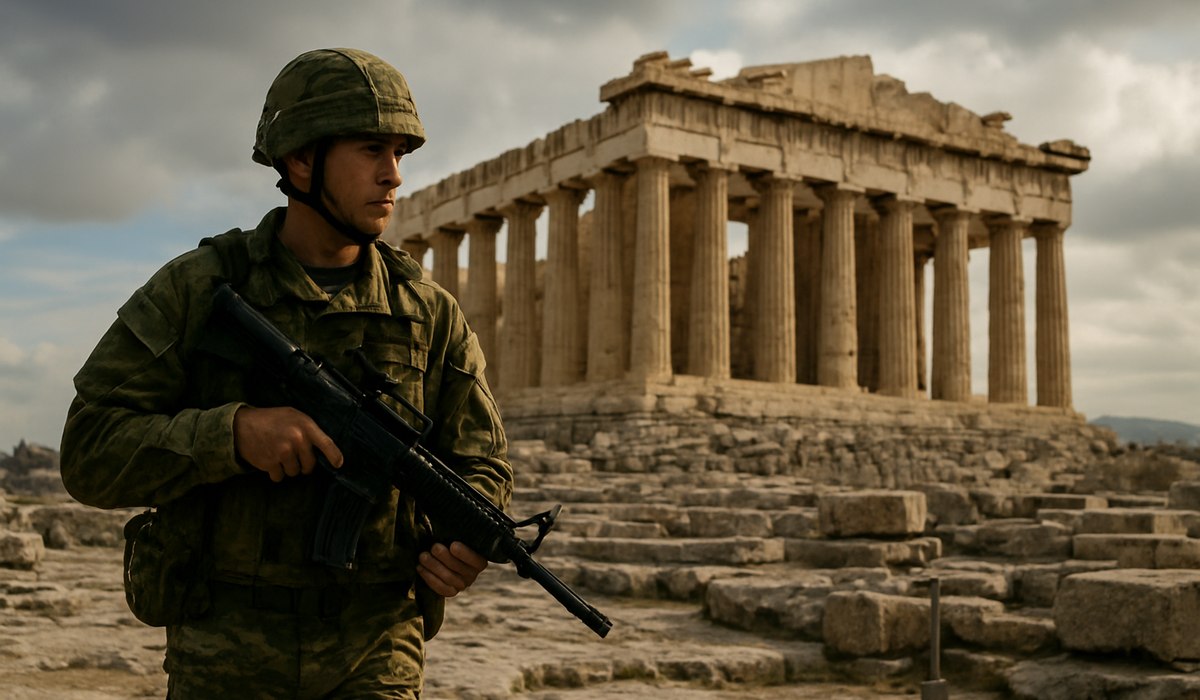
Image generated by AI
Greece Mobilizes Military to Shield Tourists as Iran Targets the World's Heritage Sites
Greece has escalated to a full military security posture after Iran's top military spokesperson issued alarming threatened retaliatory strikes against tourist sites globally—and the Greek government has taken those threats with deadly seriousness. Fifty high-profile potential target locations within Greek territory are now under continuous surveillance, fortified patrol protocols, and real-time threat monitoring. Simultaneously, the Greek government has deployed warships and F-16 fighter jets around Cyprus in a decisive demonstration of deterrence capability in the Eastern Mediterranean.
This is not a precautionary press release. This is a sovereign government mobilizing defense assets to protect its 32-million-annual-visitor tourism economy—a sector that accounts for roughly 20% of Greece's GDP—from explicit military threats issued by a hostile state actor.
The Iranian Threat: What Was Actually Said
Iran's military spokesperson issued an unprecedented warning: tourist sites worldwide could become legitimate targets for retaliation as part of Iran's military response to Western involvement in Middle Eastern conflict escalation. The statement sent immediate shockwaves through European tourism authorities.
For Greece, the threat is particularly pointed. The country possesses some of the world's most recognizable UNESCO World Heritage Sites—the Acropolis and Parthenon in Athens, the ancient theater of Delphi, the Palace of Knossos in Crete, and the iconic sunsets of Santorini—that collectively represent high-visibility, globally recognizable symbolic targets.
Greece's Emergency Security Response
The Greek government has implemented a multi-layered security hardening across its tourism infrastructure:
Land-Based Security Upgrades:
- 50 designated potential targets placed under continuous 24/7 surveillance
- Enhanced perimeter security and visitor screening at major archaeological sites including the Acropolis, Delphi, and Ancient Olympia
- Coordinated security protocols between the Hellenic Police tourism security unit and military intelligence
Naval and Air Defense Deployment:
- Greek Navy warships positioned in Cyprus-adjacent waters in the Eastern Mediterranean
- Hellenic Air Force F-16 fighter jets on rapid-response deployment around Cyprus
- These assets provide real-time intercept capability and a powerful geopolitical deterrence signal to Tehran
Intelligence Coordination:
- Direct intelligence-sharing protocols activated with EU and NATO allies
- US Department of State emergency briefings provided to the Greek Foreign Ministry
- IATA-coordinated threat assessment for Greek airspace security protocols
US Travel Warning: American Tourists Specifically Cautioned
The United States has issued an urgent travel warning specifically for American citizens visiting Greece and surrounding Eastern Mediterranean areas. This advisory is significant—the US historically avoids country-specific advisories for EU member states absent specific and credible threat data.
The warning does not recommend cancelling all Greece travel, but explicitly urges:
- Heightened situational awareness at all major tourist sites and archaeological areas
- Avoidance of large public gatherings and crowded tourist events
- Maintenance of flexible departure options in case of rapid security escalation
- Registration with the Smart Traveler Enrollment Program (STEP) before departure
What Guests Get
- Enhanced security presence at all major archaeological sites — the Acropolis, Santorini, Delphi, Crete, Rhodes, and Mykonos
- Military deterrence posture in the Eastern Mediterranean providing a visible security umbrella
- Embassy emergency services fully operational for all American, British, European, and Australian visitors
- Flexible rebooking options — most carriers serving Greece (British Airways, Ryanair, easyJet, Delta, United) have issued Mediterranean waivers
- Transparent threat communication from Greek authorities via official tourism safety portals
Greece Security Alert: Tourism Risk Assessment
| Factor | Status | Impact on Travelers |
|---|---|---|
| Military Threat Level | Elevated (Iran rhetoric active) | Heightened but not imminent attack confirmed |
| Tourist Site Security | 50 sites under enhanced protocols | Longer entry queues, bag checks, visible security |
| Naval/Air Presence | Warships + F-16s around Cyprus | Deterrence posture; no direct visitor impact |
| US Advisory Level | Increased Caution | Not Do Not Travel; exercise vigilance |
| Flight Status | All routes operational | No flight suspensions announced |
| Tourism Industry Status | Open and functioning | Some visitor hesitation on new bookings |
What This Means for Travelers
Greece remains open, functional, and operationally safe for tourism. The military deployment and security hardening are deterrence measures—they signal to Tehran that Greece is not an easy target, not that attack is imminent. Millions of tourists visit Greece every year without incident, and the country's security infrastructure and EU/NATO alliance membership provide substantial collective defense coverage.
However, the threat environment is objectively elevated compared to prior years. Practical actions for travelers with upcoming Greece bookings include: ensuring you have comprehensive travel insurance with political instability coverage, registering with your government's traveler registration program before departure, staying informed via official Greek tourism authority channels, and avoiding concentration in extremely large tourist crowds at symbolic sites during periods of heightened media attention.
For travelers considering new Greece bookings, the risk assessment remains favorable for anyone comfortable with NATO-member EU country security norms. Those with lower risk tolerance may prefer to reroute to less geopolitically exposed Mediterranean alternatives for the time being.
FAQ: Greece Iran Threat and Tourism Safety
Is it safe to travel to Greece right now? Greece continues to be open for tourism, and no attack has occurred. The security posture has been meaningfully upgraded. Greece's NATO membership, EU defense cooperation, and now forward-deployed military assets provide a robust deterrence framework. Travelers should exercise heightened vigilance and follow official advisories, but the country is not under active attack.
What are the 50 sites under enhanced security in Greece? The Greek government has not published a specific list, but the security envelope broadly covers high-profile archaeological sites (Acropolis, Ancient Olympia, Delphi), major island tourism infrastructure (Santorini, Mykonos, Rhodes, Crete), and critical maritime facilities. Visible security presence will be reinforced at all UNESCO World Heritage Sites.
Should I cancel my Greece booking? Check your travel insurance first. If you have "Cancel for Any Reason" coverage, you have the option to cancel without financial penalty. The US advisory is "Exercise Increased Caution" — Level 2 out of 4 — which does not recommend cancellation. Final decisions should factor in your personal risk tolerance, itinerary specifics, and insurance coverage.
Related Travel Guides
Greece Travel Safety Guide 2026: What Every Tourist Needs to Know
Eastern Mediterranean Cruise Safety: Port Risk Assessments for 2026
Travel Insurance for Political Instability: What's Actually Covered
Disclaimer
This article is for informational and educational purposes only. It does not constitute legal, financial, or professional advice. While we strive to provide accurate and up-to-date information, travel policies, regulations, and conditions change rapidly. Always verify information with official sources before making travel decisions. Nomad Lawyer makes no representations about the accuracy, reliability, completeness, or suitability of the information provided. Readers should consult qualified professionals for advice specific to their circumstances. The views expressed in this article are those of the author and do not necessarily reflect the views of Nomad Lawyer.
Raushan Kumar
Founder & Lead Developer
Full-stack developer with 11+ years of experience and a passionate traveller. Raushan built Nomad Lawyer from the ground up with a vision to create the best travel and law experience on the web.
Learn more about our team →