
Grand Paris Express Grésillons Interchange: New Line 15 Hub to Link Western Suburbs and Airports by 2030s
The Grésillons interchange in Gennevilliers is evolving into a strategic multimodal hub, connecting the RER C with the future automated Line 15 of the Grand Paris Express.

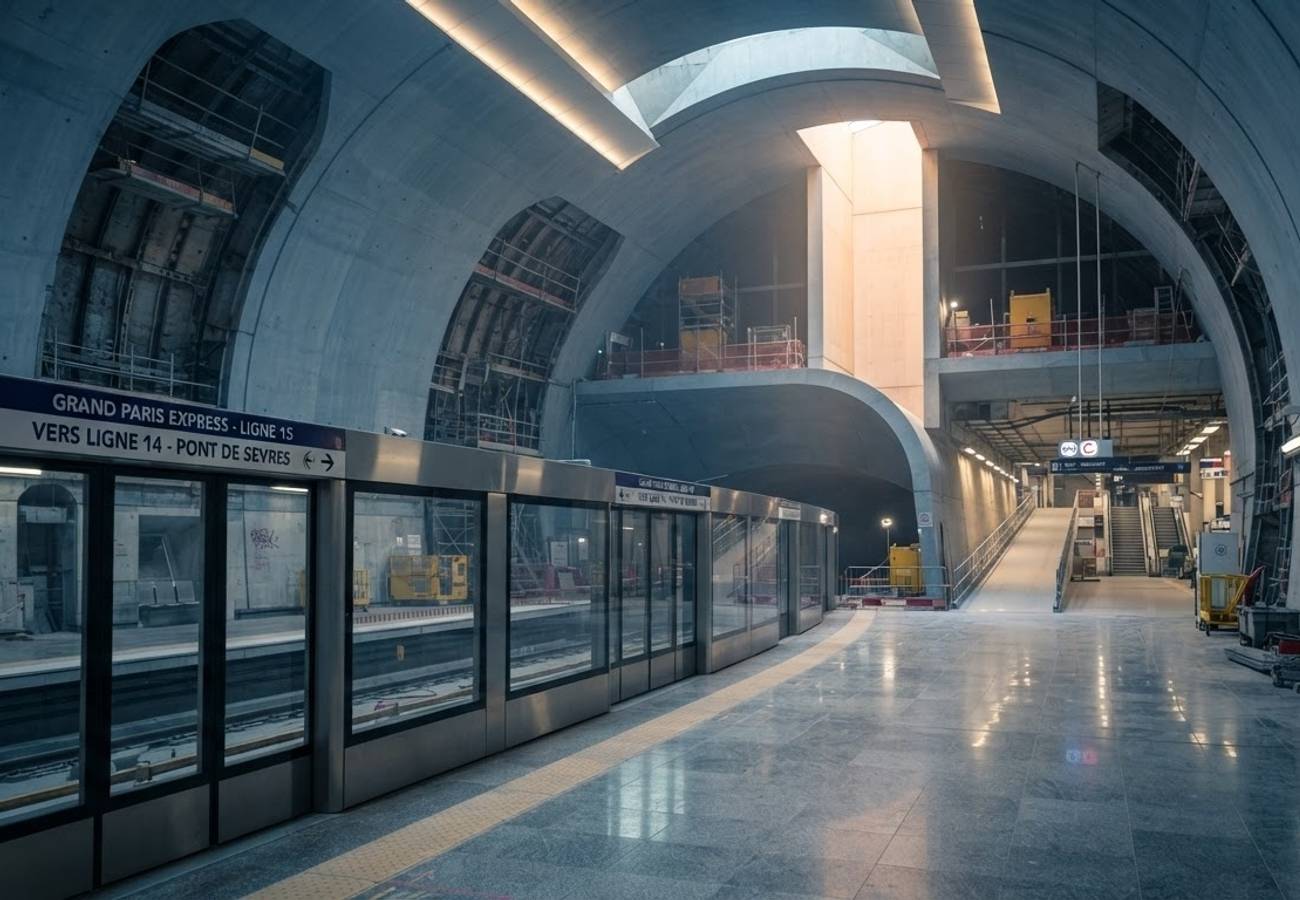
Image generated by AI
The development of the Grésillons interchange is establishing a critical new gateway between the western suburbs, central Paris, and major airport hubs. This multimodal node will integrate the existing RER C rail service with the future automated Line 15 of the Grand Paris Express.
Strategic Integration of Line 15 and RER C
Construction is currently underway in Gennevilliers, Hauts de Seine, to link the existing Grésillons RER C station with the future Les Grésillons metro station on Line 15 Ouest. Rather than operating as two distinct facilities, the design utilizes a dedicated passageway connecting the automated metro platforms directly to the RER C concourse.
Line 15 is designed as a high-frequency orbital ring, allowing passengers to traverse the suburbs without entering the congested center of Paris. Grésillons is positioned on the western arc between Pont de Sèvres and Saint Denis Pleyel, a segment characterized by high infrastructure density.
Our analysis of the project specifications indicates that Line 15 will be a fully automated, underground service. The Grésillons node is engineered to redistribute passenger flows across the region, utilizing diaphragm walls for the station box and complex vertical circulation systems to manage high passenger volumes.
Construction Timeline and Operational Milestones
Current project documentation and official transport authority data outline the following progression:
- Current Status: Works have transitioned from preparatory phases to heavy structural construction, focusing on underground walls and internal volumes.
- Tunneling: Active tunneling and station box assembly are progressing between Saint Denis Pleyel and Pont de Sèvres.
- RER C Adaptations: Île de France Mobilités is currently reconfiguring access routes and upgrading passenger areas at the existing RER C station to meet emergency and accessibility standards.
- Target Opening: Regional planning documents target the early 2030s for the full operation of the northern and western arcs of Line 15. Previous estimates cited 2030 or 2031.
Regional Impact: Connectivity and Airport Access
The Grésillons hub shifts the Paris transport model from a radial system (center-out) to a polycentric one. By linking the RER C to the Line 15 orbital ring, travelers from Gennevilliers and Asnières gain streamlined access to:
- Business Districts: Direct paths to La Défense and Saint Denis Pleyel.
- Airport Hubs: Enhanced indirect links to Paris Charles de Gaulle (CDG) and Paris Orly, allowing travelers to bypass central bottlenecks.
- Public Services: Faster transit to universities and hospitals located along the orbital ring.
For the international traveler, this means a reduction in reliance on traditional congested terminals such as Châtelet, Saint Lazare, or Gare du Nord when moving between the outskirts and the city.
Passenger Rights and Travel Advisory
While the Grésillons hub is a future development, the current construction phase impacts existing RER C users. For the affected passenger, this means:
- Service Disruptions: Coordination between Grand Paris Express and RER C is ongoing, but passengers should anticipate temporary changes to access routes and station facilities.
- Rebooking Rights: Under current French rail transport guidelines, passengers facing significant delays due to infrastructure works are entitled to real-time information and alternative routing provided by the operator.
- Accessibility: The integration of new accessibility standards means that once complete, the hub will offer seamless transfers for passengers with reduced mobility (PRM) between the RER and the automated metro.
Our analysis suggests that travelers should utilize official Île de France Mobilités alerts to monitor short-term disruptions in the Gennevilliers sector.
Industry Analyst View
The Grésillons project is a microcosm of the broader urban transformation occurring in the Île de France region. By decoupling suburb-to-suburb travel from the central city core, the Grand Paris Express is effectively expanding the economic footprint of the capital.
The integration of automated systems on Line 15 represents a significant leap in capacity and frequency. From an infrastructure perspective, the use of diaphragm walls in a confined urban setting at Grésillons demonstrates the high technical complexity required to modernize one of the world's densest transit networks without halting existing services.
The catalyst effect is already visible in local zoning; municipal documents indicate that the station is driving mixed-use developments, including new housing and office spaces, turning a transit stop into a regional economic engine.
The transition to a polycentric Paris is no longer a concept, but a concrete reality manifesting in the tunnels of Gennevilliers.
Related Travel Guides
Disclaimer
This article is for informational and educational purposes only. It does not constitute legal, financial, or professional advice. While we strive to provide accurate and up-to-date information, travel policies, regulations, and conditions change rapidly. Always verify information with official sources before making travel decisions. Nomad Lawyer makes no representations about the accuracy, reliability, completeness, or suitability of the information provided. Readers should consult qualified professionals for advice specific to their circumstances. The views expressed in this article are those of the author and do not necessarily reflect the views of Nomad Lawyer.
Preeti Gunjan
Contributor & Community Manager
A passionate traveller and community builder. Preeti helps grow the Nomad Lawyer community, fostering engagement and bringing the reader experience to life.
Learn more about our team →