
Frankfurt Airport Suspends New Terminal 3 Sky Line Train, Triggering Immediate Travel Chaos and Ground Disruptions: Latest Airline News
Just weeks after its grand opening, the massive Sky Line automated transit system at Frankfurt Airport has been abruptly taken offline, forcing frantic passengers onto emergency shuttle buses.

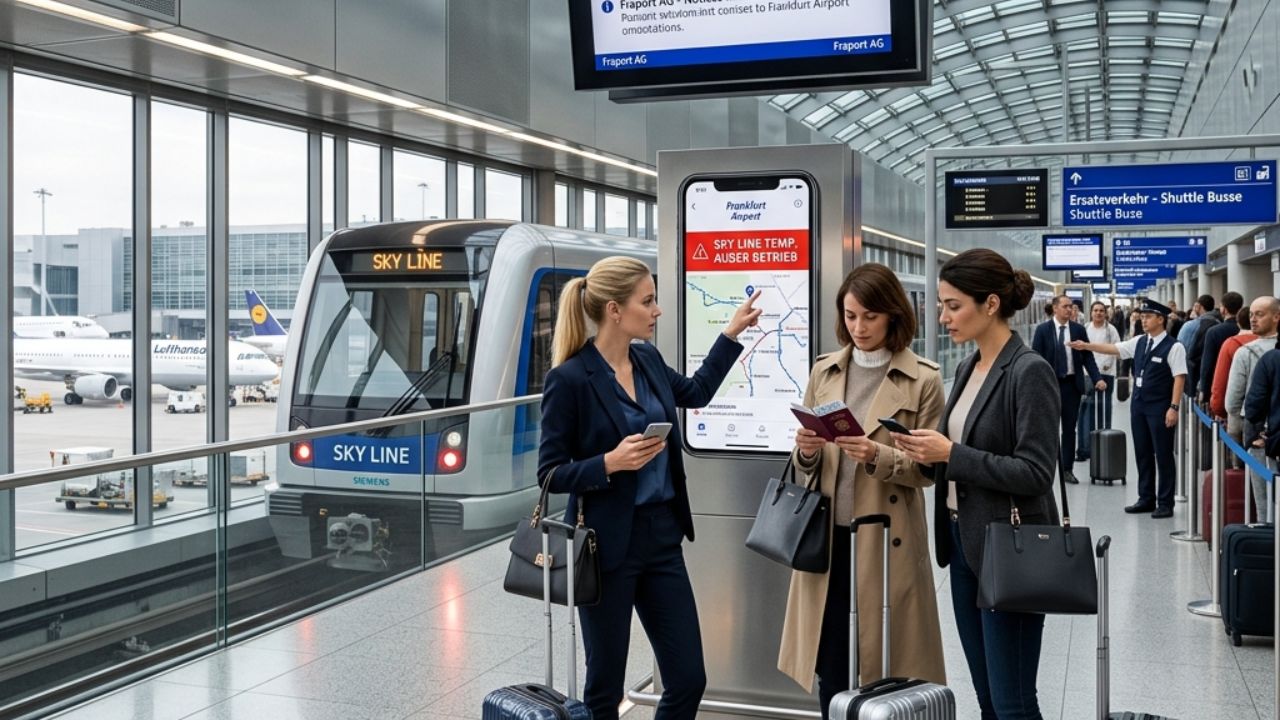
Image generated by AI
A Massive Infrastructure Disruption in Germany
While massive international transit hubs across North America and Europe are currently buckling under the intense pressure of severe flight cancellations and overwhelming airspace congestion, a highly localized, fiercely disruptive infrastructure failure is currently paralyzing ground operations at one of Europe's most critical aviation gateways. Delivering highly urgent, breaking airline news, verified industry reports confirm that Frankfurt Airport (FRA) has abruptly suspended operations of its multi-billion-euro Terminal 3 Sky Line people mover. While travelers at other regional hubs desperately attempt to navigate sudden weather delays, these exclusive aviation updates reveal that operator Fraport AG has been forced to take the brand-new, fully automated train system offline due to severe technical anomalies. By unexpectedly severing this vital transit artery just weeks after its highly publicized grand opening, this massive logistical failure has triggered immediate travel chaos on the ground, creating devastating airport disruptions that threaten to entirely dismantle aggressive 45-minute flight connection windows.
Expanded Overview: The Scale of Frankfurt’s Vital Artery
The sudden execution of this system suspension serves as a massive, undeniable example of how rapidly highly engineered modern infrastructure can cascade into logistical failure. Navigating a massive international transit hub is a delicate balancing act of absolute precision and exact timing. For decades, Frankfurt Airport has stood as the undisputed crown jewel of European aviation, seamlessly shifting millions of global travelers between continents.
The new Sky Line train was engineered to resolve a massive spatial challenge. With the highly anticipated opening of Terminal 3 on the extreme south side of the airfield, Frankfurt Airport absolutely required a lightning-fast, high-capacity link to tie the new facility directly into the legacy infrastructure at Terminals 1 and 2, as well as the sprawling regional train stations. Developed in close partnership with Siemens Mobility, the automated people mover system was built on the globally proven Val platform. Spanning a massive 5.6-kilometer double-track route, the fleet of custom-built, 11-meter-long vehicles was designed to run fully automatically around the clock. Moving up to 4,000 passengers per hour at speeds reaching 80 km/h, this high-frequency schedule guaranteed an 8-minute inter-terminal transfer window. Without it, the airport's carefully optimized connection matrix completely collapses.
Section-Wise Breakdown of the Transit Disruption
Why the High-Tech System Reached a Standstill
According to highly guarded statements from airport stakeholders and Fraport technical teams, the sudden decision to temporarily take the massive train fleet offline stems directly from highly concerning data gathered during the initial weeks of high-volume passenger testing. While the system successfully cleared preliminary, empty test runs, the sheer, crushing volume of actual daily passenger traffic violently exposed critical anomalies.
Engineers identified severe irregularities in track synchronization, automatic braking tolerances, and localized digital communication between the driverless cars and the main central control center. “When launching a mega-project of this scale, safety and absolute system predictability take precedence over everything else,” noted an internal operations engineer. Taking the entire system offline allows Siemens Mobility and Fraport engineers to aggressively conduct deep-dive track inspections and massive calibration updates. Because the vehicles operate on angled wheels surrounding a heated guide rail, technical teams are frantically focusing on verifying mechanical wear patterns and fine-tuning software scripts to entirely eliminate life-threatening communication lags.
Navigating the Disruption: Alternate Transit Plans
To prevent absolute gridlock across the tarmac, Fraport has rapidly deployed an extensive, highly aggressive emergency contingency plan. Terminal operations teams have established a comprehensive, high-frequency express shuttle bus network running continuously between all three massive passenger terminals. While these express shuttle buses actively attempt to bridge the massive physical gap across the airfield, ground transport is naturally subject to brutal airport apron traffic, massive baggage cart congestion, and active roadway constraints, making transit highly unpredictable.
Verified Frankfurt Contingency Transit Table
To fully comprehend the highly severe operational parameters and massive logistical breakdown dictating this ground collapse, the following table explicitly details the exact temporary transit routes and heavily delayed transit times currently in effect:
| Transfer Type | Temporary Alternative Route | Estimated Transit Time |
|---|---|---|
| Terminal 1 to Terminal 2 | Existing Legacy Sky Line Train System (Unaffected) | 3–5 Minutes |
| Terminal 1/2 to New Terminal 3 | High-Frequency Express Shuttle Bus Fleet | 12–15 Minutes |
| Rail Station to Terminal 3 | Dedicated Ground Shuttle Pick-Up Zones | 15 Minutes |
Passenger Impact: Budgeting for Severe Delays
For the modern global tourist and international connecting traveler, the passenger impact of this massive ground disruption is physically exhausting and highly anxiety-inducing. The modern demographic heavily relies on the promised 8-minute transfer windows to seamlessly execute highly aggressive 45-minute international flight connections.
With the Sky Line system completely dead in the water, travelers connecting through Frankfurt to or from flights at the massive new Terminal 3 are strongly, urgently advised to budget an absolute minimum of an additional 15 to 20 minutes for their transfers. Passengers are forced to drag heavy luggage onto crowded ground shuttles, enduring incredibly frustrating delays as buses navigate active aircraft taxiways. This severe ground friction vastly increases the terrifying risk of missed connections, entirely ruining carefully planned international itineraries.
Industry Analysis: The Realities of Modern Airport Logistics
From a macroeconomic and industry operations perspective, this incident highlights a highly terrifying reality for modern airport planners. Travel analysts fiercely argue that the temporary pause of the new Sky Line train serves as an incredibly stark reminder of how rapidly operational dynamics can shift at a major international hub when massive technological integration fails under real-world pressure.
Interestingly, Frankfurt is not the only major European hub aggressively transforming its transit layouts. Further northeast, Latvia’s aviation gateway is undergoing a massive evolutionary leap with the RIX Airport City project. Just like Frankfurt’s multi-tiered expansion, these large-scale infrastructure overhauls aggressively demonstrate that airports are shifting from simple transit platforms into massive, high-tech ecosystems. However, when these automated systems fail, they instantly drag the entire airport network back into the dark ages of slow, inefficient ground transport.
Conclusion: Ensuring Long-Term Stability for Fraport
The sudden, highly publicized suspension of the Terminal 3 Sky Line is exponentially more than a routine technical pause—it represents a massive, highly visible failure of Frankfurt's highly touted expansion reliability. While Fraport and Siemens Mobility heavily emphasize that this is a precautionary measure designed to protect the long-term integrity of a multi-billion-euro investment, the immediate reality for travelers is absolute chaos. By aggressively identifying and correcting these subtle alignment issues now, engineers hope to eventually guarantee decades of safe transit. Until then, passengers traveling through Germany’s largest hub must remain highly vigilant, deeply adaptable, and fully prepared for massive ground delays.
Key Takeaways
- Massive System Failure: Frankfurt Airport (FRA) abruptly suspended its brand-new, multi-billion-euro Terminal 3 Sky Line train due to critical technical anomalies.
- Engineering Flaws: The driverless people mover suffered severe irregularities in track synchronization, braking tolerances, and automated communication.
- Contingency Deployed: Fraport has aggressively deployed a massive fleet of high-frequency express shuttle buses to transport passengers across the 5.6-kilometer gap.
- Severe Connection Risks: Transit times to Terminal 3 have aggressively ballooned to 15+ minutes, destroying the previously guaranteed 8-minute inter-terminal transfer window.
- Passenger Warning: Travelers connecting through Frankfurt are urgently advised to budget significant extra time for ground transfers to avoid missing international connections.
Disclaimer: The specific transit delay metrics, technical anomalies, and alternative route schedules presented in this report are based on verified operational statements regarding the suspension of the Sky Line train at Frankfurt Airport. Official causes for this massive infrastructure breakdown, subsequent software calibration timelines, and final system reactivation dates are highly volatile and subject to continuous, real-time update. Affected passengers are urgently advised to monitor official Fraport advisories and allow significant extra time for all terminal transfers.
Disclaimer
This article is for informational and educational purposes only. It does not constitute legal, financial, or professional advice. While we strive to provide accurate and up-to-date information, travel policies, regulations, and conditions change rapidly. Always verify information with official sources before making travel decisions. Nomad Lawyer makes no representations about the accuracy, reliability, completeness, or suitability of the information provided. Readers should consult qualified professionals for advice specific to their circumstances. The views expressed in this article are those of the author and do not necessarily reflect the views of Nomad Lawyer.
Kunal K Choudhary
Co-Founder & Contributor
A passionate traveller and tech enthusiast. Kunal contributes to the vision and growth of Nomad Lawyer, bringing fresh perspectives and driving the community forward.
Learn more about our team →