
Flight Disruptions Mount at Cairo International Airport in April 2026
Flight disruptions mount at Cairo International Airport with 106 delays and five cancellations stranding hundreds of passengers across routes to London, Dubai, and Riyadh in April 2026.

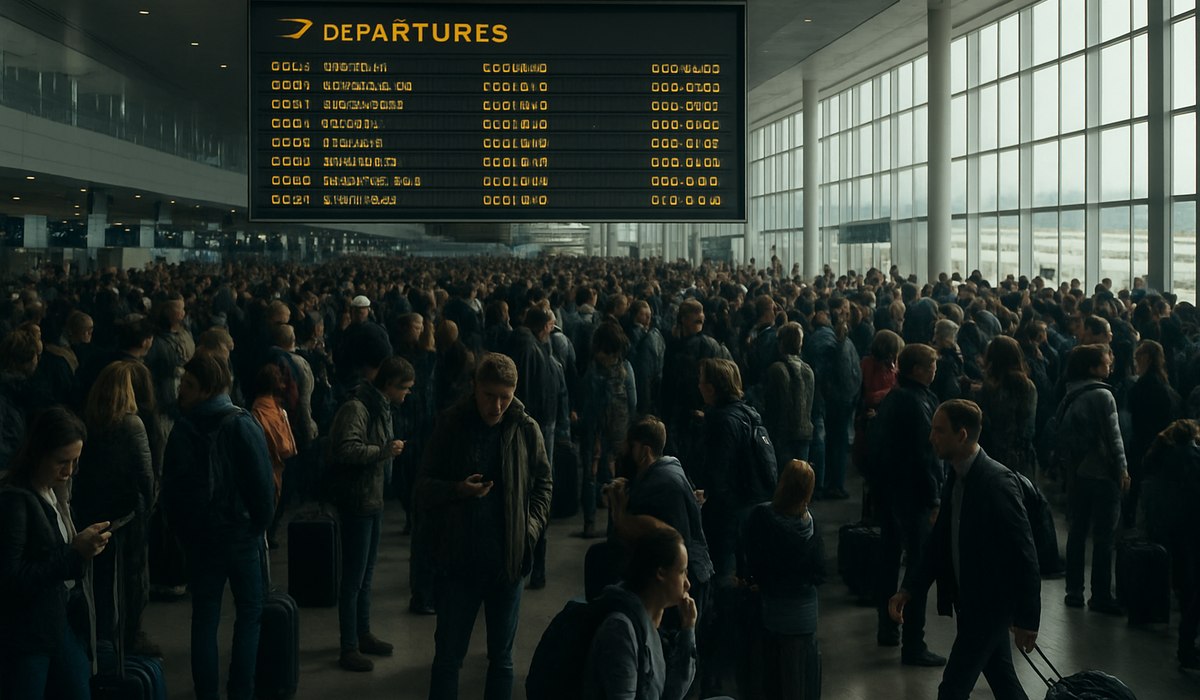
Image generated by AI
Cairo International Airport Grinds Under Operational Pressure
Cairo International Airport confronted severe operational strain on April 8, 2026, as flight disruptions mount across critical Middle Eastern and European corridors. A single day of cascading delays claimed 106 affected services and five full cancellations, stranding hundreds of passengers attempting connections through Egypt's busiest aviation hub. The disruption rippled across essential routes linking Cairo with London, Dubai, Riyadh, and Amman, compounding travel chaos during peak spring season when regional airspace remains fragile following March's heightened tensions and temporary restrictions.
Hundreds Stranded as Cairo Airport Faces Operational Crisis
When flight disruptions mount simultaneously across a hub airport, the mathematics of delay become devastating for passengers. Transfer desks, departure gates, and customer service counters at Cairo International transformed into overflow holding areas as travelers faced repeated departure time pushbacks extending hours beyond initial schedules. Connecting passengers endured the cruelest impact: those arriving late from Riyadh or Dubai missed onward flights to London entirely, forcing rebooking onto overnight services or expensive alternative routes.
The airport's role as a critical junction for African, Gulf, and European traffic meant that even localized bottlenecks cascaded into network-wide disruption. Ground handling congestion, aircraft turnaround delays, and crew scheduling conflicts fed into one another, creating a domino effect that persisted throughout the afternoon and evening. Many passengers reported confusion at departure information systems, where airline apps and airport departure boards updated at inconsistent intervals, leaving travelers uncertain about actual departure windows for hours.
Regional Instability Compounds Hub Bottlenecks
The operational fragility affecting Cairo International reflects broader Middle Eastern aviation instability that began in early March 2026. Heightened regional tensions forced airlines to implement temporary airspace restrictions and rerouting protocols, forcing consolidation of services onto remaining available corridors. Though many restrictions eased by April, the operational recovery remained incomplete.
Spring travel demand collided with constrained aircraft availability and tight turnaround schedules at Cairo, amplifying the cascade effect. Once morning rotations began running late, delays migrated through subsequent afternoon and evening flights in predictable sequence. Airlines eventually cancelled select sectors to reset schedules entirely, acknowledging that recovery had become operationally impossible without hard stops. This reset strategy, while necessary, left additional passengers stranded and forced overnight accommodations for travelers originally scheduled on cancelled flights.
The combination of external instability and internal hub capacity limitations created conditions where single-point failures rippled catastrophically across networks. A delayed inbound flight meant late aircraft positioning, missed crew connections, and eventual cancellations on dependent downstream services.
Cascading Effect: How Cairo Disruptions Ripple Across Three Continents
Cairo International Airport's geographic centrality means operational failure there affects three continents simultaneously. European operations dependent on Cairo connections faced morning delays that ultimately pushed London-bound passengers into afternoon arrival windows. African services relying on Cairo as their primary international transfer point experienced cascading rebooking sequences extending for days. Gulf operations, particularly flights to Dubai and Riyadh, felt immediate impact on their own schedules when Cairo congestion prevented timely aircraft rotation.
The interaction between Cairo's disruption and separate operational challenges at Dubai International created compounded passenger confusion on route pairs connecting both hubs. When both Cairo and Dubai experienced elevated delays simultaneously—Dubai facing over one hundred delays during similar April 2026 periods—passengers on multi-leg journeys experienced rolling uncertainty across multiple flight segments with no clear recovery timeline.
Real-time information lag contributed significantly to passenger frustration during the crisis. Departure boards updated at different intervals than airline mobile applications, creating contradictory information about actual departure readiness. Passengers standing at gates waiting for boarding calls received different departure times from check-in agents, creating widespread confusion about schedule reliability.
Which Airlines and Routes Bear the Heaviest Impact
EgyptAir, Egypt's largest carrier and dominant player at Cairo International, absorbed disproportionate disruption impact. The airline operates substantial capacity on London and Gulf routes where flight disruptions mount most severely. Recent operational data showed dozens of EgyptAir late departures and concentrated cancellations during April 8's peak disruption period.
Flynas, which connects Cairo with major Saudi Arabian cities including Riyadh, operated under sustained pressure on regional schedules. Flight tracking platforms documented elevated delay ratios on Flynas Cairo-Riyadh services, demonstrating how congestion at either endpoint rapidly spills into the other airport's operations.
Nile Air and Air Cairo, both important short and medium-haul operators from Egypt, faced double-digit delay impacts on selected days, particularly on services feeding Gulf destinations and regional centers like Amman. For all four carriers, the spring demand surge combined with aircraft availability constraints and minimal turnaround buffers created impossible operational mathematics.
The routes absorbing heaviest impact included Cairo-London (premium long-haul corridor), Cairo-Dubai (critical Gulf business link), Cairo-Riyadh (major regional connection), and Cairo-Amman (essential Middle Eastern regional service). Each affected route carried 200+ passengers daily, meaning that five cancellations potentially stranded 1,000+ travelers requiring rebooking across alternative services.
Live Flight Status and Real-Time Tracking
Travelers monitoring disruptions could reference FlightAware for real-time delay and cancellation data, which typically updates more frequently than airline systems during operational crises. The platform displayed affected flight statuses, estimated gate times, and crew/aircraft positioning information that helped passengers understand whether delays stemmed from mechanical issues, ground handling, or cascading inbound problems.
Checking FAA (for transatlantic flights impacted by Cairo operations) and respective Middle Eastern aviation authorities provided authoritative operational context, though international flight disruptions require cross-border coordination that occasionally experienced communication delays during peak crisis periods.
What This Means for Travelers
Passengers facing Cairo International connections during operational disruption periods should implement immediate protective strategies:
-
Check flight status before departing for the airport using FlightAware or your airline's official app, refreshing every 15 minutes during crisis periods.
-
Contact your airline immediately upon receiving disruption notification to discuss rebooking options before queues form at airport service desks.
-
Verify transfer window adequacy by calculating minimum connection times against actual gate positions; 90 minutes often proves insufficient during Cairo disruption when ground handling extends.
-
Purchase travel insurance covering trip delay and missed connection scenarios, ensuring coverage triggers at defined delay thresholds (typically 6-12 hours).
-
Consider alternative routing through less-congested hubs like Istanbul or Doha if Egypt-Europe connectivity remains unreliable during your travel window.
-
Request written delay confirmation from airlines for eventual compensation claims under international aviation regulations, preserving documentation for EU261 (Europe) or similar compensation schemes.
Traveler Action Checklist
-
Download FlightAware and enable real-time notifications 24 hours before departure through Cairo International.
-
Contact your airline's customer service line before arriving at the airport if your flight displays delay status.
-
Confirm transfer time adequacy against Cairo airport minimum connection guidelines (typically 2+ hours for international-to-international transfers).
-
Photograph your boarding pass and itinerary for documentation if rebooking becomes necessary.
-
Request written delay statements from airlines documenting actual departure times versus scheduled departure times.
-
Submit compensation claims through the US Department of Transportation at transportation.gov/airconsumer (for US-related flights) or local aviation authorities.
-
Preserve all receipts for meals, accommodation, and ground transportation during delay periods for potential reimbursement claims.
FAQ
Q: What caused the April 8, 2026 flight disruptions at Cairo International? A: Flight disruptions mount at Cairo due to regional operational instability from March 2026 tensions, constrained aircraft availability, tight turnaround schedules, and spring peak
Disclaimer
This article is for informational and educational purposes only. It does not constitute legal, financial, or professional advice. While we strive to provide accurate and up-to-date information, travel policies, regulations, and conditions change rapidly. Always verify information with official sources before making travel decisions. Nomad Lawyer makes no representations about the accuracy, reliability, completeness, or suitability of the information provided. Readers should consult qualified professionals for advice specific to their circumstances. The views expressed in this article are those of the author and do not necessarily reflect the views of Nomad Lawyer.
Kunal K Choudhary
Co-Founder & Contributor
A passionate traveller and tech enthusiast. Kunal contributes to the vision and growth of Nomad Lawyer, bringing fresh perspectives and driving the community forward.
Learn more about our team →