
Aviation Updates: FAA Shuts Down Washington Reagan Airport Triggering Independence Day Travel Chaos
As catastrophic logistical bottlenecks severely paralyze major transit grids, the FAA shuts down Washington Reagan Airport, guaranteeing massive July 4th flight cancellations and travel chaos.

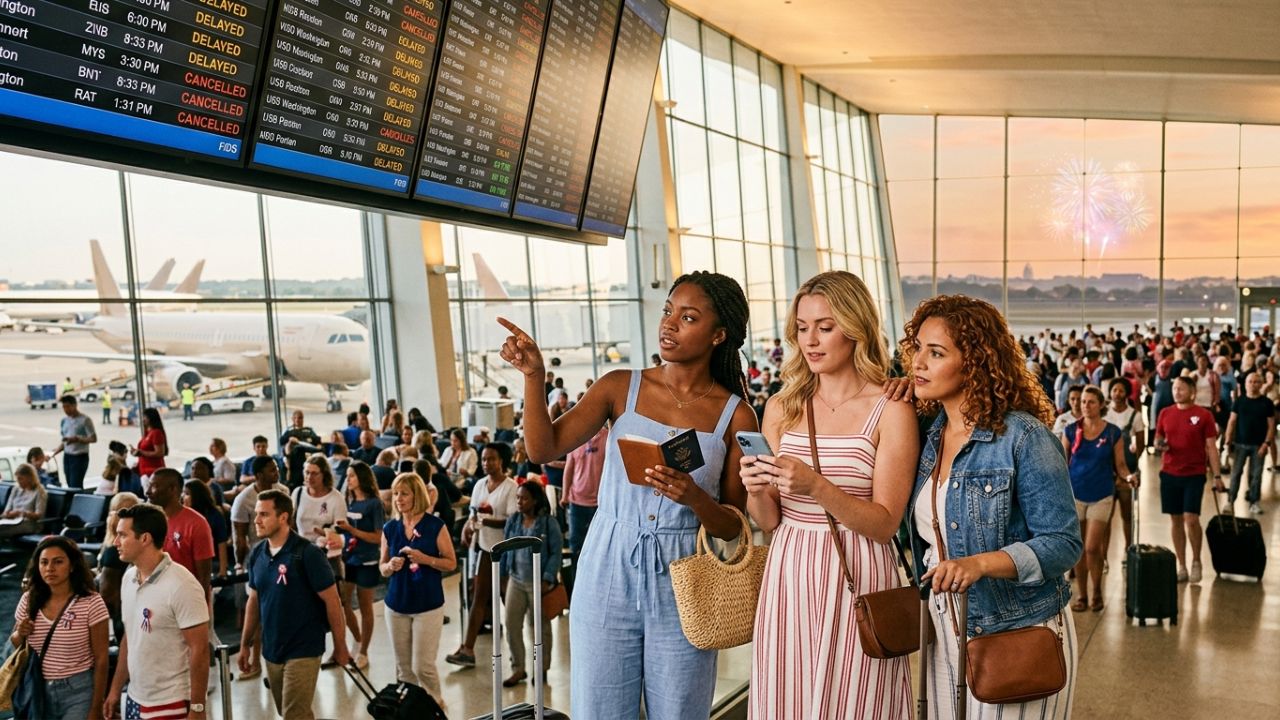
Image generated by AI
Aviation Updates: FAA Shuts Down Washington Reagan Airport Triggering Independence Day Travel Chaos
As extreme operational friction and suddenly compounding infrastructure bottlenecks continue to terrorize standard travel itineraries, the Federal Aviation Administration has violently triggered systemic domestic network failure by officially closing Washington Reagan Airport during the peak July 4th holiday.
Image generated by AI
[Washington, July 1] — As high-impact airline news platforms rapidly issue continuous, grim aviation updates regarding the intense fragility of massively congested primary transit grids, preparing for an absolute structural meltdown has officially become an international traveler's only defense mechanism. Amidst widespread rolling travel chaos, severe airport disruptions, and the terrifying threat of devastating flight cancellations severely plaguing heavily overcrowded mega-hubs, the Federal Aviation Administration (FAA) has aggressively initiated a massively controversial airspace lockdown. According to highly verified federal security alerts, the FAA is officially, temporarily shutting down all commercial operations entirely at Ronald Reagan Washington National Airport (KDCA). This incredibly severe airport closure is actively scheduled for July 3 and July 4, 2026, violently crashing directly into the absolute busiest, most highly congested travel days of the massive Independence Day holiday. This severe airspace suspension is aggressively, instantly paralyzing domestic travel, violently forcing primary network carriers—including American Airlines, Delta Air Lines, and United Airlines—to frantically reschedule thousands of highly critical flights across the Eastern Seaboard.
Background Context: The 250th Anniversary Airspace Lockdown
To fully comprehend the sheer scale of this severe operational evolution, commercial aviation analysts must closely examine exactly how massive federal security protocols violently reshape terminal stability and domestic transit economics.
The situation aggressively driving this massive wave of flight cancellations has rapidly worsened as the FAA officially announced the highly restrictive temporary suspension of all standard operations at KDCA. The FAA will fiercely manage the capital airspace exclusively through a severe series of highly restricted warnings regarding the KDCA temporary closure. This massive, planned KDCA closure is explicitly designed strictly to facilitate highly complex, extremely dangerous low-altitude military flyovers, massive large-scale fireworks deployments, and intense national security activities. These highly restricted operations are all completely integral parts of the massive, enhanced federal security measures actively commemorating the highly anticipated 250th anniversary of the United States Independence Day celebrations. The planned closure will violently create a massively disruptive, temporary controlled travel choke point and a severe series of incredibly strict no-fly periods exactly during the absolute most congested traveling times of the massive summer holiday.
Section-Wise Breakdown: Navigating the NOTAM Closures
Terminal operations and aircraft fleets are violently transforming across competing hubs, forcing major domestic operators to furiously deploy highly advanced operational frameworks to strictly ensure they mitigate massive financial losses during the federal shutdown.
The FAA NOTAM Windows: The highly planned KDCA airport closure is absolutely not a simple, clean full-day cessation of all flights. Instead, it is a highly structured, incredibly complex time-block restriction consisting strictly of scheduled, heavily controlled pauses entirely designed to allow the safe, highly delicate integration of civilian aviation directly with a high concentration of multiple, fast-moving military flyovers. Formal FAA NOTAM (Notice to Air Missions) alerts were aggressively issued, heavily blocking both commercial and general aviation directly in and completely out of the highly sensitive capital airspace. The absolute key closure windows aggressively include a daytime operational hours temporary suspension on July 3, followed immediately by a massive, highly extended shutdown directly during the absolute peak celebration period on July 4.
The Ripple Effect on Airline Rotations: Because Washington DC mathematically sees incredibly high levels of heavily concentrated domestic travel, even incredibly small operational disruptions violently trigger a massive, cascading impact directly on the national flight grid. Massive airplane rotations actively operating within the US airline system are structurally, incredibly tightly interconnected. Due directly to these highly fragile factors, the East Coast network is one of the absolute most highly sensitive systems explicitly for severe disruptions to US travel, especially during a massive surge period like Independence Day. Not having enough physical runways explicitly to rapidly accommodate the sudden, massive increase in heavily delayed flights immediately after a federal closure guarantees chaos caused directly by severely disrupted, timed-out flight staff and massive extra congestion at interconnected terminals in heavily reliant cities.
Carrier-Specific Mitigation Strategies: Due directly to American Airlines’ incredibly dense, highly concentrated domestic network explicitly tied to Washington DC, the massive airline holds one of the absolute highest operational exposure levels. Their aggressive adjustments consist of heavily pushing more East Coast arrivals actively onto the timetable, aggressively utilizing alternative connecting hubs exclusively for massive passenger re-booking, and managing a severely reduced flexibility entirely to adjust to the incredibly tight closure windows. Delta Air Lines has furiously made several heavily preventative adjustments: flights explicitly bound for Washington DC will aggressively depart at a completely new, much earlier time, aircraft have been heavily shifted to actively reduce tarmac congestion at KDCA, and a new policy increases the heavy use of regional alternative airports. United Airlines is actively battling ripple delays across its national network by actively changing DC flights, heavily providing connection protection specifically for highly vulnerable long-haul passengers, and aggressively adjusting peak hour flights less heavily to maintain basic route stability.
Strategic Details: Verified Washington KDCA FAA Closure Disruption Matrix
To ensure stranded passengers and commercial aviation analysts can accurately track the incredibly precise operational telemetry of this massive airspace lockdown, the verified structural data has been consolidated into the exact, mandatory matrix below.
| Airline Operator | Affected Routes / Hubs | Disruption Type & Timing |
|---|---|---|
| American Airlines | DCA ⇄ Dallas, Miami, Charlotte, Chicago | Delays, Rebooking (July 3 & 4) |
| Delta Air Lines | DCA ⇄ Atlanta, New York, Minneapolis | Rescheduling (July 4 Peak) |
| United Airlines | DCA ⇄ Newark, Chicago, Houston | Gate holds, Slot adjustments |
| Southwest Airlines | Indirect Connectivity (Nearby Airports) | Secondary weekend ripple delays |
| JetBlue Airways | Northeast Links (Boston, New York) | Aircraft repositioning delays |
| Regional (PSA, Envoy, Republic) | Short-haul DCA Feeder Flights | Ground holding, missed rotations |
(Source: FAA NOTAMs and US Airline Operational Patterns)
Impact Analysis: The Catastrophic Cost of Systemic Delay
Air travel explicitly across massive global transit corridors continues to massively struggle, driven violently by incredibly fragile air traffic flow constraints and severely overloaded security infrastructures.
The massive US travel disruption actively spreading across airline networks is absolutely not cleanly confined exclusively to Washington DC. The highly interconnected hub-and-spoke structure of US commercial aviation actively means the severe impact is entirely systemic. The devastating consequences violently include massive flight delays explicitly due to a highly critical lack of sufficient, legally rested staff to reposition highly displaced aircraft. Passengers are heavily missing incredibly critical connecting flights simultaneously in multiple major cities. There is intense, massive schedule compression actively severely impacting flights explicitly over shorter domestic routes. Furthermore, the massive disruption has violently affected absolutely all smaller regional carriers actively operating within the USA explicitly due to their heavy, absolute reliance on massive hub operations. Regional airline feeder flights (such as PSA, Envoy, and Republic) will absolutely arrive late, highly valuable scheduled flight slots actively in the system will be entirely missed, and aircraft will violently suffer from severely delayed, heavily cascading turnaround times.
Why This Matters: Adapting to Federal Airspace Control
Ultimately, the aggressive, massive deployment of military assets directly over a primary civilian travel hub actively marks a massively significant victory for national security optics over civilian transit efficiency. The FAA cares absolutely most about the strict safety of the highly sensitive airspace and successfully coordinating massive national events, but the absolute truth is this strict lockdown will violently, fundamentally disrupt civilian travel. Military flights operating heavily at incredibly low altitudes directly over heavily populated parts of Washington DC during mass public celebrations mandate that the airspace will be totally off-limits for almost all civilians.
As major global carriers furiously attempt to actively manage heavily restricted airspace, the ultimate modernization heavily of the massive domestic network firmly depends absolutely on passenger adaptability. If you hold tickets explicitly to travel strictly to or through Washington DC in early July 2026, you are significantly better off making highly aggressive plans explicitly to avoid these massive interruptions now. Highly recommended actions fiercely include aggressively checking flight status often heavily before going to the airport, rebooking early if travel actively occurs directly within the closure windows, and aggressively utilizing alternate, highly functional airports like Baltimore or Dulles.
Key Takeaways
- FAA Airspace Lockdown: The FAA is officially closing Ronald Reagan Washington National Airport (KDCA) on July 3 and July 4, 2026, for the 250th Independence Day celebrations.
- Military Priority: The airspace closures will explicitly facilitate highly complex, low-altitude military flyovers and massive national fireworks displays.
- Big Three Disrupted: American Airlines, Delta Air Lines, and United Airlines are facing massive operational overhauls, including holding patterns, schedule compression, and rerouted itineraries.
- Regional Airline Failure: Short-haul feeder flights operated by regional partners (PSA, Envoy, Republic) face the highest disruption rate due to ground holding and missed crew rotations.
- Systemic Ripple Effects: The massive delays in DC will cause a cascading domino effect across the US hub-and-spoke system, guaranteeing missed connections in secondary cities.
FAQ: Washington Reagan KDCA Airport Closure 2026
Why is Washington Reagan Airport (KDCA) closed on July 4, 2026? The Federal Aviation Administration (FAA) is temporarily closing KDCA to control the airspace and ensure the safe completion of military flyovers and massive fireworks displays for the 250th anniversary of Independence Day.
Which airlines are most affected by the KDCA closure? Due to their massive volume of traffic to Washington DC, American Airlines, Delta Air Lines, and United Airlines are facing the most severe operational disruptions and schedule adjustments.
Are all flights at KDCA cancelled on July 3 and 4? Not all flights are cancelled. The closure is structured as time-block restrictions (daytime suspension on July 3, extended shutdown on July 4). Flights outside these FAA-controlled no-fly windows may operate but will face heavy delays.
What should I do if my flight to DC is delayed? Passengers are strongly advised to check their flight status constantly, rebook early if scheduled during a closure window, and consider utilizing alternative airports such as Baltimore/Washington International (BWI) or Washington Dulles (IAD) to bypass the chaos.
Related Travel Guides
TSA CMAP Biometric Crew Fees Travel Chaos 2026
Delta Airlines Austin Paris Expansion Travel Chaos 2026
Lufthansa Airbus A350 Boeing 777x Travel Chaos 2026
Disclaimer: This article is strictly for informational and aviation tracking purposes. The specific operational telemetry (KDCA closure times, FAA NOTAMs) and federal security protocols (military flyovers, airspace restrictions) are based on verified analytics data available at the time of publication. Security wait times, airport weather delays, localized air traffic congestion, and strict airspace lockdowns are highly dynamic and subject to immediate modification by the operating authorities. Passengers navigating the global aviation grid should explicitly verify exact terms, conditions, and real-time transit alerts via official travel portals prior to departure.
Disclaimer
This article is for informational and educational purposes only. It does not constitute legal, financial, or professional advice. While we strive to provide accurate and up-to-date information, travel policies, regulations, and conditions change rapidly. Always verify information with official sources before making travel decisions. Nomad Lawyer makes no representations about the accuracy, reliability, completeness, or suitability of the information provided. Readers should consult qualified professionals for advice specific to their circumstances. The views expressed in this article are those of the author and do not necessarily reflect the views of Nomad Lawyer.
Kunal K Choudhary
Co-Founder & Contributor
A passionate traveller and tech enthusiast. Kunal contributes to the vision and growth of Nomad Lawyer, bringing fresh perspectives and driving the community forward.
Learn more about our team →