
Europe's Digital Border Revolution: 29 Countries Launch Mandatory Biometric Passport Scans in 2026
The EU's Entry/Exit System is now live across 29 Schengen nations. UK travelers must undergo facial recognition and fingerprint scanning at borders. Here's what you need to know.

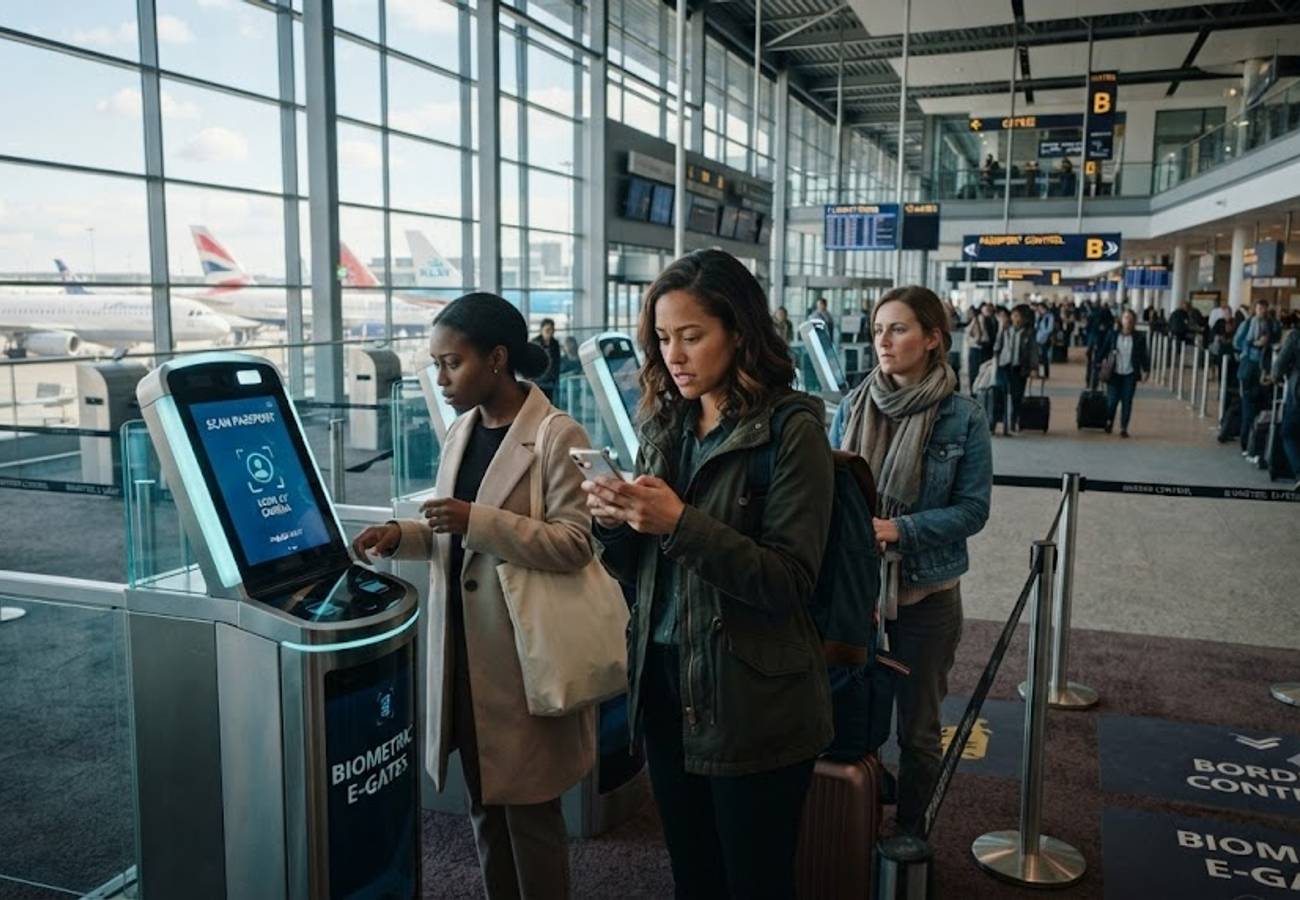
Image generated by AI
The Ink Stamp Era Officially Ends Across Europe
The European Union has finalized deployment of its transformative Entry/Exit System (EES) across 29 participating nations, permanently replacing traditional ink passport stamps with mandatory biometric facial recognition and digital fingerprint tracking. This marks the most significant overhaul to continental border control in over three decades—and it's happening right now.
Third-country nationals, including United Kingdom passport holders, can no longer simply flash a passport at a border officer. The system is live. The cameras are rolling. And your holiday timeline just shifted.
Reddit: "Just flew into Spain yesterday and spent 45 minutes at the biometric kiosk. Plan extra time or you'll miss your connection." — r/travel
Why the EU Ditched Ink Stamps for Digital Fingerprints
The mathematics of border control failed. Traditional ink stamps—vulnerable to fading, forgery, and human error—made it nearly impossible for authorities to track whether travelers overstayed their mandatory 90-day short-stay window. A smudged passport created a security blind spot.
The new EES infrastructure eliminates this vulnerability through centralized electronic record-keeping. Every facial scan, every fingerprint, every entry and exit gets logged into a secure EU database accessible to all participating nations. The system stores comprehensive travel histories for up to three years, providing border authorities with immediate, uncompromised visibility over who enters and exits the zone.
Passport forgery becomes infinitely harder when biometric data is cross-referenced against international crime databases. Visa overstayers trigger automatic alerts. The entire continental border apparatus becomes transparent and interconnected.
Which 29 Countries Are Now Scanning Your Fingerprints
The newly activated digital infrastructure is operational at international airports, maritime ports, and rail terminals across nearly the entire Schengen zone.
Major holiday hotspots now fully enforce the mandate: Spain, France, Greece, Portugal, Italy, Austria, Germany, Netherlands, Belgium, and Luxembourg. Northern escapes including Iceland, Norway, and Switzerland have also deployed the biometric kiosks, despite remaining outside the formal EU bloc.
Here's the critical exception: The Republic of Ireland and Cyprus remain completely exempt from this system. Travelers heading to Dublin or Paphos will bypass digital registration entirely, continuing with traditional entry rules.
Your New Airport Border Experience: What to Actually Expect
This is where the system impacts your actual travel plans. Arriving at any participating European checkpoint now requires a standardized, multi-step digital interaction.
Upon first arrival, you must register at a dedicated electronic terminal. The system captures a high-definition facial photograph and scans four of your fingerprints to create a unique digital profile. Border officials will ask specific questions: purpose of stay, accommodation details, proof of return travel, financial means.
The initial registration takes several extra minutes—plan accordingly. But here's the efficiency payoff: subsequent entries within the three-year window require only a rapid digital passport scan, designed to eventually accelerate your passage through terminal gates.
The process is entirely free of charge.
Reddit: "Second time through EES was literally 30 seconds. They remember your face now." — r/travel
Who Gets to Skip the Biometric Kiosks
Not everyone from the UK faces the scanning mandate. Several clearly defined groups bypass the system entirely:
British dual nationals holding official Irish or Cypriot citizenship can avoid the digital registration. Individuals with formal residence permits or long-stay visas for Schengen member states skip the biometric queues. Non-EU nationals who are immediate relatives of EU citizens and hold official residence cards are protected from the mandate.
Diplomats, heads of state, and maritime crews traveling on official business comprise the remaining exempt categories. For everyone else—standard UK tourists, business travelers, and holiday-makers—the fingerprint scanner awaits.
To understand how these immigration exemptions intersect with evolving international aviation codes, review official IATA global standards documentation which outlines boarding verification protocols across member carriers.
The Second Wave: ETIAS Arrives in 2026
The EES implementation is merely phase one of a coordinated, two-part continental security expansion. Approximately six months after the current system achieves full operational stability, the European Union will launch the European Travel Information and Authorisation System (ETIAS).
Think of ETIAS as Europe's answer to the US ESTA visa waiver system. British travelers will eventually be required to apply online, pay a small authorization fee, and receive digital approval before boarding flights to the continent. The ETIAS authorization remains valid for three years, linking automatically to your passport for seamless passage through automated airport turnstiles.
To explore detailed destination safety briefings and verify shifting visa requirements before booking your next European escape, consult Condé Nast Traveller's official travel updates for comprehensive hospitality guides and seasonal travel intelligence.
This dual technological shift—first EES, then ETIAS—separates travelers who plan ahead from those destined for frustrating border delays. The continental security apparatus is consolidating. Digital verification is non-negotiable. Your next European holiday requires understanding both systems.
The Timeline Matters: Book Smart, Travel Smarter
Current implementation is complete and operational as of July 1, 2026. The ETIAS phase launches in approximately six months, introducing its own application requirements and processing timelines.
Smart travelers are already accounting for:
Extended border queue times during peak summer season. Initial registration adding 15-45 minutes at first entry. Potential delays if biometric systems experience technical issues (they will). Documentation requirements shifting as pre-travel authorization becomes mandatory.
Book flights with buffer time. Apply for ETIAS authorization immediately when it launches. Verify your passport validity extends beyond your return date. Understand your exemption status before departure.
The era of casual European border-crossing is officially over.
Europe's digital border revolution is live—and every UK traveler needs to adapt their planning immediately.
Related Travel Guides
Disclaimer
This article is for informational and educational purposes only. It does not constitute legal, financial, or professional advice. While we strive to provide accurate and up-to-date information, travel policies, regulations, and conditions change rapidly. Always verify information with official sources before making travel decisions. Nomad Lawyer makes no representations about the accuracy, reliability, completeness, or suitability of the information provided. Readers should consult qualified professionals for advice specific to their circumstances. The views expressed in this article are those of the author and do not necessarily reflect the views of Nomad Lawyer.
Kunal K Choudhary
Co-Founder & Contributor
A passionate traveller and tech enthusiast. Kunal contributes to the vision and growth of Nomad Lawyer, bringing fresh perspectives and driving the community forward.
Learn more about our team →